An early social enterprise at 3,600 meters above sea level







China Reform and Opening – Forty Years in Perspective
An early social enterprise at 3,600 meters above sea level
Editor's note: Laurence Brahm, first came to China as a fresh university exchange student from the US in 1981 and he has spent much of the past three and a half decades living and working in the country. He has been a lawyer, a writer, and now he is Founding Director of Himalayan Consensus and a Senior International Fellow at the Center for China and Globalization.
He has captured his own story and the nation's journey in China Reform and Opening – Forty Years in Perspective. China Daily is running a series of articles every Thursday starting from May 24 that reveal the changes that have taken place in the country in the past four decades. Starting this month, China Daily will run two articles from this series each week – on Tuesday and Thursday. Keep track of the story by following us.
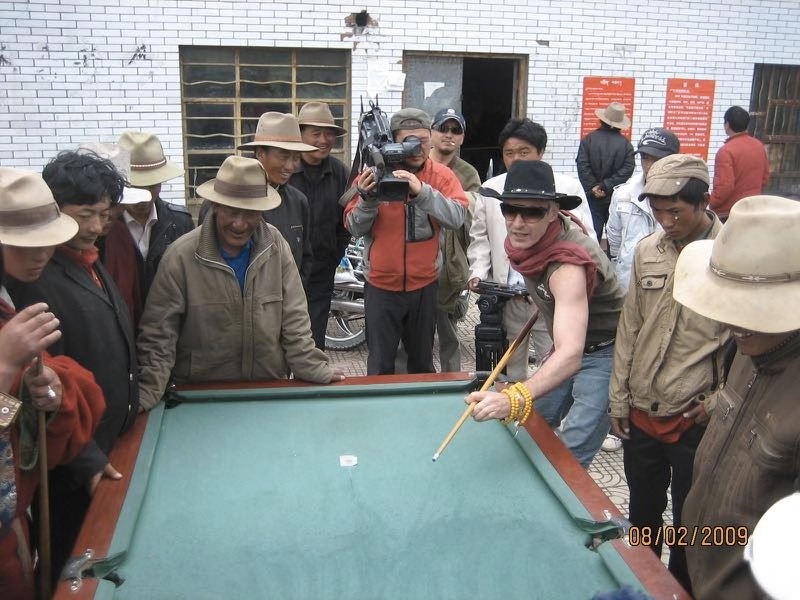
Inspired by the work of Nobel Peace Prize laureate Muhammed Yunus, I decided to launch a social enterprise in Lhasa in 2006. Pembala, who I had met while filming Searching for Shangri-lain 2002, joined me to work on the social enterprise project. Together we acquired and turned an old Tibetan courtyard into a 13-room boutique hotel, with a restaurant and teahouse, restored in a period style. Himself a carpenter, Pembala assembled a team of 30 Tibetan artisans from his hometown outside Lhasa, a village known for wood craftsmen and painters. His father had been a wood craftsman and passed the art down to Pembala. When the building next door was for sale, we acquired it as well. Now with two buildings running the length of the alley, we had a full street side, adding shops and craft studios.
From my experience during the 1990s in restoring courtyards and hutongneighborhoods in Beijing, I had come to firmly believe that alongside language, architecture was a keystone in cultural preservation and identity. Architecture represents each community's dialogue with their own environment. So throughout the many restorations I would undertake over the years ahead, only local craftsmen and women were involved in the process. We did everything in the traditional manner, trying to keep as much of the original buildings intact as possible, using old materials to rebuild new sections that had collapsed or been damaged. Even when purchasing paint, Pembala took me to an old shop where pigments were still ground from stone and stored in large metal barrels.
We heard of a stone-carving master who lived on a hill just outside the city that historically houses the protector oracle. We found him one October afternoon when the mountains were radiant with red leaves, sitting cross-legged behind a pile of manistones, each with a mantra which he had inscribed by himself. We asked him to carve deities and auspicious symbols on stones. We would insert them into the walls of our hotel as decor. Over six years he would do all the stone carving for the three hotel properties we developed. For each project the designs became more complex. By becoming his patron, we provided steady income and supported him in developing his art. Soon his carvings became famous as many came to our hotels to admire this work. Today he has a large workshop carving designs on stones for restaurants and hotels throughout Lhasa that have come to know his work through our projects.
Such craftsmanship is still taught through oral tradition from father to son, master to apprentice. With so much steel and cement construction these days, such skills will soon become extinct. Our team of local craftsmen worked with us for six years, completing three hotels, three medical clinics, workshops for the disabled, and a school.
In the late afternoon, the workers took a rest. Sitting in a circle they sang and drank chang, Tibetan liquor. These were joyous moments filled with laughter. Then they picked up their tools and continued working until dark, singing the whole time. In Tibet the concepts of work and relaxation were not in conflict. They blended into a way of life.
One morning when construction of the courtyard hotel was nearing completion, a little girl from the countryside showed up at our door. She had wide eyes, long hair down to her waist, and only a basic fifth grade education. Her name was Gusan. She offered to help clean up the construction debris.
The site was a mess but Gusan cleaned like crazy. Emerging from my partially finished room each morning, I found Gusan sitting in the sun on the veranda studying English. Every day before starting work, Gusan asked how to pronounce a new word.
When the hotel opened, Gusan stayed on cleaning rooms, always practicing English. She graduated from room cleaner to room inspector. Her English improved. She then started working at the front desk. When Pembala and I became engaged in new restoration projects and building clinics, Gusan took over managing the front desk operations for House of Shambhala.
House of Shambhala would become the first licensed "family guest house" in the old section of Lhasa. Its example sparked a wave of heritage house conversions. Some became fancy boutique hotels, others just tiny family inns. Regardless, Tibetans were able to utilize old buildings for a new purpose, protecting their architecture and reinvigorating their neighborhood.
We opened our doors expecting mostly foreign clients. To our surprise more Chinese began staying with us, wanting to experience Tibetan culture. During the day many Tibetans doing koracircumambulation in the old city would stop by our hotel to visit the shrines we always kept lit and have sweet milk or butter tea.
With House of Shambhala, I sought to create a micro-model for development. At the time I had only a vague direction and was not sure how the project would evolve. There was no model or theory. We just did it by interacting with people, and working from the ground up. Through the process of doing and creating, we embarked on what would become a social enterprise. One day when Muhammed Yunus visited Beijing, he received me at the Bangladesh embassy. The father of social enterprise who had inspired our work gave us the honor of recognizing it.
Please click here to read previous articles.