


Temple of Heaven: an Imperial Sacrificial Altar in Beijing







Category of site: Cultural site
Brief introduction
Located in the southern part of Beijing, the Temple of Heaven is a magnificent complex of fine cultural buildings set in gardens and surrounded by historic pine woods. It has been one of the most sacred places for the whole country for more than five centuries. It served as a complex of sacrificial buildings for the Ming and Qing emperors, and is the largest one in Beijing among several royal altars to Heaven, Earth, the Sun, the Moon and other deities or symbolic forces of nature.
In its overall layout and that of its individual buildings, it symbolizes the relationship between earth and heaven – the human world and God's world – which stands at the heart of Chinese cosmogony, and also the special role played by the emperors within that relationship.
Cultural heritage
Located south of the Forbidden City on the east side of Yongnei Dajie, the original Altar of Heaven and Earth was completed together with the Forbidden City in 1420, the 18th year of the reign of the Ming Emperor Yongle. In the ninth year of the reign of Emperor Jiajing (1530) the decision was taken to offer separate sacrifices to heaven and earth, and so the Circular Mound Altar was built to the south of the main hall for sacrifices particularly to heaven. The Altar of Heaven and Earth was thereby renamed the Temple of Heaven in the 13th year of the reign of Emperor Jiajing (1534). The current arrangement of the Temple of Heaven complex covering 273 hectares was completed in 1749 after reconstruction by the Qing emperors Qianlong and Guangxu.
Architecture
The Temple of Heaven is an axial arrangement of Circular Mound Altar to the south open to the sky with the conically roofed Imperial Vault of Heaven immediately to its north. This is linked by a raised sacred way to the circular, three-tiered, conically roofed Hall of Prayer for Good Harvests further to the north. Here at these places the emperors of the Ming and Qing dynasties as interlocutors between humankind and the celestial realm offered sacrifice to heaven and prayed for bumper harvests. To the west is the Hall of Abstinence where the emperor fasted after making sacrifice. The whole building is surrounded by a double-walled, pine-treed enclosure. Between the inner and outer walls to the west are the Divine Music Administration hall and the building that was the Stables for Sacrificial Animals. Within the complex there are a total of 92 ancient buildings with 600 rooms. It is the most complete existing imperial sacrificial building complex in China and the world's largest existing building complex for offering sacrifice to heaven.
In architecture the entire design is symbolic. The southern part of the Inner Temple is square, while the northern part is semi-circular, a pattern representing the ancient belief that Heaven is round and Earth square. The northern wall was built higher than the southern wall, illustrating the notion of Heaven surpassing Earth. Compared to the imposing complexity and intricacy of royal palaces, the altar area here is simple, setting off the vastness of the sky, and the grandeur of Heaven.
In ancient China, odd numbers were regarded as heavenly or as related to the sun. Since nine was considered the most powerful of all numbers, the altar, a three-tiered terrace, was constructed with rings of stone slabs in multiples of nine, and the steps and balustrades are also in multiples of nine. At the center of the top terrace lies a round stone known as the Center-of-Heaven Stone, which has an amplifying impact for speeches made from it.
Three major structures of the altar, namely the Circular Mound Altar, the Imperial Vault of Heaven and the Hall of Prayer for Good Harvests all have round floors and roofs, in accordance with the concept of round Heaven. Deep-blue tiles were chosen to cover these structures so as to harmonize with the blue sky.
The Circular Mound Altar, also known as the Altar for Worshiping Heaven or the Sacrificial Altar, is the place where the emperor worshiped Heaven at the winter solstice. The Imperial Vault of Heaven is the place where the tablets of the gods were kept, surrounded by a circular wall of polished bricks, known as Echo Wall where a person whispering close to the wall at any point can be heard distinctly at any other point along the wall.
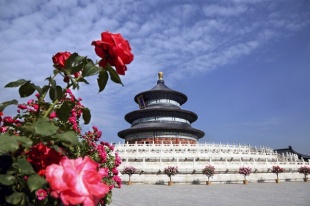
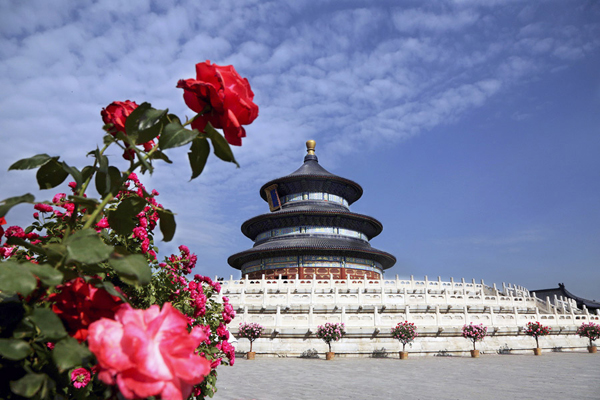
In the northern part of the temple, the Hall of Prayer for Good Harvests is a lofty, round structure with triple eaves and a cone-shaped blue-tile roof crowned with a gilded knob. When the hall was built in 1420, the colors of the triple eaves, from top to bottom, were blue, yellow and green, representing the God of Heaven, the emperor, and the common people. In 1752, all the eaves were painted blue. The hall burned down in 1889 after being struck by lightning. It was reconstructed in 1890 and renovated in 1970.
The ceiling of the Hall of Prayer for Good Harvests is painted with an exquisite design of nine dragons, and is supported by 28 wooden columns. The four central columns, called the Dragon-Well Columns, represent the four seasons. They are surrounded by two rings, one inside the other, of 12 columns each. The inner ring symbolizes the 12 months of the year, and the outer, the 12 divisions of day and night according to the old Chinese way of reckoning time. Every year, the emperor led civil and military officials to the hall and prayed for good harvests.
Designed with distinctive compactness and exquisiteness, and decorated magnificently, the Temple of Heaven is a building complex of a beauty rare even among the sacrificial buildings in China and a valuable part of the architectural heritage of the world.