



Villages Walk 40-Year Path to Wealth







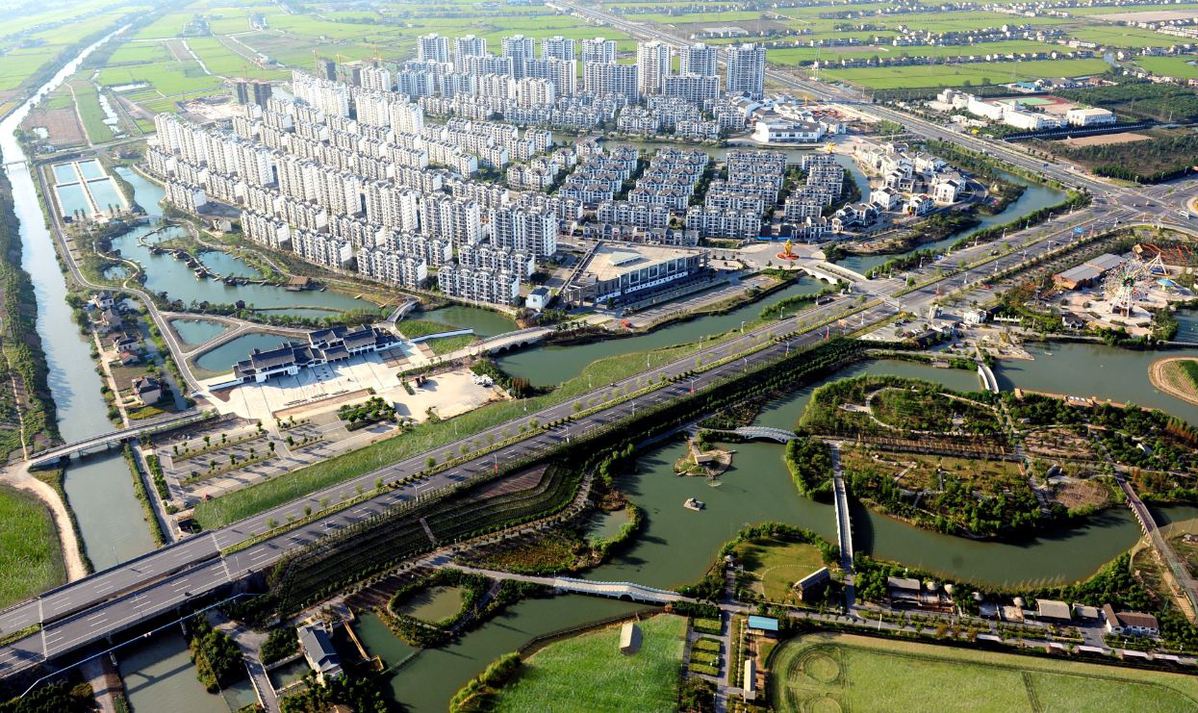
Reform brings far-reaching changes to Jiangsu
The book Peasant Life in China, written by prestigious anthropologist and sociologist Fei Xiaotong in the 1930s, lifted the veil on the nation's rural areas to the outside world by documenting traditional life in a small village in Suzhou, Jiangsu province.
Fei was a pioneering researcher and professor noted for his studies of China's ethnic groups. He was born in Wujiang, Jiangsu, in 1910 and died in Beijing in 2005.
British social anthropologist Bronislaw Malinowski (1884-1942) wrote in the preface to Fei's book: "Our attention here is directed not to a small, insignificant tribe, but to the greatest nation in the world." The book was published in 1939 in the United Kingdom by Routledge.
The far-reaching changes that have taken place in Suzhou since the book was published have transformed it into one of China's wealthiest areas in the four decades since the reform and opening-up policy was launched.
Fei coined the term "the Sunan pattern" - literally the development path in southern Jiangsu - in 1983 at the age of 73 when he saw family-run village and township enterprises booming along the south bank of the Yangtze River, mainly in Suzhou, Wuxi and Changzhou.
He had concluded decades earlier that this vast rural area could develop industry to adapt to changing times. Gradually introduced urbanization led by industry helped to lift the people out of poverty in the early 1980s.
Cheng Changchun, a government counselor in Jiangsu and dean of the Jiangsu Yangtze River Delta Economic Research Institute, said, "The success and the transformative ability of the Sunan pattern is testimony to the effectiveness of the reform and opening-up policy."
Cheng said that as the Chinese economy finds itself on the "cusp of yet another quantum leap", continued prosperity under the Sunan pattern underscores the need for the national reform and opening-up policy to be deepened and widened.
Today, not many college graduates can resist decent pay and bright career prospects in a big city, but a few do.
He Luwei, 37, who has a master's in economics, graduated from Zhejiang University in Hangzhou, the provincial capital, with a Certified Public Accountant qualification, but chose a career path different from that pursued by his peers in cities.
Ten years ago, he went to Huaxi village in Jiangyin city, Wuxi, Jiangsu, and to his surprise found an ideal job and a dream place for a long-term stay.
Now a senior accountant at a chemical fiber plant in Huaxi, where his wife was born, He said, "I've never regretted my decision to stay for the past 10 years." His wife graduated from Suzhou University.
The couple's annual income is about 400,000 yuan ($57,720), equivalent to that of a middle-class family in Beijing.
Dubbed the wealthiest village in the country for decades since the reform and opening-up policy was launched, the average annual personal income in Huaxi last year was 90,500 yuan. It was just 220 yuan in 1978.
According to the National Bureau of Statistics, the country's annual per capita disposable income was 25,974 yuan last year - 36,396 yuan for urban residents and 13,432 yuan for the rural population.

Huaxi, or "the village", as people still refer to it, is now a commercial giant with diversified business and investment in manufacturing, mining, finance, metallurgy, textiles, tourism, marine industry, new energy, high-technology and modern agriculture.
The village has a Shenzhen-listed company, Jiangsu Huaxicun Co, which saw revenue of just over 2 billion yuan last year, according to its annual report. The company was listed in 1999, making Huaxi the first village in the country with such an enterprise. The same year, the village's sales revenue reached 3.5 billion yuan.
Jiangsu Huaxi Group Co, which is overseen by the village and is collectively owned by the residents, saw revenue of 50 billion yuan last year, driven by its transformation from low-efficiency steel and textile businesses to high-end manufacturing, modern agriculture and high-technology.
Wu Xie'en, the village Party chief, said, "Our debt ratio is around 67 percent - completely reasonable and under control."
Villagers who were born and grew up in Huaxi, who number about 2,800, receive dividends each year as well as monthly pay.
"We are getting bigger and stronger by eating the 'reform meal'," Wu said. "Huaxi has caught the rhythm and each opportunity provided by reform and opening-up in the past 40 years."
Wu, the son of the former Huaxi Party chief Wu Renbao, who died in March 2013 aged 85, took over from his father in 2003 as village Party chief and chairman of Jiangsu Huaxi Group, which owns and invests in more than 80 enterprises at home and abroad.




















