More Argentines develop thirst for learning Chinese







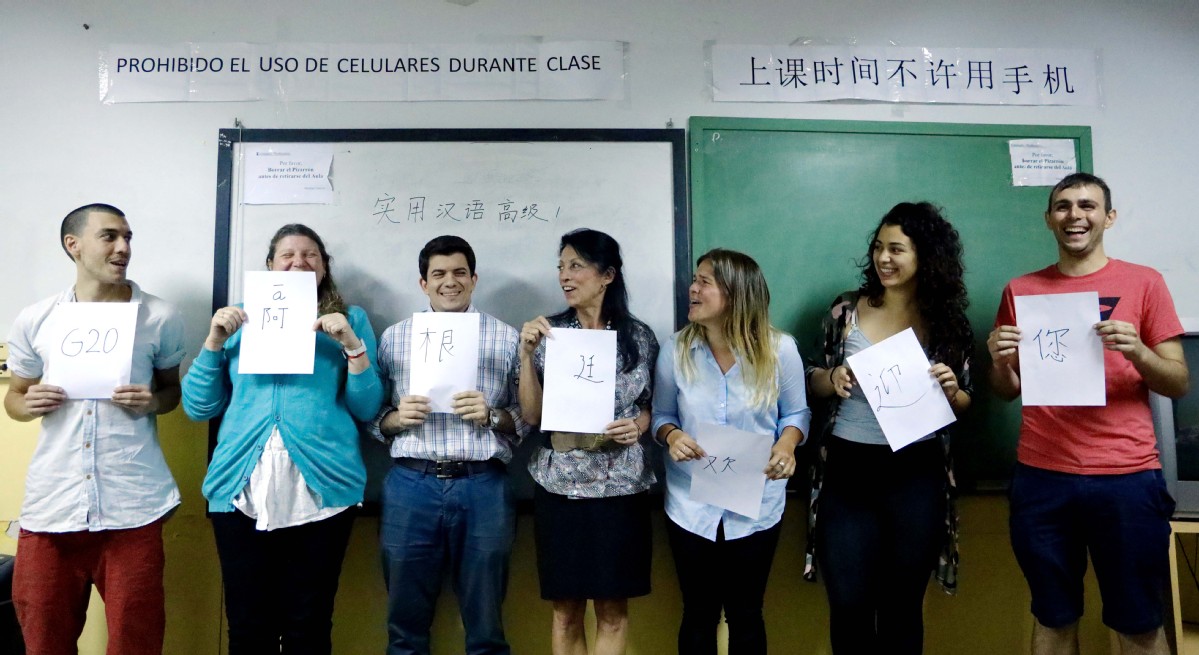
Joaquin Calles became interested in learning Chinese when he first picked up the classic Chinese philosophical book Tao Te Ching more than a decade ago.
However, scant additional information was available in Spanish on the school of thought in this work. Curious to learn more, Calles decided to study Chinese so he could further explore ancient Chinese philosophy.
Learning the language fascinated him.
"I found Chinese characters very interesting because they are very much related to the culture," Calles said. "For example, the Chinese word for medicine, yao, in its traditional form is related to music and herbs. It implies a connection with food and mood," he said.
Calles had to find another school when the Language University Center canceled the Chinese class due to insufficient demand. He found another venue and four years later gained a degree in Chinese translation.
To improve his Chinese, Calles enrolled with Chinese Language Education in Beijing in 2012. After completing a three-month program, he traveled in China for two months.
"My spoken Chinese improved a lot on the road. When you travel, you have no choice but to speak Chinese. I had to use the language to communicate," he said.
That experience enabled him to finally communicate well in Chinese, and he also came to understand the country's people better.
Calles returned to Argentina and taught Chinese for a while. He loved the job and wanted to further improve his language skills.
In 2015, he obtained a scholarship through the Confucius Institute at the University of Buenos Aires, also known as CIUBA, and studied at Jilin University, in Changchun, Jilin province, for three years. "I got my master's degree about three months ago," Calles said.
Back in Buenos Aires, he holds Chinese courses at CIUBA in addition to teaching the language at a prestigious private primary school and to some Argentine companies doing business with China.
Calles' experience illustrates Argentines' growing interest in learning Chinese and how two Confucius Institutes in the South American country have helped to both fuel and meet that demand.
CIUBA, the first one, was established in 2009 at the University of Buenos Aires in partnership with Jilin University, according to its director Liu Dongping.
When CIUBA first opened, only a small number of students with a strong interest in China, such as Calles, took the opportunity to study Chinese.
A decade later, due to the vastly increased economic exchanges between China and Argentina, about 1,700 Argentines now study at CIUBA each year, Liu said.
It also offers many cultural classes such as history, Chinese culture, tai chi, Chinese painting, philosophy and others. Each year, about 300 people learn some aspect of Chinese culture through CIUBA.
Chinese language and culture have become sufficiently popular in Argentina for CIUBA to employ people such as Calles to teach the language, as well as cultural courses on tai chi, Chinese history and painting, Liu said.
"A retired teacher in her 70s has been studying Chinese with us for more than five years. She wanted to learn the language before but was stopped by her husband 'because it seemed useless'. However, her interest in Chinese was so strong that she finally went against her husband's wishes," Liu said.
CIUBA has been active in introducing Chinese culture to Argentines.
Each year, it stages a Chinese Film Week, and many Chinese authors are invited to give lectures. The institute also helps with academic exchanges between the University of Buenos Aires and Chinese universities. It took part in organizing a special forum, "China and Latin America", ahead of the G20 Leaders' Summit in the Argentine capital.
Liu said: "In October, we had a night at the National Museum of Oriental Art. Using Chinese collections from the museum, our history teacher, Clara Sanchez, presented a lecture, A Trip to the Old and New Silk Road. The program ended with a tea ceremony. It was a great success."
Another Confucius Institute also opened in 2009, at the National University of La Plata in partnership with Xi'an International Studies University in Shaanxi province.
Li Fangjun, director of CI-UNLP, said that while the on-campus student population of more than 270 a year is much lower than that at CIUBA, the institute has focused on online Chinese education and set up sites to reach the more-remote areas in Argentina, extending as far south as the archipelago of Tierra del Fuego.
"We have set up more than 500 Chinese education sites at universities and language centers in various provinces. However, I am not satisfied with the results and how they are being operated. My primary goal is to improve the teaching efficiency at those sites," said Li, who started in the job about six months ago.
Ushuaia, a popular tourist destination in Tierra del Fuego known as "the end of the world", has seen increasing numbers of Chinese tourists in recent years.
Li said: "This led to a demand for Chinese. A local language education center came to us for help, and we assisted them in setting up a Chinese program."
More Argentines are now interested in learning Chinese, Li said.
"I went to the Chinese Education Expo in October and saw great enthusiasm from the local population. Whole families attended and were eager for detailed information. A student who had just gained a master's degree in China came to look for a PhD program," Li said.