In love with languages







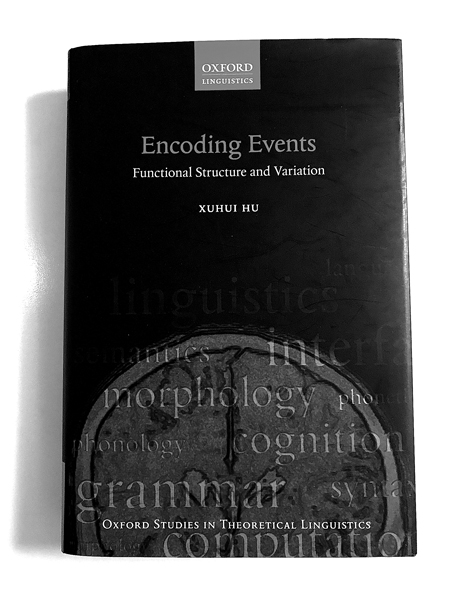
In October, his book, Encoding Events: Functional Structure and Variation, was published by Oxford University Press-the first academic work on linguistics from the Chinese mainland to be added to the Oxford Studies in Theoretical Linguistics series, one of the top series in the field.
The general editors of this series, Hagit Borer and David Adger, professors from Queen Mary University of London, write in the preface of Hu's book: "The contribution to the study of resultatives made by this manuscript is considerable. Further, to the best of our knowledge, this is the first full-length manuscript to study the syntax of Mandarin from a constructivist perspective and, as such, it is sure to become the benchmark against which all future such work will be measured."
The central focus of the book is how humans are cognitively supported to express the information of an event (for example, John's kissing of Mary), Hu says.
He developed his study based on the theory of universal grammar, usually credited to Chomsky. The theory suggests that normal human brains are hard-wired with a certain set of grammatical rules that is independent of sensory experience.
Hu concludes that universal grammar provides a universal structure for the linguistic encoding of events. The position of a noun phrase in the structure determines what role it takes in an event. For example, in the sentence "John kissed Mary", John is the originator of the kissing event.
In the book, he also explicates how lexical meaning interacts with universal grammar in determining the legibility of an event, thus addressing the broader issue of how two components of cognition-humans' conceptual knowledge and universal grammar-interact with each other.
For example, it is grammatically correct to say, "John kissed Mary", but unacceptable to say, "John smiled Mary". It is because the meaning of the grammatical structure has to be compatible with the meaning of the verbs. "That is our basic knowledge of a certain event," he says.
That is to say, in the first sentence, the meaning of the grammatical structure requires an originator and also a theme, and the meaning of the verb, "kiss", indeed has the two roles: The one related to the subject doing the kissing and the one related to the subject who's being kissed.
However, for the verb "smile", its meaning is only compatible with an originator but no theme, which is why that sentence is unacceptable.
Besides, by analyzing concrete constructions in different languages like English, Chinese (Mandarin and classical Chinese), Romance and Bantu languages, Hu tries to explain the underlying reasons for cross-linguistic differences and the differences in the historical development of a certain language.
Hu's study starts with an interesting phenomenon he has personally observed in different languages. In the English language, there is the so-called resultative construction. For instance, "John hammered the metal flat". In Chinese, there is also such a construction, but it has to be "John hammered flat the metal", when translated word for word.
Among the many differences, an obvious one is, compared to English, in Chinese, the adjectives that describe the result must follow the verbs when appearing in similar structures. In contrast, in Romance languages, there are no such structures, and a sentence cannot have a manner verb and an adjective at the same time.
Such differences inspired Hu to think about the underlying reasons. In order to explain the questions, Hu established his own theory to systematically explain how linguistic structures express the information of events, based on the theory of universal grammar.
"Linguistics is a natural science. One of the most important qualities for linguistics researchers is to remain curious about linguistic phenomena-that is to be curious about the world and to find puzzles in simple things, which is the requirement for both myself and my students," he says.
"Besides trying to use existing theories to explain the phenomenon, it is also important for a researcher to have the ambition to develop new theories or to improve on the existing theory."
Contact the writer at yangyangs@chinadaily.com.cn