



Firms ride high tide of Internet







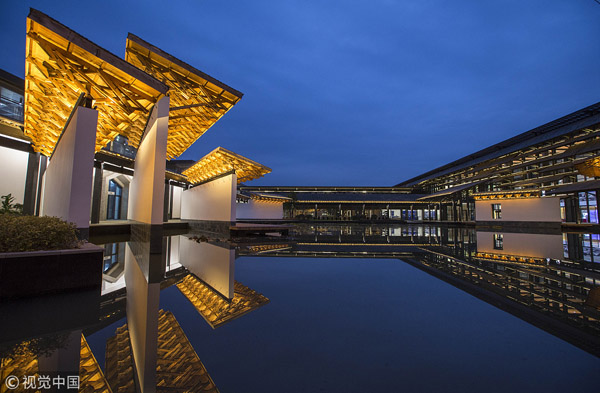
Editor's Note: The 5th World Internet Conference, organized by the Cyberspace Administration of China and the People's Government of Zhejiang Province, will be held in Wuzhen between Nov 7 and 9 this year. The annual event will discuss ways to improve mutual trust and steps for collective governance along with measures to boost innovation. China Daily will release daily special reports for the WIC, starting from today.
With their success in popularizing mobile internet applications in China's massive consumer market, local companies are striving to establish a beachhead in the industrial internet, a new front widely recognized as key to integrating the digital and real economies.
For example, Haier Group, China's largest home appliance maker has built an industrial internet platform, a network of industrial apps that collect and analyze data from consumers, suppliers and factories boasting machines with internet-connected sensors. The system, COSMOPlat, is designed to allow companies to customize products at speed and scale while boosting productivity and cutting costs.
Chen Lucheng, vice-president of Haier, said in addition to making Haier's own factories more flexible, the industrial internet system is empowering companies by bringing them closer to consumers and suppliers
The platform involved 320 million users and 3.9 million enterprises last year, covering electronics, textiles, equipment, construction, transportation and chemical engineering. Based on the open platform, Haier has also launched a string of internet-connected smart factories around the country, hoping to boost efficiency.
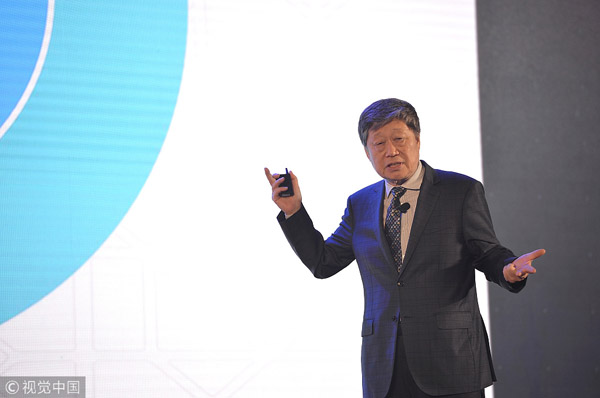
Zhang Ruimin, chairman and CEO of Haier, said the most important characteristic of the internet era is the zero-distance relationship with consumers, highlighting the importance of integrating users and enterprises in the new manufacturing age.
Haier's move is part of broader efforts by Chinese companies to drive digital transformation on the nation's sprawling assembly lines. The push is fueled by strong government policy support as well as manufacturers' desire to upgrade their plants.
Former Vice-Premier Ma Kai said in a speech earlier this year that the industrial internet has become a new battlefield for global manufacturing and technology companies. The sector remains in its infancy, but it is gaining importance as it provides an opportunity to further enhance China's manufacturing prowess.
The State Council unveiled a guideline in November that aims to build three to five industrial internet platforms, which will reach international standards by 2025, and lead the world in key areas by 2035.
Specifically, China will build around 10 cross-industry platforms by 2020 to accelerate digital transformation at enterprises. China also aims to encourage over 300,000 industrial enterprises to move their business to cloud platforms and cultivate more than 300,000 industrial apps by the end of 2020.
Qianzhan Industry Research Institute forecast that the market size of China's industrial internet sector will reach 10.8 trillion yuan ($1.64 trillion) in 2025, without disclosing the figure for this year.
"Accelerated steps on the industrial internet are of significance to China's advanced manufacturing amid fierce competition from abroad. It will help promote the deeper integration of the nation's real economy with the internet, big data and artificial intelligence," said Yang Chunli, a researcher at the China Center for Information Industry Development, a Beijing-based think tank.
"To compete globally in the internet and manufacturing, China must foster national platforms, which will act as the main pillars of future industrial transformation. Key industries such as automobiles, digital, energy and aerospace are some of the potential areas in which to establish such national platforms," Yang added.
The view was echoed by Qu Xianming, an expert with the National Manufacturing Strategy Advisory Committee. Qu said that as China promotes the in-depth incorporation of technological advances with socio-economic development, innovation will account for an increasingly large part of the real economy.
"Industrial growth will benefit considerably from the strategy, which can drive the long-predicted convergence of the IT and industrial fields in China," Qu said.
According to the 2017 report of the World Intellectual Property Organization, China is the only middle-income country among the world's top 25 most innovative economies, where it is ranked 22nd.
China now has more researchers than the United States, outspends the European Union in research and development, and "is on track to beat all other nations in its yearly production of scientific papers", the science magazine Nature reported.
But more efforts are required to leverage such technological and innovative prowess to drive the nation's real economy. The industrial internet is an efficient way of injecting such innovation into the manufacturing of consumer electronics, automobiles, clothing and other items, Qu added.
According to a recent report from the Alliance of Industrial Internet, China's industrial internet sector is still in its infancy, as a group of Chinese companies, including Sany Heavy Industry Co Ltd, started tapping into the sector several years ago.
Last year, the Ministry of Industry and Information Technology, China's top industry regulator, selected 206 smart manufacturing pilot projects, of which 28 are related to industrial internet innovation.
Now, around 50 percent of the world's industrial platforms are provided by US companies and China still faces a gap with developed countries in terms of the function, degree of commercialization and integrity of the overall ecosystem, according to the report.
Yang from the China Center for Information Industry Development also noted that a group of companies including China Aerospace Science and Industry Corp, the nation's largest missile maker, and Haier did quite well in industrial internet but some of them focus on certain vertical areas with limited users and resources, which still lag behind world-leading platforms such as General Electric's Predix and Siemens' MindSphere.
"However, most industrial platforms across the world are in the early stage of commercialization and are still exploring the market. In other words, China stands almost at the same starting point as developed countries," Yang said.
"Even though some companies have started to map out the industrial internet, they have just launched their products and the service system still needs to be improved," she added.
In addition to traditional manufacturing companies, telecom carriers are also entering the field. China United Network Communications Group Co, the nation's second-largest mobile carrier by subscribers, established a new unit at Xiongan New Area earlier this year, as part of its broader effort to help build it into a high-tech and smart area.
China Unicom Xiongan Industrial Internet Co Ltd, as the new company is called, is designed to co-ordinate innovative business teams and related resources such as cloud computing, big data, internet of things, and the industrial internet for Xiongan New Area.
Hao Liqian, chairman of the new company, said China Unicom aims to build globally pioneering network infrastructure and application platforms in Xiongan.
Yu Xiaohui, chief engineer at the China Academy of Information and Communications Technology, a government think tank affiliated with the Ministry of Industry and Information Technology, said a key source of innovation will be smart manufacturing driven by big data.
"Two years ago, big data was chiefly used to help companies do targeted advertising or recommend personalized news in the consumer market," Yu says.
"But now the global industry has reached a consensus that big data is the core to powering the new industrial revolution."




















