


Huangshan Mountain







Category of site: Mixed site
Brief introduction
Huangshan, known as "the loveliest mountain of China", lies in the south of Anhui province in eastern China. It was called Yishan Mountain in the Qin Dynasty (221-206 BC), and got its current name in 747 during the Tang Dynasty (618-907).
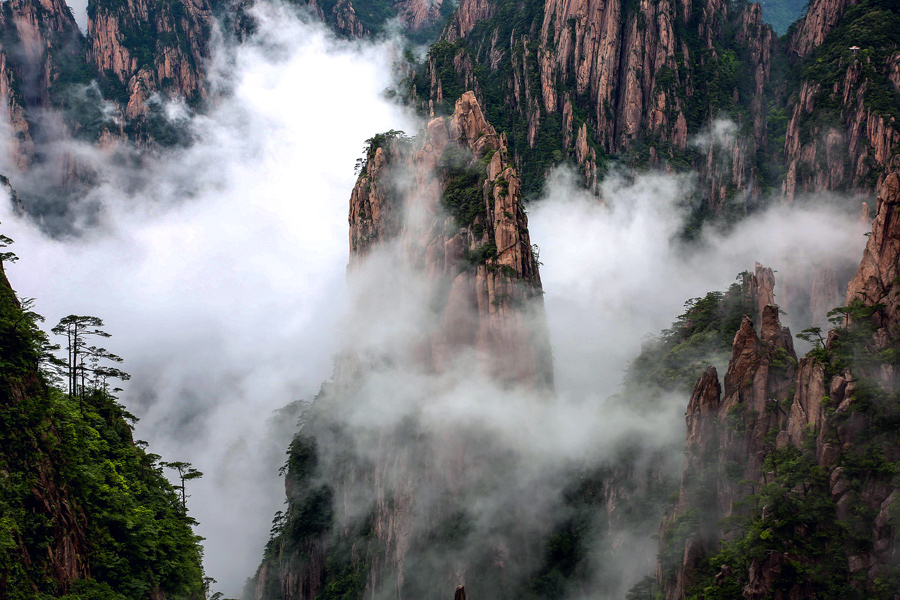
The scenic area covers 154 sq km, and is celebrated for its peaks, rocks, pines, clouds and springs. The renowned Four Wonders of Huangshan Mountain are the spectacular rocks, odd-shaped pines, hot springs and a sea of clouds. Other attractions are lakes, waterfalls, streams, rare flowers and animals. Forests cover 83.4 percent of the area, with some 1,452 species of native plants that fall into 203 families. Huangshan Mountain also has a rich cultural heritage. Xu Xiake, a famous traveler of the Ming Dynasty (1368-1644), visited Huangshan twice, and described it in a poem, calling it the best of all mountains in China.
Today it holds the same fascination for visitors, poets, painters and photographers who come on pilgrimage to the site, which is renowned for its magnificent scenery made up of many granite peaks and rocks emerging out of a sea of clouds.
In 1990, Huangshan Mountain was added to the world cultural and natural heritage lists.
Natural heritage
Huangshan Mountain is renowned for its magnificent natural scenery, which includes massive granitic boulders and ancient pine trees that are often further enhanced by cloud and mist effects. This dramatic landscape includes formations of natural stone pillars, grotesquely-shaped rocks, waterfalls, caves, lakes and hot springs, formed by its complex geological history. The property features numerous imposing peaks, 77 of which exceed an altitude of l,000m, with the highest, the famous Lianhua Peak (Lotus Flower Peak), reaching up to l,864m.
Huangshan Mountain has a complex geological history. The formation of the peaks dates back to the Jurassic Period of the Mesozoic Era as a result of crustal movements and subsequent uplift. During the late Mesozoic Era and the early Cenozoic Era, a large amount of granite magma erupted through fissures due to further crustal movements, which became the main body of the mountain after cooling down.
Thanks to the complicated natural environment, Huangshan has a well-preserved ecosystem. Vegetation covers 82.6 percent and forest, 56 percent of the total land area. Some 1,450 plant species are native to the area, of which one is under first grade protection; four are under second grade, and eight under third grade. There are 10 species on the verge of extinction, with six endemic to China and two to Huangshan.
Cultural heritage
The cultural value of Huangshan Mountain's scenic landscape first entered the Chinese imagination in the Tang Dynasty and has been held in high esteem ever since. The mountain was named Huangshan (Yellow Mountain) by imperial order in the year 747 and from that time on attracted many visitors, including hermits, poets and painters, all of whom eulogized the mountain's inspirational scenery through painting and poetry, creating a rich body of art and literature of global significance. During the Yuan Dynasty (1271-1368), 64 temples were constructed on the mountain. In 1606, the monk Pumen came to Huangshan and built the Fahai Meditation Temple. By the Ming Dynasty (around the 16th century), depictions of Huangshan Mountain had become a favorite theme of Chinese landscape painters, establishing the influential Shanshui ("Mountain and Water") school of landscape painting. Showcasing the interaction of man and nature in this highly scenic setting has inspired generations of Chinese artists and writers.
Huangshan Mountain has long been closely connected with religion. As early as in the Tang Dynasty, stories about Huangdi (the Yellow Emperor), and the alchemists Rongchengzi and Fuqiugong making pills of immortality on Huangshan Mountain were recorded. Many peaks are named after them, such as Xanyuan Peak, Fuqiu Peak and Pill-making Peak. Even the name Huangshan Mountain is related to the story of the Yellow Emperor's making pills of immortality. Taoist temples were built on Huangshan Mountain in the early days, including Fuqiu Temple and Nine-Dragon Temple. Since the end of the Ming Dynasty, Buddhism has taken the place of Taoism in Huangshan culture. Buddhist monasteries have been built in large numbers, among which Xiangfu Temple, Ciguang Temple, Cuiwei Temple and Zhibo Temple are called the Four Big Monasteries of Huangshan.
Legends and stories
The wonderful scenery of Huangshan Mountain has attracted many visitors. Among them were said to be immortals, like the Yellow Emperor, the Dragon King and even the Eight Immortals. The story goes that once on the day of the annual gathering of the Eight Immortals, seven of them arrived on time, while Han Xiangzi was late. Zhang Guolao guessed that on his way, Han must have become fascinated by the scenery of Huangshan Mountain. Then Zhang Guolao flew into the sky to look for Han Xiangzi. Just as Zhang expected, Han was sightseeing on Huangshan Mountain. He was enjoying himself so much that he forgot the gathering. Zhang tried every possible way to persuade Han to leave. Han, however, was reluctant to go, and turned a stone into a replica of himself, in case he forgot the way to Huangshan the next time. The stone therefore was named Immortal Showing the Way. Zhang, for fear that Han would slip away again, rode backwards on his donkey to keep Han in sight and also to keep seeing the mountain.