


The Great Wall







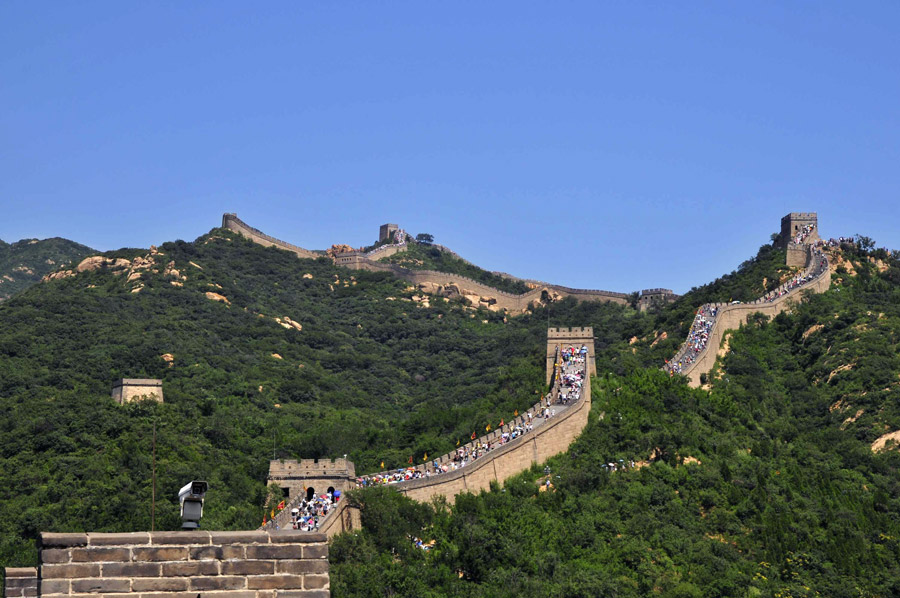
Category of site: Cultural site
Brief introduction
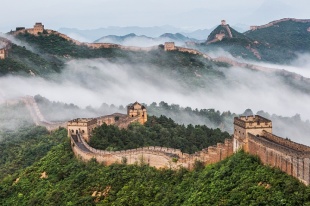
Just like a gigantic dragon, the Great Wall winds up and down across deserts, grasslands, mountains and plateaus, stretching from east to west of China. It was continuously built from the 3rd century BC to the 17th century AD on the northern border of the country as the great military defense project of successive Chinese empires, with a total length of more than 20,000 kilometers. It begins in the east at Shanhaiguan in Hebei province and ends at Jiayuguan in Gansu province to the west. Its main body consists of walls, horse tracks, watch towers, and shelters on the wall, and includes fortresses and passes along the Wall.
With a history of more than 2000 years, some of the sections are now in ruins or have disappeared. However, it is still one of the most appealing attractions all around the world owing to its architectural grandeur and historical significance.
The Great Wall, one of the greatest wonders of the world, was listed as a World Heritage by UNESCO in 1987.
History
The construction of the segments which later made up the Great Wall began during the Spring and Autumn Period and lasted into the Warring States Period (7th century BC-4th century BC). Many feudal states built hundreds of miles of wall fortifications as boundaries. These unlinked walls were the embryonic form of the Great Wall. In 221 BC, Emperor Qin Shihuang ordered the walls of the Qin, Zhao and Yan kingdoms in the north to be linked up and reinforced, after he united China. The extended new wall stretched from Lintao (in today's Xinjiang) in the west through Fengsui to the western edge of Xinjiang, with a total length of over 20,000 li. The construction work lasted for over 2,000 years, through such dynasties as the Northern Wei, Northern Qi, Eastern Wei, Northern Zhou, Sui, Liao, Kin and Ming.
It was during the Ming Dynasty that the Wall took on its present form. At that time, it stretched some 6,300 km from the Yalujiang River in the east to Jiayuguan Pass in the west, and is known as the Ten Thousand Li Wall. Rammed earth was later replaced by stone, according to the varying physical features of individual sections. Other materials such as planks were also used. Sometimes mountain ridges were even taken directly as the body of the wall.
Take the Badaling section for example. The Wall is on average 7.8 meters high and 6.7 meters wide, narrowing to 4.5 meters on the top in a trapezoidal shape. It was built with slabs and bricks, with rammed earth at the core. At that time, building materials could only be conveyed by porters, simple vehicles, mules or goats. It was recorded that it took thousands of people a half year to finish a section 200 meters long.
Cultural heritage
The Great Wall has an incomparable symbolic significance in the history of China. It reflects collision and exchanges between agricultural civilizations and nomadic civilizations in ancient China. Its purpose was to protect China from outside aggression, but also to preserve its culture from the customs of foreign barbarians.
Because its construction implied suffering, it is one of the essential references in Chinese literature, being found in works such as the Soldier's Ballad of the Han Dynasty or the poems of Du Fu (712-770) and the popular novels of the Ming Dynasty.
The Great Wall is a miracle in human history. No other ancient building in the world has been constructed for so long a time, on such a grand scale and at so tremendous a cost. Dr. Sun Yat-sen once commented that the Great Wall is the most famous work in China and a unique and truly marvelous sight on earth. Neil Armstrong, the first man who set foot on the moon, reported that, there are only two man-made works that can be identified from space and the moon. One is the Great Wall of China; the other is the dykes of Holland. Former US president Nixon said, after he visited the Wall, that only a great nation could build such a great wall.
The Great Wall, both as a cultural relic and unique natural landscape, has its special advantages. It has been widely known among domestic and foreign tourists that one is not a true man unless he climbs up the Great Wall (attributed to Chairman Mao Zedong). When the former prime minister of the UK Edward Heath mounted the Wall, he said, "The past and future of China boast the same charm... The Great Wall looks much more spectacular than I've seen in photos, embroideries or paintings".
Legends and stories
There is a legend about Meng Jiangnv, whose husband was conscripted to work on the Wall soon after they got married. When autumn came, Meng Jiangnv worried that her husband would suffer from the cold in the north, so she walked all the way to the construction site of the Great Wall, taking padded clothes which she had made for him. But when she got there, she was told that her husband had already died from exhaustion and had been buried at the foot of the Wall. Meng Jiangnv's grief was so bitter that 800 li (400 km) of the Wall collapsed, revealing a pit containing piles of skeletons. She couldn't identify her husband among them, and so she threw herself into the sea together with some of them. Later, two rocks in the shape of grave tablets appeared at the spot. A temple named after Meng Jiangnv was built at the foot of the Great Wall to commemorate her loyalty to her husband.