Residency project
Unlike Tian, whose mission is to lead his fellow villagers out of poverty, curator Yang Xiaobo focuses on the villagers' involvement in artworks.
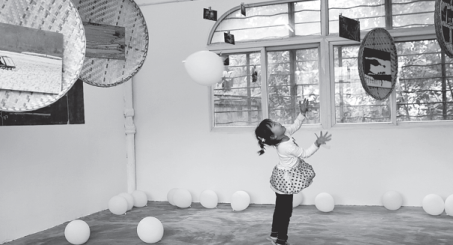
Yang was in charge of an art residency project last year for the Echigo-Tsumari Art Triennial. He worked with several Chinese artists to transform vacant classrooms into art spaces in a mountainous village in Niigata prefecture.
"It's not simply about displaying artworks in villages or how many visitors are attracted after the two-month art festival is over. We should care more about the artistic influence on locals when art events end," Yang said.
He fears the sudden rise in the number of art festivals being held in villages throughout China may be just a passing fad.
This year, Yang brought three artists to Longquan, a village about an hour's drive from Hefei, capital of Anhui province. Longquan is still poverty-stricken, as many people have moved to cities.
Yang's team stayed there for about four weeks in May and completed several works with locals.
They transformed a primary school of about 50 classrooms into a large exhibition space. The school had only three students and three teachers. One month later, when the team departed, the school was left without any students when all three boys graduated.
Artist Wang Mao invited one boy to write a poem on a blackboard as part of a classroom installation. The poem told the story of a man looking for the source of a river.
The boy, abandoned by his mother as a baby, believes that one day he will find her, and waits for her at the entrance to the village every day. He added a sentence on the blackboard, "It's a road to find my mom."
Yang said: "The boy understands the artwork. That's how art works."
The villagers love to read poems and produce calligraphy. Yang and other artists invited them to write poems and combine their work with installations in classrooms. They also turned the school playground into a giant installation, which attracted locals for dancing.
Yang said the villagers' engagement with artworks had taught them about what art represents and offered the children other opportunities for the future.
"I hope our art event can be a regular program the villagers can join. It will gradually change the people here," Yang said.
Public artist Hu Quanchun has been working on projects in rural villages since 2013. Every year, he has visited different villages to explore the role of the artist in rural construction, but said some areas had been damaged as a result of changes brought by artists.
He said some artworks may not match the natural environment and could possibly ruin ancient houses renovated by artists. "The landscape of a village might be totally changed in a bad way," Hu added.
Last year, Hu and his team stayed for a month in Yubulu, a picturesque village in Guizhou province that is surrounded by mountains.
When they arrived in the village, locals thought they were singers or dancers, because that was all they knew about art. The villagers, from the Miao ethnic group, excel at both singing and dancing.
Hu did not create sculptures or installations, as he has done in cities. Instead, he paid the villagers to build a 12-meter diameter stone drain in a rice field to record the village's history.
Many years ago, it often rained heavily in the village, turning rice paddies into a river. Locals made many drains in rice fields to disperse the water. But it seldom rains there now and the old drains no longer work due to lack of maintenance.
"It's a thing I made to remind people of the village's past, and it also can work as a drain if there's a storm," Hu said.
The huge drain has become a popular site in the village, and many drive for hours to Yubulu just to see it.