Cellphones banned in classrooms







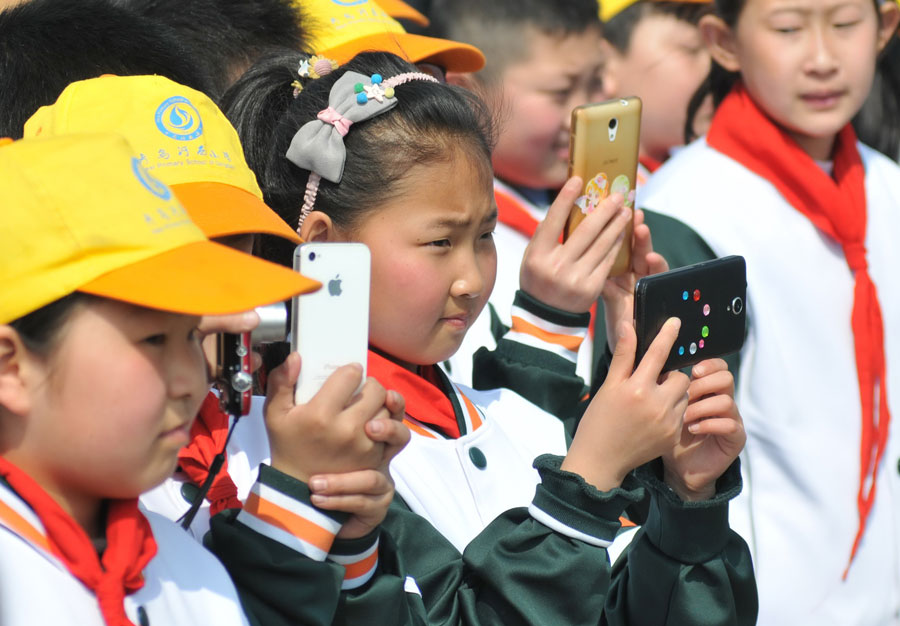
Shandong province regulation aims to curb nearsightedness in children
Primary and middle school students in Shandong province will not be allowed to use cellphones or tablets in classrooms starting from Nov 1, according to a new regulation.
The regulation, adopted by the provincial legislature last month, calls on schools to keep such devices for the students during schooltime if they bring them to school, with the aim of curbing the incidence of myopia.
Parents should also control the time their children spend on electronic devices, teach them to keep a proper distance from books and screens, and ensure a correct reading position and sufficient lighting, it says.
In late August, the Ministry of Education, the National Health Commission and six other government departments launched a multilayered action plan to help battle nearsightedness in children.
As well as forbidding students from bringing cellphones and tablets to class, the action plan asks teachers not to rely on electronic devices when teaching and giving assignments, and asks them to assign only written homework.
Shandong's regulation is significant, according to a local health expert.
Sun Wei, deputy director of the province's Prevention and Treatment Center for Child Visual Impairment, said using legal tools to protect children's eyesight is of great importance.
The regulation sets out the responsibilities of government organizations, schools and parents to battle nearsightedness in children, he said.
"More than 40 percent of primary and middle school students in Shandong have myopia and I believe with concerted efforts from government, school, parents and students, the rate can be reduced in the future," Sun said.
The regulation does not ban teachers from using electronic devices for teaching and giving assignments. Chu Zhaohui, a senior researcher at the National Institute of Education Sciences, said banning students from using cellphones and tablets in class is easier than forbidding teachers from using digital teaching aids.
"After all, we are living in a digital age and it is important to equip our children with relevant skills," he said.
Wang Jing, the mother of two primary school students in Qingdao, Shandong province, welcomed the local government's plan to control the use of electronic devices.
"Young children are easily addicted to electronic devices and excessive time spent on such devices will hurt my children's health and school grades," she said.
The ministry's action plan aims to reduce the overall myopia rate among teenagers by more than half a percentage point a year from 2018 until 2023. Provinces with a high incidence of myopia are required to achieve a cut of at least 1 percentage point a year.
According to a WHO report, the myopia rate among Chinese primary school students - nearly 40 percent - is the highest in the world.
The percentage of primary school students with myopia should be capped below 38 percent by 2030, with less than 60 percent of middle school students and less than 70 percent of high school students nearsighted, the action plan says.
It recommends that children's use of electronic screens not exceed 15 minutes in a single session and not more than one hour a day.
In addition, authorities will further regulate the total number of online games available and take measures to limit the playing time of minors.
The plan also includes specific requirements regarding homework loads for students. For example, middle school students should aim to complete homework each day in less than 90 minutes, and there should be just one set of exams a semester for first-and second-graders in primary school.
To increase enforcement of the plan, progress on curbing children's nearsightedness will be included in the government's performance evaluation system.





- Chongqing park becomes stage for captivating natural phenomenon
- Chongqing's cat theme park draws visitors, aids rescues
- Winter fishing season brings fresh catches at Hunan's Liuye Lake
- Former Guizhou official gets 11-year sentence for bribery
- Xizang expands elderly care faster than its population growth
- Ningxia offers near-total childbirth cost coverage to reduce burden on families