



Majority of rich Chinese look to invest overseas







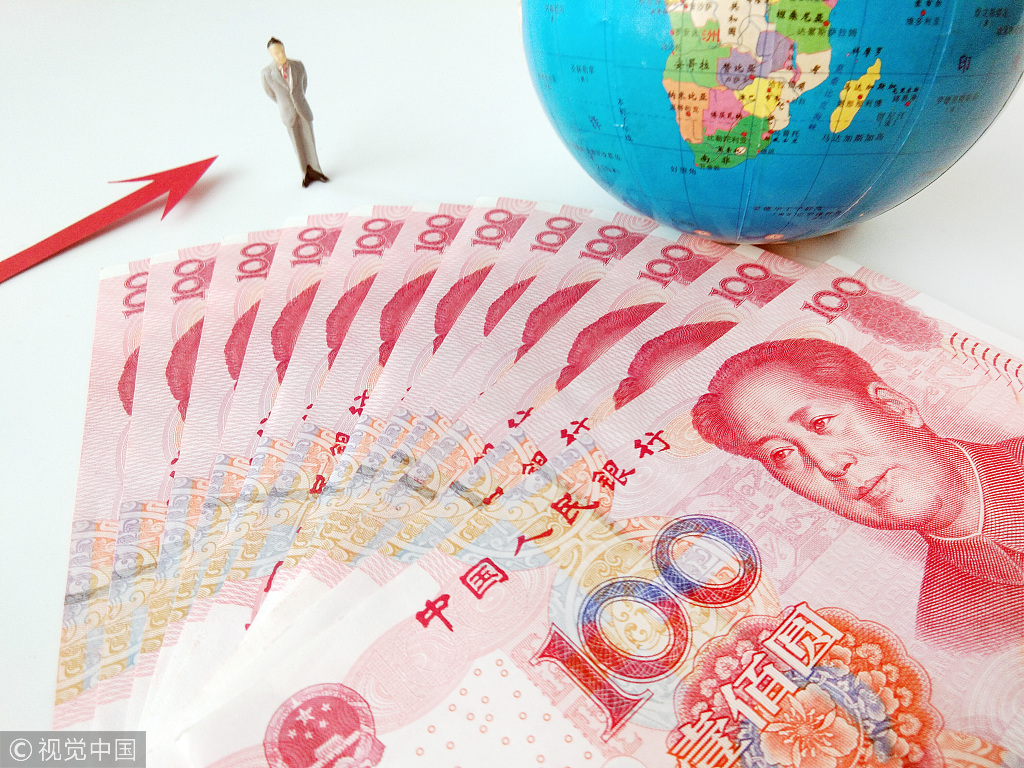
Top reasons include children's education, asset portfolio diversification, wealth preservation and appreciation, survey finds
When the United States stock market opens every week, Jessica Liu checks on her portfolio. With an investment of $10,000 in the overseas stock market, she also owns real estate worth $5 million in Canada, where her son is studying, which costs $150,000 a year.
Liu is a typical example of China's high net worth individuals - people with a net wealth of over $1 million - investing overseas.
In 2017, there were 1.97 million high net worth individuals on the Chinese mainland. Their combined investment assets totaled 65 trillion yuan ($9.5 trillion), according to a report released by Minsheng Wealth, the National Institution for Finance and Development and Bon Corp at the end of last year.
A report released by Credit-Ease Wealth Management and Beijing-based market researcher HCR in April showed that up to 74.2 percent of the mainland's high net worth individuals are considering investing or have already invested overseas, among which 24.8 percent have already completed the process.
Among them, 21.8 percent are involved in the manufacturing industry, while 19.3 percent work in the financial sector. Others work in trade, the internet, real estate, architecture, healthcare as well as the media.
Most have higher education backgrounds, with 82.7 per-cent of them having a bachelor's degree or above.
When conducting overseas investment, most of them buy financial products or real estate, and many choose to study, live or emigrate overseas.
Tian Jie, a financial analyst at Beijing-based internet consultancy Analysys, said that compared with domestic investment, investing overseas provides a broader range of choices.
"Investment channels in China are limited, while investing in overseas countries enables global asset allocation," Tian said.
"There are more investment targets overseas with higher quality, such as stocks and bonds. In addition, related laws and regulations are sounder and there are more diversified ways to invest," he said.
Investors have a wide variety of financial products from which to choose, including stocks, futures, cash, gold, petroleum and real estate, Tian said. Explaining why most investors looking overseas choose to purchase financial products, he said it is the major investment method in most countries.
"The threshold is also low. Even small deals are under secured legal protection. Investors can rest assured," he said.
According to the results from CreditEase and HCR's survey, Chinese investors buy financial products from more than one domestic wealth management company or private bank.
"Investing overseas can disperse risks, and the complete financial systems and excellent services in popular investment regions are also more conducive to the preservation and appreciation of assets," said Zhang Yue, senior vice-president of CreditEase.
The survey found that 37.2 percent of high net worth individuals have already completed or are in the process of global asset allocation. Another 37.1 percent are considering taking that step.
When asked about their reasons for investing overseas, the top three answers are children's education, risk dispersion via portfolio diversification, and wealth preservation and appreciation. Investors' favored countries are the United States, Australia, Canada and the United Kingdom.
Teresa Dong, a 35-year-old Beijing resident, plans to purchase a property in Singapore.
"Apart from providing a home for my parents after their retirement, the major reason why my husband and I plan to buy a house in Singapore is that we want to offer our children a place to live when they study abroad," said Dong. "Also, I can have a temporary residence permit to oversee my children's education. When the children finish their education, the house can serve as a long-term investment."
She said the real estate market in Singapore offers higher cost performance. "The quality of the buildings are better, and the communities are more livable, offering free swimming pools, gyms and barbecue facilities.
"For foreigners, a two-bedroom apartment costs only about 5 million yuan. We can let it out at about 20,000 yuan per month, which is higher than the rent in China," Dong said.
As promising as the market is, investing overseas also involves challenges.
"Due to the high degree of liberalization of overseas investment, the market tolerance for some non-standardized products is also high. Consumers are recommended to choose standard markets and authorized financial institutions," said Tian from Analysys.
"Overseas real estate policies and regulations are very different from those in China. We must understand the local systems in detail to avoid risks," he said.
The report also found that up to 30 percent of the high net worth individuals have either started the immigration process or have already moved overseas, and more than 20 percent are considering moving overseas.
"Nowadays more and more high-net-worth people have realized that getting an overseas residence permit is a guarantee for their wealth and future, and it is beneficial for their asset allocation, tax planning, wealth inheritance and education for children," said Jenny Zhan, president of Good Hope, a subsidiary of Credit-Ease that specializes in investment immigration.
The United States ranks No 1 among their desired immigration destinations, representing nearly half of the interviewees' choices, the report showed. Australia and Canada ranked No 2 and No 3, respectively, followed by Singapore and New Zealand.




















