



The facts and China's position on China-US trade friction







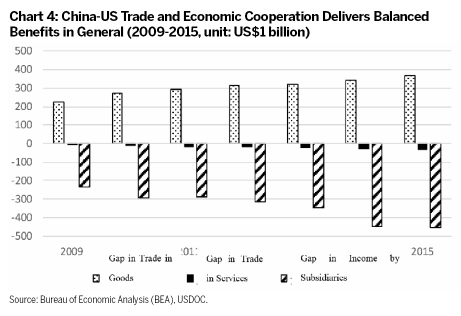
The gap in China-US trade in goods is a natural outcome of the US economic structure, and a result of the two countries' comparative strengths and the international division of labor. The persistent and growing gap in trade in goods between the two countries is a result of a number of factors, rather than China's intent.
First, it is a natural outcome of a low savings rate in the US. From the perspective of national accounts, the balance of a country's current account is decided by the relationship between savings and investment. The US economy is characterized by low savings and high consumption. Savings have been lower than investment for many years. In the first quarter of 2018, the US net national savings rate was as low as 1.8%. To balance its domestic economy, the US has to attract a large amount of foreign savings by trade deficit. This is the fundamental cause of the US trade deficit over the years. The US began to run trade deficits in its foreign trade in 1971, and by 2017 it was running trade deficits with 102 countries. The US trade deficit is an endogenous, structural and sustained economic phenomenon. The current trade deficit of the US with the rest of the world has shifted among its trading partners and resides with China for the time being.
Second, it is a fair reflection of the complementarity and comparative strengths of Chinese and US industries. In terms of trade mix, China's trade surplus with the US mainly comes from labor-intensive products and manufactured goods, and its trade deficit with the US lies in capital-and technology-intensive products such as aircraft, integrated circuits, and automobiles, as well as agricultural products. In 2017, China ran a US$16.4 billion trade deficit with the US in agricultural products, accounting for 33% of China's total trade deficit in the agricultural sector; a US$12.75 billion trade deficit with the US in aircraft, accounting for 60% of China's total trade deficit in this sector; China also ran a US$11.7 billion deficit in automobile trade with the US. Therefore, the imbalance in trade in goods is a result of voluntary market choices where both countries have played to their industrial competitive strengths.
Third, it is a result of the international division of labor and the changing configuration of production locations by multinational companies. As the global value chain and international division of labor expand, multinational companies have come to establish factories in China to assemble and manufacture products and sell them to the US and the global market, thanks to China's low production costs, strength in auxiliary production, and reliable infrastructure. When it comes to players in foreign trade, according to China Customs, 59% of China's trade surplus with the US was contributed by foreign-invested enterprises in China in 2017. In the process of receiving international industrial relocation and joining the Asia-Pacific industrial network, China has, to a large extent, taken over the trade surpluses of Japan, the ROK and other East Asian economies with the US. According to US BEA, the shares of Japan, the ROK and other East Asian Economies in the total US trade deficit have declined from 53.3% in 1990 to 11% in 2017, while China's trade surplus with the US has risen from 9.4% to 46.3% in the same period. (Chart 5)





