Aral Sea's return is still possible







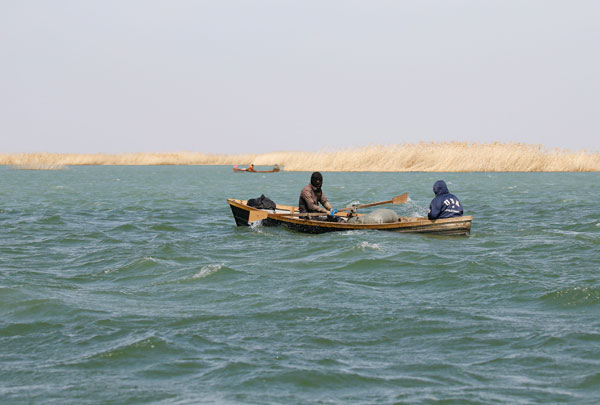
Fishermen sail a boat on the Aral Sea outside the village of Karateren, south-western Kazakhstan, April 15, 2017. [Photo/Agencies]
Every year, 150 million tons of toxic dust are carried by breezes from the bottom of the drying Aral Sea, according to a report from Golos Bishkeka.
Desert landscapes covered with white flakes interspersed with sand cities are now a frequent picture for Uzbekistan and Turkmenistan. The southern or Great Aral is almost completely dry, and storm clouds cover the cities of the countries adjacent to the basin. The picture is absolutely apocalyptic: empty streets, a dense gray haze covering the horizon and a spotlight that reminds us people still live there. Such storms are now happening more often. The sea appears to be taking vengeance on man for what was done to it.
Before its shallowing, the Aral Sea was the fourth-largest lake in the world, an oasis in the Central Asian desert feeding all the adjacent cities. There was fishing and a resort zone. But from the 60s, the lake-sea began to dry up rapidly with the efforts of the Soviet authorities, which initiated the use of the Amu Darya and Syr Darya rivers to irrigate cotton and rice fields. The Aral Sea died even faster than his executioners expected. The oasis has turned into a cracked white desert, with islands of rusted ships and a thorny roll-over field. It has become an ideal setting for filming end-of-the-world films and depressing music videos.
Since then, the era of projects to save the Aral Sea has begun. Sometimes incredible scenarios were suggested: for example, digging a channel from the Caspian Sea to the Aral Sea, or turning the Siberian rivers to drop water into the Aral from the Ob and the Irtysh. But these projects, although technically possible, could lead to other environmental disasters. Therefore, a safer option was chosen — the division of the sea and the salvation of each part separately.
The northern part was saved by Kazakhstan. Work began with the construction of the Kokaral Dam to stop water leaving in the sand. When the dried pool began to fill, biologists started restoration of flora and fauna. Those efforts were not in vain; now the water level in the Small Aral has reached 50 meters and the concentration of salt in a liter has decreased so much the pond became suitable for fish. The number of species there has already exceeded two dozen.
The Small Aral’s example gives hope to scientists it is also possible to revive the Great Aral. But this requires financial support, political will and a scientific approach. First, it is necessary to improve long-standing irrigation canals in Uzbekistan and Turkmenistan. Second, there must be a refusal to maintain small reservoirs in the delta of the Amu Darya, which evaporate in the summer. These flows can be directed to the filling of the western part of the Great Aral, where there is still water. Third, it is necessary to abandon the cultivation of moisture-loving crops, which, despite ecological disaster, continue to grow at the same industrial scale in Uzbekistan and Turkmenistan.
These are just a few projects that could give the Greater Aral a chance to live. In the long term, there are many more options. More than 70 projects have been submitted to the International Fund for Saving the Aral Sea and the governments of countries in the region. Other countries are ready to join in, because they understand the drying sea is a catastrophe. Already, the number of people affected by the drying of the Aral exceeds 5 million. These are people diagnosed with respiratory diseases, esophageal diseases, laryngeal cancer and even blindness.
The possibility of reanimating the lake-sea was a topic of the meeting on August 24 in Turkmenistan by the heads of the founding states of the International Fund for Saving the Aral Sea. This meeting was special, as the last time these delegates met was nine years ago.
The country clearly outlined a plan of action and showed serious intentions. Due to this, the republic attracted two World Bank loans for projects to regulate the Syr Darya river bed and preserve the northern part of the Aral Sea. The total cost of its two phases is more than $200 million.
Projects to save the Greater Aral Sea are likely to be many times more expensive, but judging by the concerns of the international community and the frightening estimates of the consequences of a complete dryout, there should be no problems with financial support.
So if Uzbekistan declares its readiness to save the sea, the authorities of the country should understand it may be necessary to sacrifice projects for the exploration and production of oil and gas at the bottom of a dried-up basin. Central Asian states will have to choose between the ecology and health of their population and uncertain income from the production of hydrocarbons.
The choice will not be easy. But it is important to realize there is no other chance. Saving the Aral Sea is still possible, and the sea can be resurrected. It can support the ecosystem and revive the economy of coastal areas, even if it doesn’t make a complete return to its former splendor. The revitalized Aral Sea will give countries in the region much more opportunity than any potential projects on the site where it once was.
The author is an observer on world water issues based in Beijing.