How CPEC can help Pakistan's chronic power shortage







The China Pakistan Economic Corridor (CPEC), a part of China’s Belt and Road Initiative, is a 3,000 kilometer linkage of roads, pipelines and railways to transport goods from GWadar port in Pakistan to Kashgar in the Xinjiang Uygur autonomous region of China. The $46 billion project aims to rapidly modernize Pakistan’s infrastructure, improve its energy system and establish special economic zones. CPEC is not just a transit route for Chinese exports; rather, it entails an elaborate plan to overcome economic issues, such as unemployment, the energy crisis, the underdevelopment of national infrastructure and the overall external economic dependency by building capacity in these sectors.
Pakistan is going through a severe power shortage these days. Over 140 million Pakistanis either have no access to the power grid or suffer over 12 hours of load shedding daily. The average shortfall in the power sector is 4,000 MW. The shortfall in the power sector can rise to 7,000 MW or 32 percent of the total demand for electricity. Chronic power shortage, in the form of load-shedding and power outages, cost 14 billion Pakistani rupees (7 percent of GDP) last year. Under all these circumstances Pakistan industry severely shrank. Industries are forced to use diesel generators to meet their requirements. Over 500,000 families are impacted by unemployment as industries have been forced to shut down due to the energy shortage.
Although the government is attempting to add capacity to the grid to remedy the persistent power shortage, these measures will take time to come into effect. Another alternative is to shift to renewable forms of energy, such as wind and solar power. There is enough potential from wind generation to supply all of Pakistan's electricity needs. The China Pakistan Economic Corridor is another way Pakistan could turn towards cleaner forms of energy, as China is a world leader in total wind and solar installed renewable energy, at about 140 GW. A sum of $35B has been promised by China for multiple power generation and transmission projects under CPEC agreement.
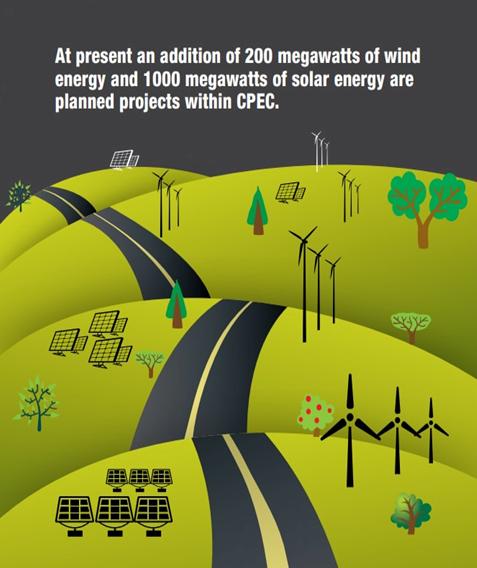
The investment is spread over 17 power generation projects and one HVDC transmission project. Chinese companies, under CPEC, will be working on four wind power projects of 300 MW capacity, one solar power project of 900 MW, three hydro power projects of 2,714 MW, five coal projects in Thar Sindh of 3,960 MW and four imported coal projects of 4,260 MW in total, along with a ±660 kV HVDC transmission line between Sindh and Punjab. These projects are of strategic importance for China to expand its influence in the region. Working with Pakistan enables shorter supply routes and quick development of the western province of Xinjiang (capital Kashgar).
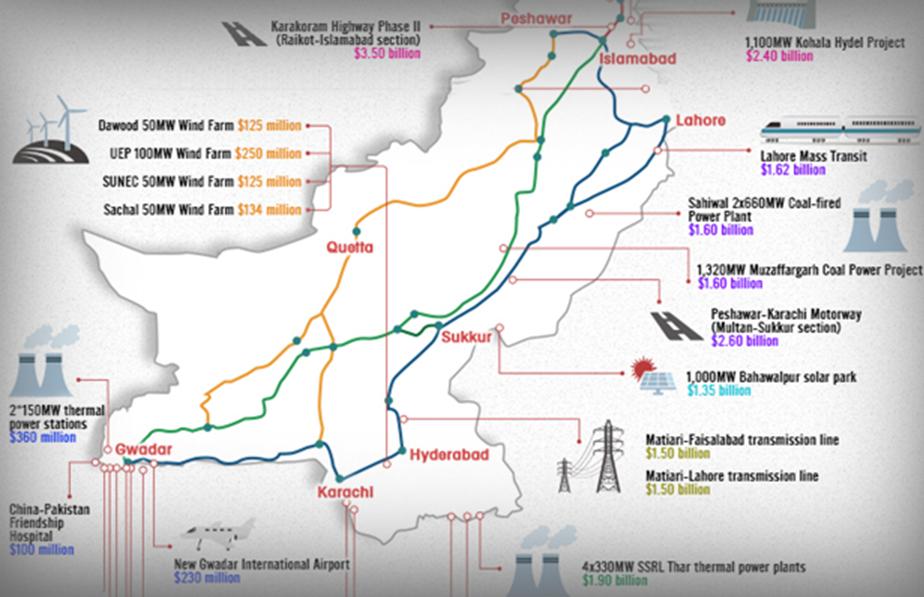
One of the key projects in CPEC is the ±660 kV Bipolar Matiari-Lahore HVDC transmission line project, which will transmit 4,000 MW of electricity. This project is the first ever HVDC transmission line in Pakistan and it will also be the first transmission line project in the country being developed by the private sector. Previously all the transmission work was carried out by TSO, National Transmission Dispatch Company (NTDC), itself. The project includes two converter stations and two electrode-grounding stations at Matiari/Lahore, three repeater stations and a transmission line. This connection will evacuate 4,000 MW of electricity power from seven projects under CPEC: 1,320 MW Port-Qasim Coal Project (Karachi), 1,320 MW Shanghai Electric Coal Project (Thar), 660 MW Engro Coal Project (Thar), 1,320 MW HUBCO Coal Project (Baluchistan) and 330 MW Siddique Sons Energy (Karachi). 1,320 MW Port-Qasim Coal Project Karachi’s Phase-I of 660 MW would be functioning by 2018 and Phase-II of same capacity would be on the grid by 2020. 1,320 MW Shanghai Electric Coal Project with Phase-I & II of 660 MW each would be completed in 2018 and 2020 respectively. Engro Coal Project Unit I & II, 330 MW each, would be functioning fully in 2019 and 1,320 MW HUBCO Coal Project would be completed by 2020.
A significant module of CPEC is the industrial collaboration that foresees to fully benefit from the demographic and natural endowment of the country and enhancing its industrial capability through creation of new industrial clusters, while balancing the regional socioeconomic development, enhancing people’s wellbeing, and promoting domestic peace and stability. In the past five years, China-Pakistan trade has continued to grow rapidly, with an annual growth rate of 18.8% on average; bilateral investment also has been soaring, and China has become one of the biggest sources of foreign capital for Pakistan. International economic and technological cooperation has shown strong momentum, expanding into more areas while social and people-to-people exchange has increased at parallel. The orderly and timely flow of economic factors in both countries along the CPEC will significantly improve the resource allocation efficiency and bring into full play the comparative advantage of each country with respect to the industrial sector specifically.
Zahid Javid is a master's degree student and doing research in electrical engineering at the School of Electrical Engineering, Shandong University.