Returning to roots: China’s elders and the cadences of daily life







Of the many popular proverbial idioms in China — known as chengyu, or four-word idiomatic expressions that often refer to Chinese mythology or ancient philosophy — one of the most recognizable concerns the tradition of returning home when one reaches old age. The idiom itself reads as ‘luoyueguigen,’ (落葉歸根)and it literally translates to “falling leaves settle upon their roots.” In usage, it refers to the journey whereby elders relocate in their later years to the village or city of their birth. The returning represents something universal, and nearly universally accessible, in China — just like holidays, such as the Spring Festival, when a mass migration takes place as workers and urban transplants return to their homes — the idea of luoyueguigen resonates as a kind of unifying action, an unwritten but indelible principle.
But with the rapid rise in migration to urban city centers — it has been calculated that hundreds of millions of once rural residents now reside in cities — the journey home for elders (who often move with their children) has brought new challenges and involved greater distances.
Today, those challenges seldom concern the actual journey back home (the high-speed rail system here makes even remote towns readily accessible), but rather the fact that many of the villages where China’s elders grew up have experienced immense changes. Places that were once relics of traditional life have seen the rise of shopping centers and large complexes, or large streets built next to ancient houses, often changing the very contours of village life.
This creates a distinctive sociological pressure, for imbedded in the principle of luoyueguigen is a rediscovery of the “roots,” a circular reconnection with the quotidian life, the habits and rituals, that constituted childhood. For many, that means a life of exercise and leisure, of slow days and communal meals. And for that to be possible, the poetics of the space where one grew up must also be retained — the streams that one walked by, the fields where one’s family worked, the houses and marketplaces where one lives and gathers and shops.
Of all the cities and villages to which I have traveled in China, including small communities throughout Southwest China's Gansu province and towns in Central China's Hubei province, the village in which I am currently living on a three-week homestay, Songxi in Pujiang county, Zhejiang province, has taken action to retain those roots. Other municipalities in China might find pragmatic guidance by its example.
Several hours outside of Shanghai and accessible by a single road that weaves alongside the main aqueduct, the village still retains, both spatially and atmospherically, the practices of life that have long defined the roots of old age. There are communal squares for tai chi, meals served in the village center, and streams that are overhung by their original bridges.
But perhaps most importantly, there is the sense here that the laoren themselves are not an afterthought here, but rather helping to shape, and being given the opportunity, to preserve the village’s ways of life.
On a hot August morning, we headed to the square where many villagers gather to chat, and entered the adjacent atrium which, filled with locals practicing calligraphy, appeared to epitomize life here. There, we met Shao Baoding and his wife, Xu Yuexing, and talked about their daughter (who currently lives and works in Spain) and their lives here in Songxi.
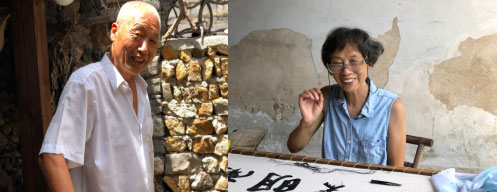
Both were testaments in their own ways to the return principle. Shao had served in the Chinese Army in the 1960s, touring in East China's Jiangsu and Anhui provinces and throughout Central China's Henen province, before returning to Pujiang county. Xu Yuexing herself had stayed in Pujiang her whole life, but now that her daughter lives abroad, she felt a unique duty to retain their life here so that “my daughter, when she comes back and visits, will not forget her parents and her origins.”
But for Shao Baoding and Xu Yuexing, deeply connected with returning to one’s roots was finding ways to actively construct and preserve them.
“Luoyueguigen is important, but I couldn’t return home right away after the military because our house had not been fixed in years. We spent three years fixing it and making it suitable, with a garden and tea area. Now it is a home, and I can invite other veterans over to play poker and chat,” Shao told us. As we talked to Xu Yuexing, she too was embodying the importance of creation, working on a traditional form of calligraphy weaving.
Their stories offer a paradigm for what rural areas in China, and perhaps other cities with elderly populations deeply connected with their original cities, might construct— not only community spaces, but opportunities to reconstruct the activities that composed one’s life, from construction to calligraphy. Shao, for example, still carves wood each morning, often using the roots from old or dead trees to construct sculptures.
Another villager, Xu Fude, also emphasized the importance of returning to a once habitual life, and told us that retiring to the village made sense because it was not just a space, but one where there is a sense of empowerment.
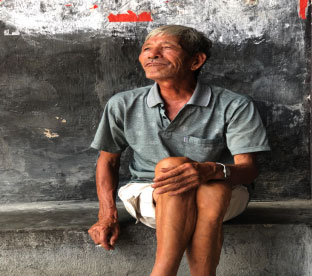
“It’s good to be back in old Songxi village after spending much of my life in the city. We can walk around here, share ideas, and so much of our pasts are inscribed in the streets. That helps us remember, and it gives the present more meaning,” he said.
Xu reveals where China might turn as it works to enable its elders to find existences, and the roots from which they come, to be grounding and enriching.
Not every village can preserve what Songxi has, but perhaps they can turn here for a lesson in the kind of quotidian lives that bring China a core part of its history, and the possibility of remembering and retaining it.
Jacob Pagano is a writer and reporter. He has worked as an assistant producer for the In Contrast podcast at New England Public Radio, lived and reported in China, and written for publications including The Oxford Culture Review, The Oxford Review of Books, and The Mainichi Daily newspaper.