



IDH 'Encyclopedic' Research Review published in Cell sub-journal







A review paper namely "Biological Role and Therapeutic Potential of IDH (isocitrate dehydrogenase) Mutations in Cancer" led by Chinese scientists was recently published in Cancer Cell, an international academic journal.
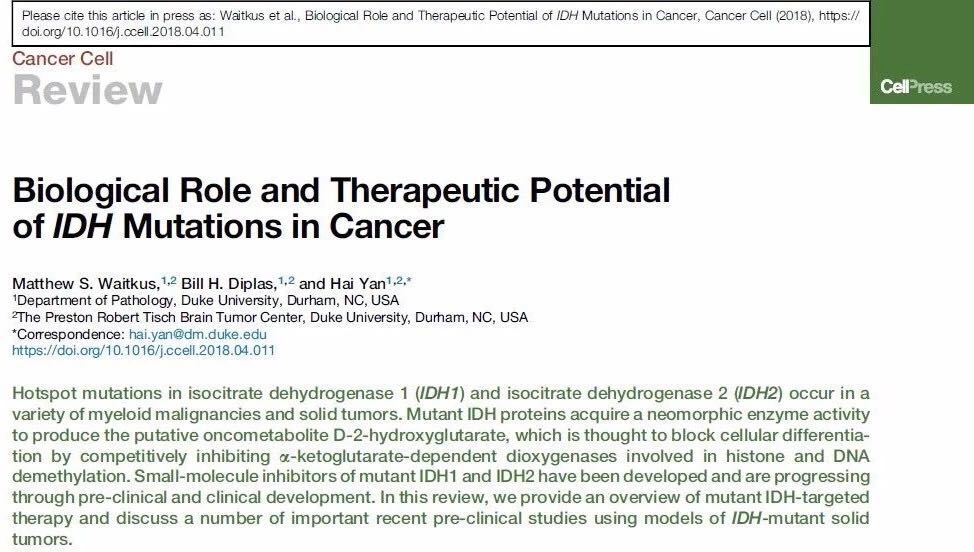
Led by Yan Hai, chair professor at Duke University and co-founder & chief scientist of Genetron Health, the paper provides a detailed review on the preclinical and clinical studies of IDH inhibitors in gliomas and acute myeloid leukemia (AML) as well as other potential alternative therapies and immunotherapies for people carrying IDH1/2 mutant tumors.
It found out that the development and validation of IDH mutation therapy strategies is very important and will provide the patients with therapeutic benefits in the future.
According to Yan, IDH is an important metabolic enzyme in the tricarboxylic acid cycle. Mutations of IDH1/2 will cause the generation of a new enzyme that can convert αKG into D2HG (D-2-hydroxyglutarate) and accumulate in cells, and increased D2HG concentrations can be detected in the serum of patients with brain gliomas due to IDH mutations and with acute myeloid leukemia (AML).
Given that D2HG content in normal tissues is extremely low, D2HG can be a very sensitive biomarker for clinical testing, he explained.
Back in 2009, the hotspot mutations of the IDH1/2 were firstly found by Yan Hai and his partners in patients of a malignant brain tumor, known as adult glioblastoma, and the results were published in Science and NEJM. Since then, IDH came into sight of scientists of cancer genomics.
In subsequent research reports, the clinical significance of IDH1/2 genetic mutations has gradually been detected in a number of cancers including AML, intrahepatic cholangiocarcinoma, chondrosarcoma, thyroid cancer, prostate cancer, paraganglioma, and melanoma.
Based on this, IDH1/2 were included in the guidance on WHO Classification of Tumors of the Central Nervous System as the record in human history to use molecular classification as a gold standard for brain tumor diagnosis.
In 2013, Yan Hai discovered that TERT promoter mutation is a key driver of many common tumors and can serve as another important basis for molecular classification of brain glioma.
Yan Hai led his team five years later to complete the gene map of TERTpwt-IDHwt for the first time through whole genome sequencing. And the results were published in a sub-journal of Nature.
So far, based on the new key promoter gene for malignant glioma discovered by the team led by Yan and its partners, the molecular classification standard for such malignant brain tumor is expected to be further updated.
The IDH gene is an important driving gene for brain gliomas, especially in gliomas with WHO grade II/III, where the frequency of mutation is high. Consistent efforts for the development of IDH mutation inhibitors and the treatment for gliomas are also underway.
However, it is found in multiple studies that the efficacy of IDH1/2 inhibitors is still unstable for gliomas, and the reasons are still unclear.
Possible reasons include the blood-brain barrier, the difference in the reversibility of apparent genetic changes of IDH mutation induction in different tissue types, and the possibility of IDH to change from driver mutation to passenger mutation in the progression of glioma disease.
Over the past years, immunotherapy has been a hot topic, but that cannot be used so far as a treatment for gliomas.
Multiple studies have shown that IDH1/2 hotspot mutations and L-/D-2HG isomers may have important effects on the immune systems the tumor microenvironments. Moreover, IDH1/2 mutations and the mutant product D2HG may cause immunosuppression of gliomas, which, however, may cause the tumors to be sensitive to immunotherapy.
It has also been reported that new antigenic epitopes produced by IDH1/2 mutations may provide an opportunity for the vaccination of related peptide vaccines, which may induce an anti-tumor immune response. In the mouse models receiving the treatment, 25% of the mice have had significant effects. Therefore, IDH1/2 mutations may cause immunosuppression by altering the expression of immunogenic cytokines and receptors, and specific antigens produced by IDH mutations may mediate anti-tumor immune responses when stimulated by peptide vaccination.
In the case of AML, the frequency of IDH1 mutations in most adult cases is approximately 5.5% - 10.4%, while that of IDH2 mutations is approximately 8.6% - 17.7%. The potential effects of targeted therapies for IDH mutations in AML have been demonstrated in a number of in vitro and in vivo pre-clinical studies.
The first result of phase-1 and phase-2 clinical tests on the safety and tolerability performed in human bodies showed that patients used 100 mg/d of enasidenib (IDH2 inhibitor) with an OS ratio of 38.5%; about 20.2% of patients achieved CR. According to the result of a study on relapsed and refractory AML in Blood in 2017, among patients treated with enasidenib, the total effective rates reached 40.3%. The duration of 19.3% patients (34) achieving CR and OS was 19.7 months.
Based on such delighting findings, in August 2017, the FDA approved enasidenib, previously known as AG-221, the IDH2 inhibitor produced by Celgene and Agios for the treatment of IDH2 variation and relapsed and refractory AML. And Abbott’s RealTime IDH2 test kit was approved for companion diagnostics.
Besides, IDH1 inhibitors have achieved good pre-clinical results in some mouse models, and at present, some small molecule pharmaceuticals for AML treatment of IDH1 mutations are under development, including ivosidenib (AG-120), the oral targeted inhibitor for IDH1 mutations developed by Agios for the treatment of relapsed or refractory AML due to IDH1 mutations, whose new drug application is subject to FDA's priority review, with the PDUFA Date being August 21, 2018.
At the same time, Cornerstone Pharmaceutical and Agios have announced an exclusive partnership and licensing agreement to promote the clinical development and commercialization of ivosidenib (AG-120) through monotherapy or combination therapy in China.










