



Piloting the State-owned enterprise reforms







China Reform and Opening – Forty Years in Perspective
Piloting the State-owned enterprise reforms
Editor's note:Laurence Brahm, first came to China as a fresh university exchange student from the US in 1981 and he has spent much of the past three and a half decades living and working in the country. He has been a lawyer, a writer, and now he is Founding Director of Himalayan Consensus and a Senior International Fellow at the Center for China and Globalization.
He has captured his own story and the nation's journey in China Reform and Opening – Forty Years in Perspective. China Daily is running a series of articles every Thursday starting from May 24 that reveal the changes that have taken place in the country in the past four decades. Keep track of the story by following us.
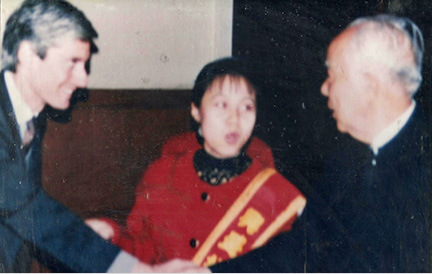
1997, Hefei City, Anhui province: By re-tooling one enterprise after another, I inadvertently became the doctor of State-owned enterprise reform. In 1997, I was appointed to lead a task force blueprinting a nationwide reform program.
The experiment was to begin in Anhui province. No surprise, this was where free market reforms started two decades earlier, when Wan Li, then-Party secretary of Anhui, endorsed a local village experiment when 18 families contracted to agree that after selling their quota of produce to the state the rest could be sold to the market. The experiment would become the pilot for a system of reform in the 1980s and 1990s called the "self-responsibility system," allowing for a first tier of transition toward the market.
No wonder, Anhui was chosen to be the experimental ground for four major industrial enterprises to be reformed. If the restructuring concepts succeeded, these could become a pilot or even blueprint for national State-owned enterprise reform. I was invited to be team leader, or coordinator of the experiment, joined by representatives from different government departments on the national level with counterparts from Anhui province, together with experts from Eastern Europe who shared their experience with similar reforms in the post-Soviet era. On the ground, with a team of Chinese economists and officials, we inspected huge industrial enterprises in four sectors: iron and steel, cement, chemicals, and fertilizer.
Each carried huge debts complicated by decades of government funds from different departments – industrial ministries, local city, province, and national government. After 40 years, these lines of capital were confused, tangled. Were they grants or loans? Had they been accounted for? How?
I could smell pig iron smolder as it rolled off the production line. Gas belched in all directions. "All of our equipment dates back to the 1960s and 1970s," said factory manager Wang shaking his head. "That's why we cannot make products that compete with Korean imports, unless we can buy the necessary technology. But that requires a huge capital injection. How to get those kinds of funds? No investor wants to take on the social burdens that our enterprise carries." Workers turned their heads and looked curiously. The unseemly presence of a foreigner was a rare distraction from the endless monotony of years on the same production line.
Leaving the production facility we drove past blocks of schools, kindergartens, cafeterias, medical clinics, recreation centers, and retirement gathering areas. A worker could be born, go to school, get married, work, live and die within the confines of this enterprise without ever having to set foot outside. The enterprise was a complete city in itself.
"We have 50,000 people living here, including retirees and families of workers all of whom we must support," said Wang. "As for workers themselves, we have about 20,000. To achieve maximum efficiency, we need about 2,000 using existing equipment. If we upgrade the equipment so we can compete with South Korean steel, we even need fewer workers."
This was the seemingly insurmountable challenge China had to face in restructuring the rust of its planned socialist economy.
The State-owned enterprises were responsible for housing, healthcare, retirement and basically all aspects of living, social and material benefits for the workers and cadres of the factory. That was China's first priority after nearly a century of internal chaos, civil war, foreign invasion and semi-colonization. The State-owned enterprise model actually solved the core set of problems that Mao and his revolutionaries inherited when they took power.
But in the competitive globalized world of the 1990s, China's enterprises had to get rid of their social burdens. This required commercializing everything from healthcare to education, housing to insurance.
All of this needed regulation. At the time there was none. Ultimately all of the costs would be passed on to the capital markets (although they hardly really existed either).
For example, removing the burden of housing required banking reforms to provide loans so people could borrow money to buy their own homes, so developers could borrow cash to actually build them. The need for legal collateral, called for land and ownership rights, which also did not exist under socialism. In fact the very concept of private ownership did not exist at all. Ultimately, this called for outright constitutional reform.
So in 1998 China embarked on a major restructuring of State-owned enterprises together with its entire social structure. The commercialization of medical care and introduction of pension funds meant re-organizing the insurance industry, which in turn called for entire financial reforms. This thing was so complex it could only be handled by adjusting each link in the chain in a sequential order. This is where the concept of sequencing began to emerge.
Li Jiange, who then served as Zhu's monetary policy advisor, put it all in perspective. One evening, sitting in my courtyard over a jasmine tea chat he reflected, "The Washington Consensus is like western medicine. It tries to cure the problem at its surface. We prefer Chinese medicine approach: examine the problem holistically and find the root cause. The western medicine is a quick fix, but often has serious side effects. Chinese medicine is a longer and slower process. But it seeks the root of the problem. Often several causes are interconnected so they must be solved together, but in sequenced steps."
Please click here to read previous articles.





