



Policy change to strengthen solar sector







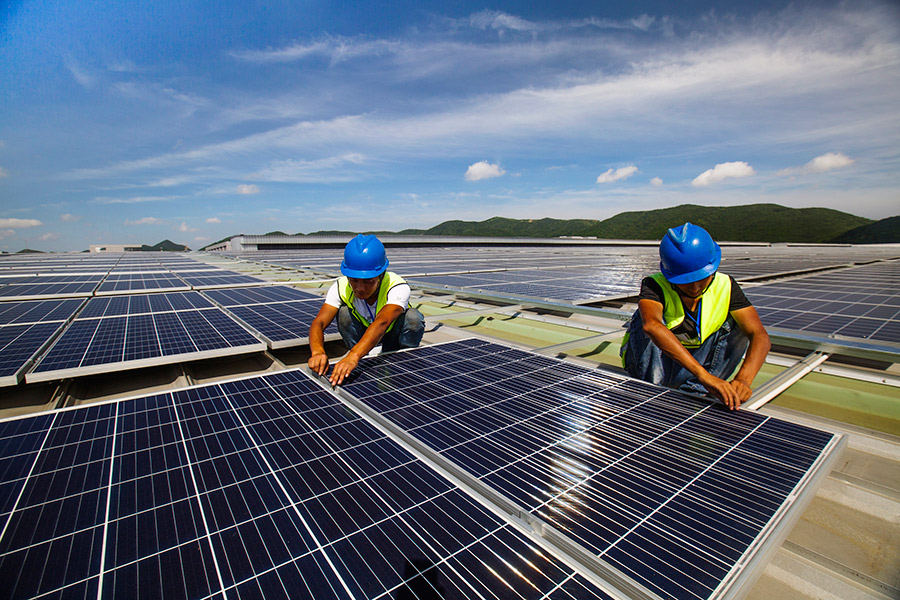
Reduction of feed-in tariffs will be conducive to photovoltaic industry's sustainable and efficient development, government agencies say
Despite a blow that sent solar stocks into free fall in June, China's new rules to reduce government feed-in tariffs for the photovoltaic industry will encourage its more sustainable and efficient development, while stabilizing the rapidly growing and overheating sector, solar power industry insiders said.
The National Development and Reform Commission, the Ministry of Finance and the National Energy Administration announced a cut in the national feed-in tariff by 0.05 yuan (0.7 US cents) per kilowatt-hour on June 1. The authorities also announced a reduction of the same amount in subsidies for power generated by distributed photovoltaic projects. Subsidies for county-level poverty alleviation photovoltaic projects will see no change.
The new policy is designed to encourage more sustainable and efficient development of the solar power sector, the NEA said, adding that it will speed up the launch of a quota system obliging regions to buy more renewable power.
According to the NEA, China saw a subsidy gap of 112.7 billion yuan for renewable power generation by the end of 2017, with those for the photovoltaic sector reaching 45.5 billion yuan. The gap is expanding every year.
Many companies were expanding their capacity, spurred by the high-speed development of the sector, which led to excess production capacity and poor-quality solar power products, the NEA said.
Joseph Jacobelli, a senior analyst of Asian utilities at Bloomberg, said bigger developers like China Longyuan Power and Huaneng Renewable, which still have returns from existing assets, will survive the subsidy reduction, while the new rules will weed out smaller players.
The new rules, which might have some negative impacts for manufacturers with lower margins in the short term, illustrate the government's determination to optimize the pace of solar power development, as the feed-in tariff is not sustainable in the long term, said Qian Jing, vice-president of JinkoSolar Holding Co Ltd, the world's biggest solar panel producer by shipments.
The feed-in tariffs reduction could also encourage China's solar power toward grid parity, which will in turn make sure solar power remains a key force in the nation's energy restructuring, according to Qian. She said the government might want to offer photovoltaic companies a bumper period for subsidy cuts and a relaxation of the cap on new projects.
Yang Liyou, general manager of Jinneng Clean Energy Technology Ltd, or Jinergy, said companies will shift from capacity expansion to quality improvements. While the reduction of subsidies will limit the scale of the sector, it will also lead to a batch of higher-quality power stations and advanced technologies that can lower costs, he said.
According to Leon Chuang, global marketing director of Risen Energy Co Ltd, many photovoltaic companies are already adjusting their strategies in accordance with the new rules, focusing on photovoltaic energy storage and overseas market expansion.
The new policies will allow the low-cost, high-efficiency products to win the market and bring the industry back to a rational development path, according to Leon. Companies should figure out how to react to the new rules instead of complaining, he said.
Overseas expansion
Lin Boqiang, director of the China Center for Energy Economics Research at Xiamen University, said the surplus capacity in the domestic photovoltaic market will encourage upstream firms to seek more overseas opportunities, especially in Africa, and countries and regions participating in the Belt and Road Initiative.
Risen Energy said, in addition to the markets where the company is already seeing stable business, including Europe, the United States and Australia, the company is also actively laying out strategic business plans in Indonesia, India, Nepal, Ukraine, the Czech Republic, Romania, Bulgaria and Cambodia.
Jinergy said it has also seen its sales to overseas markets increase by 30 percent so far this year, with components already exported to South Asia, Mexico, Argentina, Australia and Japan.
JinkoSolar has signed a three-year agreement to supply 1.43 gigawatts of high-efficiency modules to sPower, a US-based independent renewable energy producer. Previously, JinkoSolar had supplied over 800 megawatts, approximately 2.5 million solar panels, for sPower's photovoltaic projects.
According to the NEA, the country's photovoltaic products have been exported around the world, including many emerging markets.
China's photovoltaic module exports reached 31.5 gW, equivalent to $10.45 billion, last year, which accounted for 41.4 percent of China's total module output.
According to the NEA, China's photovoltaic industry has witnessed rapid development in recent years, with its solar power generation capacity reaching 118.2 billion kilowatt-hours in 2017, a year-on-year increase of 78.6 percent, accounting for 1.8 percent of the nation's total power generation, compared with 0.1 percent in 2012.
Last year also witnessed the rapid development of the distributed photovoltaic sector, with an installed capacity of 19.25 gW, a year-on-year increase of 360 percent, it said.
To further encourage the distributed photovoltaic sector, the government said that while new solar plants that require subsidies will not be approved, smaller-scale distributed generation on rooftops will be capped at 10 gW, half of last year's rate.
To optimize the pace of solar plant construction, China will add just 30 gW of capacity this year, compared with the record 53 gW last year, the NEA said.




















