Beijing Olympics: Legacy and future







If the 2008 Beijing Olympic Games was China’s coming out party, then the Beijing 2022 Winter Olympic Games will be its graduation. Today, as Beijing celebrates its 10-year anniversary since its famous opening ceremony on Aug 8, 2008, the Beijing 2022 Winter Olympic preparatory committee is well entrenched in preparations for 2022. Looking back, most people involved or who attended the 2008 Games remember the event fondly; some even remark it was transformative for the city and country. For this author, the Games were not only a lifetime memory, but also proof Beijing can put on world class sporting events like anywhere else in the world.
Ten years ago today
Sitting in the Bird’s Nest 10 years ago on a very warm evening, I remember experiencing many emotions. Excitement for the coming two-weeks of competition. Accomplishment for all of the work that went into the preparations. Anxiety for plans we had in place for sponsors yet to be carried out, joy for all the ideals the Olympics represent and hope for what was possible. As the teams marched in I could only imagine the athletes' own emotions and what the Olympic journey meant to them. I can still picture with amazement Li Ning’s journey around the mouth of the Bird’s Next to light the flame. While I recognize these are my own experiences, it is no secret hosting the Olympics in Beijing 10 years ago was part of a grand plan of reform.
Beijing’s Olympic story dates back more than 25 years to 1993, when it lost its bid for the 2000 Summer Olympic Games. According to a Sept 24, 1993 New York Times report, Li Tieying, a member of the political bureau of the CPC Central Committee (2001) at the time, sent a message to the Chinese delegation in Monte Carlo, where the 2000 Games announcement was held.
He said, "There were many reasons why China did not win the right to hold the 2000 Olympics, but this doesn't mean that China does not have the strength and the conditions to hold an Olympics." He continued: "Applying for the Olympics is an important step in our country's process of reform and opening up. Although we did not win the right to hold the 2000 Olympics, through our steady work, we achieved very big results."
Determined, Beijing came back and launched a campaign in 2000 to bid for the 2008 Olympics under the theme, “New Beijing, Great Olympics”. Part of the promise was to use the Olympics to serve as a catalyst for progress. What followed in the corresponding years was a build-up of a sports and entertainment infrastructure, a further expansion to the subway system, the drafting of tighter traffic rules as a solution to Beijing’s burgeoning gridlock problems, and the adoption of measures to address rising environmental issues.
Certainly China’s critics wanted even further reforms coming from the Olympics, and today many of these are still debated. However, few people can argue China made good on its plans to find uses for its Olympic venues. Today, for example, the Bird’s Nest is used for major sporting events and concerts, and the Water Cube is open to the public. In fact, the Olympic Forest Park is open to local and international tourist groups and it is a regular stop for many visitors. It is certainly a Beijing landmark.
It’s difficult to claim Beijing’s traffic situation has improved, but I imagine it is much better today than what it might be without the mandated restricted odd and even license plate travel policy implemented during the Games. Also known today as the “Road Space Rationing” project, this is a traffic restriction program aimed at reducing traffic congestion by restricting the numbers of cars on the road based on license plate numbers on specified days. Anyone who drives in Beijing would not dare violate this policy at the risk of suffering significant penalties and losing their license.
These are just some of the notable developments defining Beijing’s legacy in holding the XXIX Olympiad in Beijing. Gallup, the global research firm, discovered in a study measuring opinions towards China, that overall views have become more favorable since 2008. In the research the Gallup team asked respondents, “what is your overall opinion of China? Is it very favorable, mostly favorable, mostly unfavorable or very unfavorable?” The study found global opinions of “mostly favorable” had climbed six percentage points from 36% in February 2008 to 42% in February 2018.
I remember one family member, who knew little about China, remarking after watching the Games on NBC, “I have never seen so many happy people in one place”.
Preparations for 2022
Nearly seven years after Beijing held its Summer Games, a delegation gathered on July 31, 2015 in Kuala Lumpur to witness Beijing get the nod to host the 2022 Winter Olympics. Among the promises, Beijing’s bid focused on putting on an economical and sustainable Olympics and using the Games to ignite passion among the citizens of Greater Beijing to embrace winter sports as a new industry.
Thomas Bach, president of the International Olympic Committee, said in a message prior to the announcement awarding Beijing the bid, “Beijing hopes to use the Games to accelerate the development of a new sport, culture and tourism area, and to encourage interest in winter sports in a region that is home to more than 300 million people in northern China.”.
Not surprisingly, Beijing is well on its way. Bach visited Beijing in early June and commented, “Guided by Olympic Agenda 2020, the Organizing Committee is today already laying the foundation for the success of the Olympic Winter Games Beijing 2022. This is reflected in the fact that Beijing 2022 has made it mandatory to include sustainability in all areas of planning the Games. In particular, the IOC is pleased that Beijing 2022 intends to use the Games as a catalyst to improve the health of the population, tackle environmental issues and promote sustainable economic growth in the region. These are all objectives in the spirit of Olympic Agenda 2020 to make the Olympic Games fit into the long-term development plan of a city and region. “
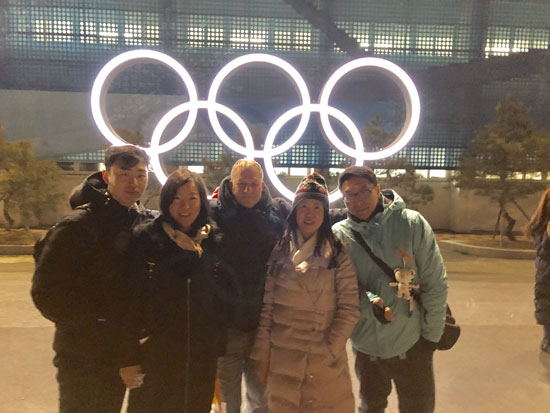
In advance of this visit on February 9, 2018, just prior to the close of the PyeongChang Winter Olympics, a spokesman for the Beijing preparatory committee reported on progress and addressed questions related to venue development, sustainability, snow conditions and more. His message: “Beijing is well on its way.”
Even “new age” sponsors with Chinese roots were present in PyeongChang as part of the Olympic movement, reinforcing the connection China has to all things Olympic. Companies like Alibaba were front and center as a global sponsor, operating experience centers next to long-time Olympic sponsor stalwarts, such as Coca-Cola.
For this writer, who has lived in China for more than 22 years, and who witnessed Beijing’s transformation in the lead up to 2008, there are certain themes common in the hosting of the Games: Costs. Security. Venue construction. Environment. Weather. The list goes on.
I have no doubt Beijing will be well-prepared for the 2022 Winter Olympics and hope it will also serve as a catalyst for progress as China emerges from its “coming out” to its “graduation.” Getting the hard and soft side of putting on the Olympics represents true success and based on my experience so far, I believe 2022 could be the best Olympics ever.
The author is the chief executive, public relations & influence, Asia, Ogilvy.