Talks best way for US to settle trade disputes







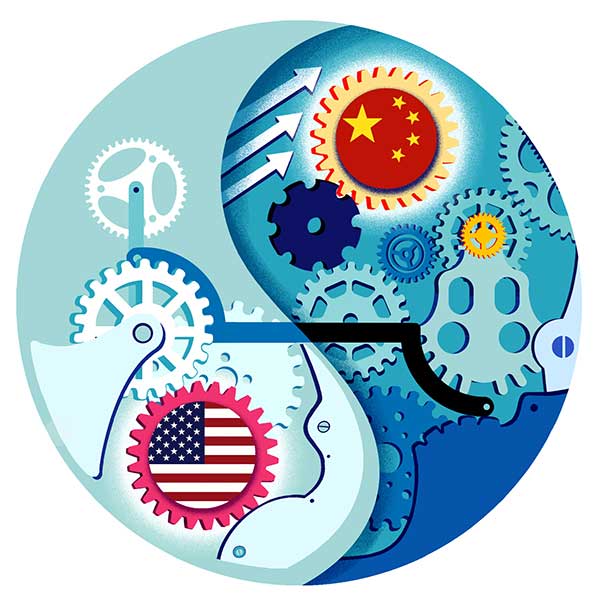
China launched reform and opening-up in 1978, and established diplomatic relations with the United States one year later. Since then economic and trade ties between the two sides have deepened and facilitated China's remarkable economic growth. But the US has been the largest overseas beneficiary of China's growth bonus.
China's growth and its cooperation with the US are important external factors fostering the US' macroeconomic performance, with China's massive market demand helping US companies earn huge profits, and sharpen their international competitiveness.
Also, China's fast-paced economic growth has boosted the recovery of the US and world economies after the global financial crisis, which was triggered by the subprime mortgage crisis in the US in 2008. According to the International Monetary Fund, China contributed 43.2 percent (calculated in market exchange rate), or 28.6 percent (calculated in purchasing power parity) to global GDP growth from 2010 to 2017.
And the fact that consumer goods comprise a high proportion (about 50 percent) of China's exports to the US has been a key factor in keeping the US' inflation rate low.
China is the US' largest creditor, and by purchasing large amounts of US government bonds, it has helped the US raise funds at low costs, reduce its expenditure on national debt interest, and expand its room for fiscal policy regulation.
Trade in services with China has strengthened the US service industry's competitiveness. The US' service exports to China increased from $15.8 billion in 2008 to $57.6 billion in 2017, with its trade surplus rocketing from $4.9 billion to $40.2 billion, which accounted for 32.5 percent of the US' global service trade surplus. In the past decade, the US has earned $228 billion in service trade with China.
As China further opens up its financial, telecommunications, medical care, education and pension sectors, the US' surplus in service trade with China is bound to rise even higher, particularly after China expands the share of foreign investment in its banking, securities, fund, futures and financial management businesses.
The US has also greatly benefited from its investment in China. According to the US Bureau of Economic Analysis, the US' accumulated investment in China had hit $92.5 billion by 2016, which yielded a profit of $11.8 billion. The average rate of return on its investment in China is 12.8 percent, 5.1 percentage points higher than that of its investment in other parts of the world.
In contrast, China's investment in the US is mainly concentrated in government bonds, and the rate of return fluctuates between 1 percent and 3 percent, remaining below 2 percent most of the time. This means the return on China's investment in the US is much lower.
The BEA data also show that China is an important source of profits for US multinational companies. The Chinese market, and its huge and growing demand also play an important role in stimulating the US companies' technological innovation and upgrading.
A Deutsche Bank report says the US companies' sales in China are markedly higher than the US' exports to China, and have probably surpassed the Chinese enterprises' sales to the US.
All this proves the US is not the side being robbed in bilateral trade. The economic and trade ties between the world's two largest economies, including the trade and investment structure, and the distribution of labor and interest, are a result of the long-term development of the world economy. So the US must realize its trade disputes with China can be settled only through negotiations on an equal footing. The two sides should therefore prevent their trade frictions from escalating and evolving into a threat to global economic recovery.
The author is a researcher in economics at the Chinese Academy of Macro Research.