Trump's IP theft case weak







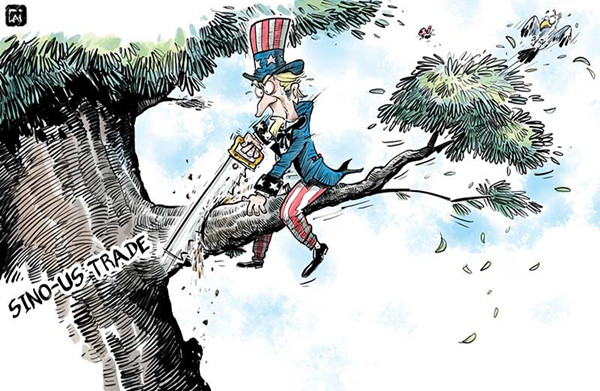
US President Donald Trump's administration has based its decision to impose trade tariffs on China, and risk a broadly catastrophic trade war, on a report that does not stand up to scrutiny. The decision, it seems clear, was made before the report was even written.
No one wins in a trade war. Yet Trump seems determined to pursue one with China, which he accuses of causing the United States' trade deficit, violating World Trade Organization rules, and using unfair practices to acquire foreign technology. While most economists marvel at Trump's ignorance of how trade balances work, many broadly agree with his charges regarding intellectual property. But the evidence supporting these charges is also weak, at best.
The so-called Section 301 trade investigation launched by Trump's administration last year accused China of acquiring foreign technologies using discriminatory licensing restrictions, unfair technology-transfer agreements, targeted outbound investment, unauthorized intrusions into US commercial computer networks, and cyber-enabled IP theft. "The weight of the evidence", the report concludes, shows that China uses foreign-ownership restrictions to force US companies to provide their technologies to Chinese entities.
But the case is not nearly as strong as the report suggests. For starters, because Chinese companies are not starved of capital-thanks to China's chronic savings glut-gaining access to foreign technologies is their main motivation for trying to attract direct investment from abroad. Under WTO rules, they are free to seek technology transfer from their foreign partners on a commercial and voluntary basis.
Fortunately for China, foreign companies have been more than willing to enter its market, not least because of its preferential treatment of direct investment. In fact, for decades, foreign and domestic companies alike have willingly accepted China's "market access for technology" strategy, which required foreign investors to "import" advanced technology in exchange for entering the Chinese market.
Whatever downside they may see to this approach, the fact remains that foreign enterprises-including completely foreign-owned companies and foreign partners of Chinese companies-have benefited greatly from their investments in China. A 2006 World Bank report put the average rate of return for foreign multinationals in China at 22 percent. According to a report compiled by The Conference Board of international enterprises, the average rate of return on capital for US multinationals in China in 2008 was 33 percent.
That said, the earnings before interest and taxes of foreign enterprises in China had been worsening since 2009, although the situation improved in 2017. This is an issue that the Chinese government must take seriously. In any case, no one can claim that foreign companies were forced to operate in the Chinese market. The claim that US companies have been compelled to transfer their technology to China is thus unfounded.
That argument has never been backed up with persuasive evidence. While the Office of the US Trade Representative, which compiled the Section 301 report, claims to have conducted many surveys, all respondents are anonymous, and their assertions are little more than hearsay-nothing that would stand up as evidence in a court of law. And, even if they were regarded as true, such claims would not definitively prove that forcing foreign enterprises to transfer their technology is prevalent in China.
The Section 301 report's accusations regarding outbound investment-namely, that China uses "government capital and highly opaque investor networks to facilitate high-tech acquisitions abroad"-are similarly flimsy. The USTR assumes that China's government not only has a clearly defined investment strategy, but also that an army of obedient companies is willingly carrying it out.
Yet the American Enterprise Institute reports that, from 2005 to 2016, Chinese companies made just 202 investments, including mergers and acquisitions, in the United States, only 16 of which-totaling $21 billion-were in technology sectors. Chinese investors spent far more than that-$94 billion-on real estate in the US in 2013 to 2017, according to the Chinese Academy of Social Sciences.
The sectoral distribution of Chinese companies' outward investment indicates that there is not even an effective market mechanism at work driving Chinese enterprises to invest in a rational way. Instead, companies are making independent-and often irrational-investment decisions, which sometimes lead to large losses.
The final issue raised by the Section 301 report relates to cyber-enabled theft of IP and sensitive commercial information, which the US claims is carried out by the Chinese government. The report acknowledges that since 2015-when China and the US agreed that neither would "conduct or knowingly support cyber-enabled theft of intellectual property, including trade secrets or other confidential business information for commercial advantage"-the number of detected incidents of hacking originating in China has declined. Yet some US officials insist that this likely reflects a shift toward more centralized, practiced, and sophisticated attacks by a smaller number of actors.
The truth is that China has been making steady progress in its protection of intellectual property rights. As Nicholas Lardy of the Peterson Institute of International Economics points out, "China's payments of licensing fees and royalties for the use of foreign technology have soared in recent years, reaching almost $30 billion last year, nearly a four-fold increase over the last decade." In fact, Lardy continues, "China probably ranks second globally in the magnitude of licensing fees paid for technology used within national borders."
It seems clear that the Section 301 report was based on rumors, surmises and half-truths. The obvious question is how the Trump administration can base a policy decision as consequential as trade tariffs-which could trigger a catastrophic trade war-on such weak evidence. The equally obvious answer is that the report was intended to justify, rather than inform, the policy.
This is not to say that the issues raised by the Section 301 report are mere fantasy, or that China's fulfillment of its World Trade Organization commitments has been impeccable. On the contrary, China has plenty of room to improve its WTO compliance, especially when it comes to opening-up its financial-services sector and strengthening IP protection.
But trade-related issues should be addressed within the WTO framework, with the US using that body's resolution mechanisms to address its grievances. In lieu of such an approach by the Trump administration, China should consider launching a new round of WTO negotiations in cooperation with Australia, Canada, the European Union, Japan, Mexico, and New Zealand. Multilateralism should be preserved, with or without the US.
Trump's trade war will not succeed in driving China to abandon its aspiration to catch up to the advanced economies. China is ready to fight a war of attrition. Unfortunately, both sides-as well as the rest of the world-will incur heavy losses in the process.
The author is former president of the China Society of World Economics, director of the Institute of World Economics and Politics at the Chinese Academy of Social Sciences, and served on the Monetary Policy Committee of the People's Bank of China from 2004 to 2006. Project Syndicate