



Steel sector makes headway in capacity reduction







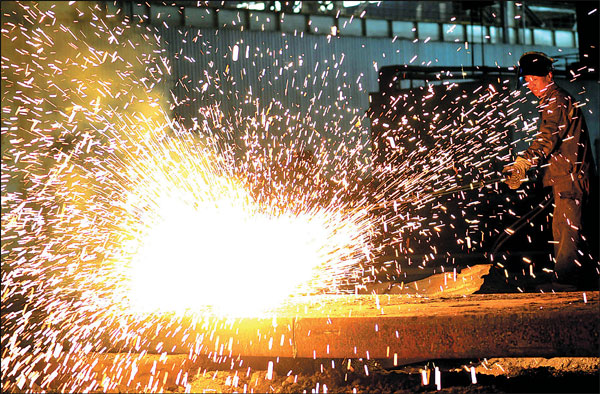
China's steel sector made considerable progress in the reduction and elimination of excess industrial capacity during the first six months of the year, while its ongoing efforts to curb pollution continued to bear fruit, experts said.
During the first six months of this year, the nation produced 373 million metric tons of iron, 451 million tons of crude steel and 5.31 million tons of finished steel, up 0.5 percent, 6 percent, and 6 percent respectively on an annualized basis, according to data published by the China Iron and Steel Association (CISA) on Wednesday.
The association's China Steel Price Index, which tracks the price movement of the commodity in China, stood at 115.8 by the end of June, a 14.6 percent year-on-year growth.
CISA said that during the six month period, its members saw sales revenue surge by 15.33 percent year-on-year to 1.97 trillion yuan ($290.6 billion), while net profit rose 151.5 percent to 139.3 billion yuan.
The industry has also been able to lower the overall debt levels. By the end of June, the debt-to-asset ratio of the CISA members was 67.3 percent, a year-on-year drop of 3.9 percentage points. Net receivables decreased by 7.68 percent from last year, while the net accounts payable dropped 6.51 percent year-on-year.
Yu Yong, chairman of the association, credited the sound performance of the industry so far this year to the country's continuous efforts and achievements in removing overcapacity and crackdown on inferior-quality steel products.
"Elimination of outdated capacity has helped boost the overall quality of steel produced and helped balance the market demand and supply," Yu said, adding that the oversupply problem in the industry has almost been solved.
In 2017 and 2016, the country eliminated 120 million tons of excess capacity in the sector, going far beyond the targeted goals. Earlier this year, China said it would cut 30 million tons of excess steel capacity this year, in line with its plans to eliminate 150 million tons of overcapacity in the industry by 2020. Experts expect the industry to achieve its target ahead of the set timetable.
Yu also said that supply-side reforms of steel enterprises have helped reduce capacity, deleverage debt, cut costs and boost performance, citing examples of enterprises such as China Baowu Steel Group Corporation, HBIS Group and Shougang Group.
"After years of development, China's iron and steel industry is now at the turning point to transform its development pattern from quantitative growth to quality improvement. Chinese steel companies will no longer pursue growth in size, but focus on quality development and higher profits," Yu said.
"Companies are looking to reduce costs and rejig equity structure, along with an expanded focus on innovation-led development and structural upgrade."
However, some of the biggest gains made by the industry during the last six months have been in the efforts to reduce pollution. Chinese steel enterprises are not only stepping up their green efforts, but also becoming global leaders in environmental protection technology and equipment, Yu said.
In the first six months of 2018, the quantity of fresh water used to make a ton of steel fell by 5.71 percent from the same period a year ago, while energy consumption for each ton of steel produced fell 3.76 percent year-on-year. In the case of particulate matter, the decrease was 16.18 percent, according to the association.
Xia Nong, a senior official with the National Development and Reform Commission, said that the industry still has a long way to go to achieve high-quality development, and it is crucial for the industry to update and transform.




















