



China Focus: China strives for affordable cancer drugs







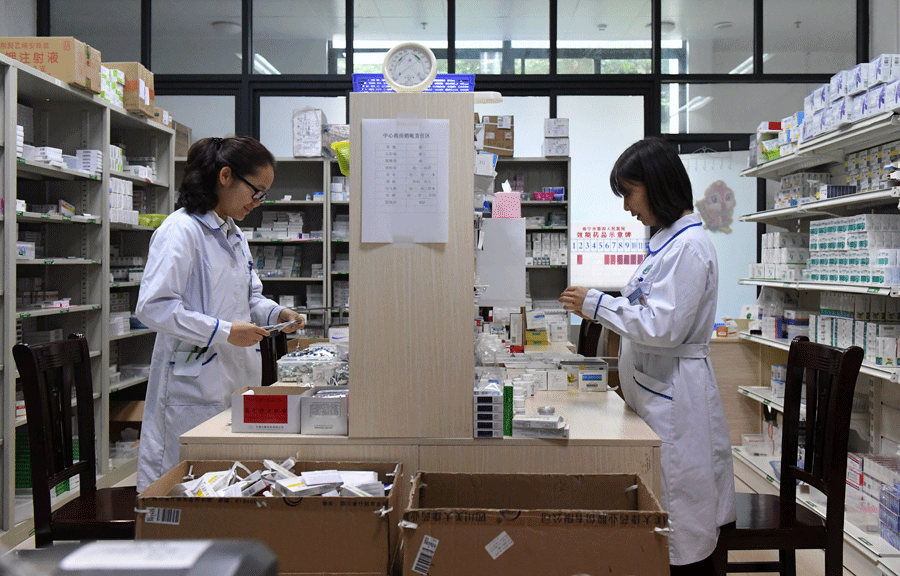
BEIJING -- A breast cancer patient surnamed Zhou in a hospital in Chengdu, Sichuan province, said she is grateful for the reduced costs of cancer drugs.
Zhou said she used to pay over 30,000 yuan ($4,500) each month for the drug Herceptin. "Since the price dropped and my insurance now reimburses the cost, I feel like a weight has been lifted off my shoulders."
The cost and short supply of cancer drugs have been a longstanding public concern in China.
To alleviate these concerns, the government has introduced policies to address the issue while experts have called on domestic pharmaceutical enterprises to invest more in research and innovation and make more cancer drugs available for the patients.
PRICE REDUCED
From May 1, import tariffs have been lifted on all common drugs including cancer drugs and cancer alkaloid-based drugs.
This is one of the government's latest efforts to make medical care more affordable and accessible to citizens.
In July 2017, the country included 15 tumor-targeting medicines into its list of medically insured drugs and reduced their prices. The list covers a majority of the most frequently used cancer drugs.
Prices of some medicines have dropped remarkably. In Hunan province, the price of each vial of Herceptin decreased from 17,600 yuan to 7,600 yuan, and the price of each vial of Fulvestrant, also used to treat breast cancer, dropped from 11,500 yuan to 4,800 yuan.
The newly-formed State Medical Insurance Administration said it would further cut the price of cancer drugs on the list via public bidding and procurement.
And medical insurance institutions and pharmaceutical enterprises should negotiate before more cancer medicines, currently not on the list, are included and covered by the insurance.
Meanwhile, the State Drug Administration (SDA) is expediting the approval of cancer drugs. For example, the approval of the marketing of human papillomavirus (HPV) 9-valent vaccine was shortened to just eight days.
According to Jiao Hong, head of the SDA, the administration will fast-track more imported cancer medicines for approval so these medicines can enter China one to two years earlier.
INNOVATION NEEDED
With the prices of cancer drugs substantially declining, demands are exploding nationwide, resulting in a shortage of some drugs in a few areas.
"The key to minimizing cost and reliance on imported cancer drugs is to raise our capability in research and development," said Zeng Yixin, vice director of the National Health Commission.
Data published by the National Cancer Center (NCC) showed that China saw 3.8 million new cases of malignant tumors and 2.3 million cancer-related deaths in 2014.
"Such a large population of cancer patients cannot rely solely on imported cancer medicines," said Shi Yuankai, deputy director of NCC. "China must advance the innovation capacity of its own pharmaceutical enterprises to meet the demand."
China has more than 4,000 pharmaceutical producers, of which over 90 percent produce generic drugs.
With policies to encourage drug research and innovation in recent years, China is forging ahead to make innovative drugs.
Independently developed domestic drugs, such as lung cancer-targeting drug Conmana and gastric cancer-targeting drug Apatinib, now offer a cheaper alternative to the more expensive imported drugs.
In June, HYML-122, a drug targeting acute myeloid leukemia, was approved by the SDA for a clinical trial. It was developed by a research team from Hefei Institute of Physical Science. If the trial is successful, the drug will be put into clinical use in five years.
Liu Qingsong, the team leader, said they are striving to make cancer as controllable as chronic diseases like high blood pressure and diabetes. "Our goal is to enable cancer patients to live a normal and fulfilling life."


- Cherry blossom festival in Yongfu town celebrates agricultural innovation and cultural exchange
- China's first domestically built cruise ship welcomes its 1 millionth guest
- The Devil Still Dances: High Vigilance against Japanese Militarism's Infiltration in Sports and Culture Fields
- 189 historical artifacts of Japanese invasion donated to museum in NE China
- Death toll rises to 8 in North China factory explosion
- Over 140m train tickets sold for Spring Festival travel rush












