Real economy shielded from systemic risks







Financial systemic risks were stimulated in the first half of this year due to Sino-US trade friction, as well as the overlapping effect of domestic financial deleveraging in a tightened regulatory environment, but the real economic sectors have been isolated from the risk, said research published on Thursday.
The index, monitoring 202 listed companies in the financial and property sectors, is calculated by researchers to indicate financial systemic risk under some extreme scenarios.
It jumped sharply this year, especially since March when Sino-US trade tensions emerged and Chinese financial regulators issued new regulations to curb shadow banking financing activities, said Zhou Hao, a professor at Tsinghua University's PBC School of Finance.
Similar surges in the index could be seen during the 2008 global financial crisis and the financial market turbulence in mid-2015, when the index jumped even higher than the warning level.
"This time, the index is still under the warning line, meaning the risk is controllable without hurting the real economy so far," Zhou told China Daily.
"But we still need to pay attention to the potential influences and prevent financing difficulties for small business in the second half, as tight financial regulation is expected to continue."
He suggested to maintain a prudent and neutral monetary policy stance in the second half along with financial deleveraging, but moderate policy fine-tuning is required to ease liquidity stress among financial institutions.
The trade tensions, meanwhile, could be seen as the direct factor that resulted in pessimistic expectations on future policy and economic uncertainties among investors. The negative effects were first shown in the earlier stock market fluctuations.
Chinese banks have higher risks than insurance and securities companies, and more attention should be paid to joint-stock commercial banks, compared with the five largest State-owned banks and city and rural banks, according to Zhou.
"If the trade tensions continue to escalate in the second half, joint-stock commercial banks will be more fragile, as their nonperforming loans will increase," said Zhou.
He explained that these banks have granted more loans to small and medium-sized enterprises, and have more exposure to interbank market business, or so-called shadow banking.
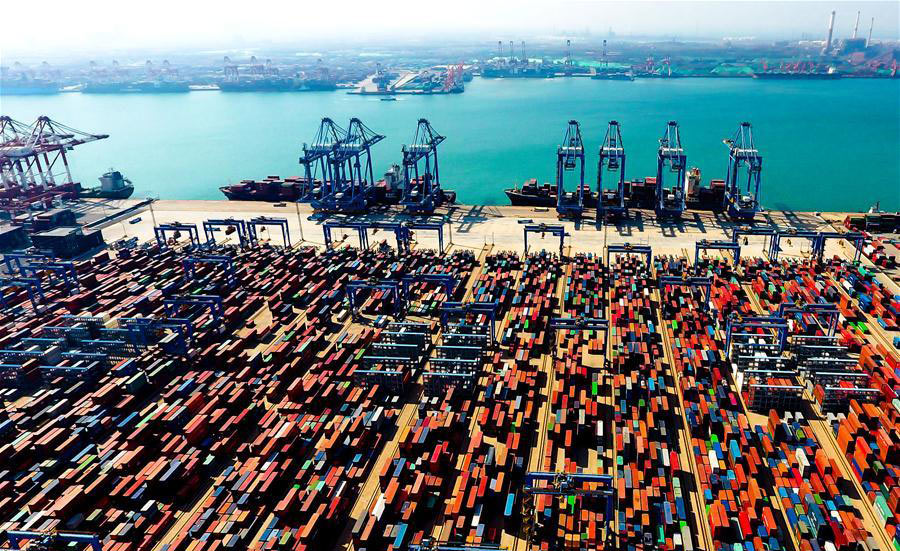
Tariffs on additional $16 billion of imports were reportedly expected from both China and the United States, when trade tensions rose with the US planning a 10 percent tariff on $200 billion of Chinese imports. The US levied tariffs on $34 billion of Chinese imports starting on June 6 and China announced equal and comparable retaliatory measures following that.
"A numerical estimate of financial implications on a cross-sector basis is uncertain due to the untested nature of trade friction between the world's two largest economies," Alex Griffiths, Fitch Rating's group credit officer in the global corporates department, wrote in recent research.
But the tit-for-tat retaliatory trade actions could raise credit risks for companies in the two countries, especially for those already under pressure, although the vulnerability after the initial tariffs rounds is limited, according to the ratings agency.
"A prolonged trade dispute resulting in weaker GDP growth, higher inflation, increased currency volatility or rapid changes in commodity prices could have wider rating implications," said Griffiths.
Escalating trade protectionism and cascading supply-chain effects could have a disproportionate effect on US corporations, especially large multinational companies such as Boeing, Intel, Deere&Co, Texas Instruments and GE. But most Fitch-rated Chinese corporations would suffer a limited direct impact from US tariffs as they are domestically focused, according to Fitch's research.