New science with an ancient focus







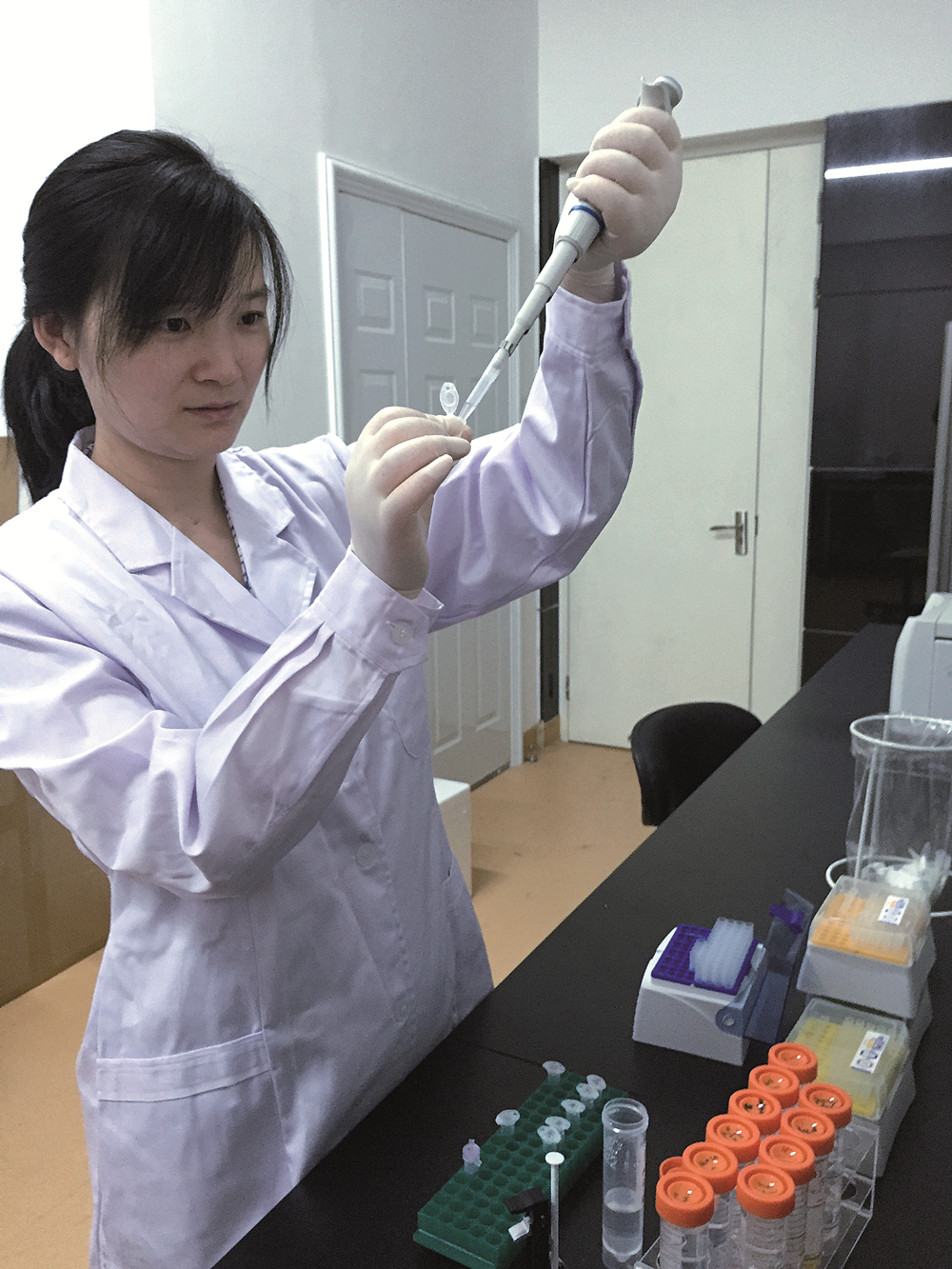
Leading researcher Fu Qiaomei has made big contributions to genetic analysis of prehistoric humans
The science of studying the roots of modern people via DNA extracted from the bones of ancient humans — people who lived from 5,000 to 50,000 years ago — is very new. Even 15 years ago, it barely existed.
But recent, surprising findings have clarified our views of prehistoric populations, as scientists figure out what the DNA says about ancient human populations and how they are related to people now living.
Fu Qiaomei, a professor at the Institute for Vertebrate Paleontology and Paleoanthropology of the Chinese Academy of Sciences, has been a big contributor to this transformative research, first as a graduate student, then as a post-doctoral fellow and now as team leader.
In a paper published in the journal Current Biology in October last year, Fu's team at the CAS reported that they had succeeded in sequencing the genome-wide data from the 40,000-year-old remains of a human found at Tianyuan, about 50 kilometers southwest of Beijing. Fu says this work shows there already was an identifiably East Asian lineage present in the region in that early period.
The technology for understanding the human genome has become much cheaper since the first one was sequenced in 2003 at a cost of about $3 billion. By 2006, Illumina, a company that makes DNA sequencing machines, got the cost down to $300,000. By 2014, Illumina charged $1,000, and it has announced that it plans to reduce the cost to $100.
This technology is just the beginning of the work. Scientists around the world are striving to understand what this genomic information implies for health and other human characteristics and for human history.
Extracting and analyzing the DNA from prehistoric bones is especially hard. DNA deteriorates when exposed to water or solar radiation. And DNA from bacteria hides the human DNA. Furthermore, the DNA of modern humans who handle the bones is hard to separate from the original DNA, which is often less than 0.2 percent of the total DNA present in the bone.
Fu has worked at two labs that have been on the forefront of solving these technical problems: the Max Planck Institute for Evolutionary Biology in Leipzig, Germany, and the Department of Genetics at Harvard Medical School in the United States.
The team at the Max Planck Institute, led by Professor Svante Paabo, was the first to sequence the Neanderthal genome. Much to their surprise, they found that Neanderthals must have interbred with modern humans, so that all modern Europeans and East Asians get from 1 to 4 percent of their DNA from Neanderthals, even though the ancestral line split from modern humans 300,000 to 500,000 years ago.
In 2015, Fu announced that she and her colleagues had sequenced a 40,000-year-old jawbone found in a Romanian cave that had an even greater amount — 5 to 11 percent — of Neanderthal DNA, indicating that the man had a Neanderthal ancestor in the previous four to six generations, according to the journal Nature.
After completing the Neanderthal sequencing in 2013, the Max Planck lab discovered a previously unknown kind of archaic human, called Denisovans, by sequencing the DNA of a tiny piece of finger bone found in a cave in Siberia. Denisovans split from modern humans even further back — 700,000 to 800,000 years ago — but they still contributed DNA to modern people on Papua Island and to Australian natives. It is thought that people in the Tibet autonomous region derive their ability to thrive at high altitudes from Denisovan DNA.
After studying at Northwest University in Xi'an, the capital of Shaanxi province, and then at the Chinese Academy of Sciences in Beijing, Fu completed her PhD in the Department of Evolutionary Genetics at the Max Planck Institute. She says her interdisciplinary work as an undergraduate, studying both chemistry and cultural relics, prepared her for her current work, even though she did not know it at the time.
Fu initially went to Germany for a trial period, since she had not previously studied genetics. "At that time, I was not really confident, but I told myself to try my best. Sometimes I felt really stupid and frustrated because I did not understand the discussion in group meetings. The group was really high pressure and you got really good feedback. They gave me a half year to test me — to show whether I have potential or not," she says.
She quickly established herself in the field. In his book Neanderthal Man: In Search of Lost Genomes, Paabo credits Fu, who was still a graduate student at the time, and another team member, Johannes Krause, with analyzing and cataloging the DNA that led to the discovery of the existence of Denisovans. In an article in the journal Nature, he said she "turned out to be one of the most amazing students we've ever had".
After completing her PhD and post-doctoral year in Germany, Fu moved to another leading laboratory, at Harvard Medical School, working on the genomes of ancient peoples. David Reich, director of the Harvard lab, credits Fu and Matthias Meyer, another researcher in the Leipzig labs, with developing a key technique that made it possible to extract DNA from ancient bones, even though the percentage of DNA that comes from the ancient human, rather than from bacteria or modern contamination, is tiny. In his recent book, Who We Are and How We Got Here, he writes, "The method of DNA isolation that Meyer and Fu developed has been central to the success of the ancient DNA revolution."
Fu says: "Here is an example of why 'in-solution capture' is really helpful. For a lot of ancient DNA samples we have really, really high levels of microbial DNA. If we just use the techniques we do for modern samples, we just get microbial DNA. This meant that many samples could not be studied. For full genome analysis, you need efficiency — meaning that you increase the amount of DNA that you get from humans, but also retain the complexity of the sample. The technique was developed in 2013 and first applied to the Tianyuan individual."
Fu's current work concentrates on building the capabilities of the ancient DNA lab at the Institute for Vertebrate Paleontology and Paleoanthropology and on filling in the gaps of knowledge about East Asia.
"Before we published the Tianyuan genome-wide data, this region was empty. There was a lot of data for Western Eurasia, but we did not even know whether the Tianyuan individual was Asian or not. Science magazine mentioned that this filled a gap in the field," she says.
"We also have a project to understand North and South China in the early transition period. It will be very interesting to know how they are related to the present day north and south and how this structure influences the present day. Right now, we have some hints, but it is hard to have final conclusions because we need more samples. We are also trying to understand the period older than 10,000 years ago in East Asia," she says.
Another area for future research is looking for ancient humans in addition to the Denisovans and Neanderthals. "We know there were lots of other archaic humans. We have not been successful in discovering them yet, but we are searching," Fu says.
"Beyond that, we want to study pandas, and animal domestication. Right now, pandas are only found in Sichuan, Shaanxi and Gansu, but in the past, even several thousand years ago, they appeared in Yunnan and Guangxi. Now, there are no pandas there. This is not our major emphasis, but it is an interesting extension of the techniques," she says.
Despite her success in foreign research labs, Fu says she never thought she would stay outside China. She was always thinking about returning.
"I didn't apply for work in Europe or the US — I just wanted to come back. The work is really high pressure here, but I just feel comfortable. When I was in Europe and the US, it didn't feel like home," she says.




- China launches satellite to aid in early extreme weather detection
- Report on mining accident that killed 6 suggests accountability for 42 individuals
- Law aimed at bolstering standard Chinese language education passed
- Connecting cities, changing lives
- World's longest expressway tunnel opens to traffic
- Taiwan lawmakers vote to pass motion to impeach Lai