



'Trust in the Party' key to China’s success







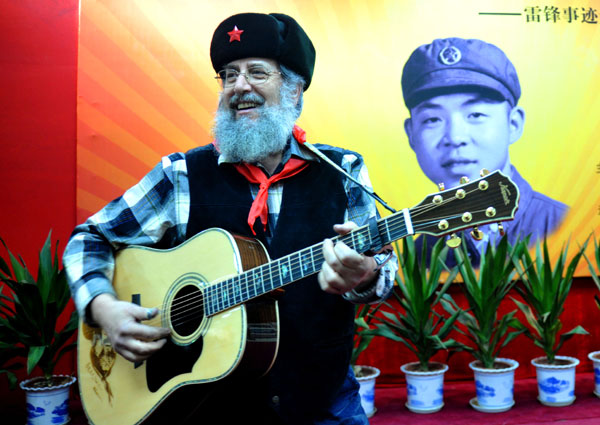
I went to the Chinese countryside to spend Spring Festival there.
For a month I talked with folks about the things of which they care.
They’ve worked real hard to make China strong and will make it stronger yet,
But the struggles that they face again, they ask you not forget.
They said “Mao gave us our country and our food we owe to Deng.
And we’re happy for 60 years of gains, since the freedom bells have rung.
We trust in the party to lead us on the road,
That will ease the burdens of our lives, a bright future to unfold.”
The above lines are the first verse and the chorus of a song I wrote in 2009 at the time of the People’s Republic of China’s sixtieth anniversary. I had come to China four years earlier to teach English, but soon found myself inspired to record my experiences in China in the lyrics of songs like Mood from the Chinese Countryside. Although I had played guitar since I was nine and music had always been part of my life, I had never felt moved to write my own songs — never, that is, until I came to China.
Let me back up and explain how I came to China. I am an American sociologist who left the academic world in 1976 after receiving my Ph.D and several years of university teaching. I became what American sociologists now call a “public sociologist”. I left the university and for the next three decades I worked as a full-time volunteer organizer for low-income workers in the United States. We worked on building community-based organizations, both to solve immediate economic and social problems facing poor Americans as well as struggle against policies and programs that expanded poverty. Seeing the need for a scientific approach to our work, we understood the importance of studying the history of successful and unsuccessful workers’ struggles in the United States and elsewhere. Although I studied Marxism during my university years, my work as an organizer was what exposed me to 20th-century China.
My introduction to the Chinese struggle was through the famed book by American journalist Edgar Snow, Red Star Over China, which I studied and taught. Snow’s classic book, greatly contributed to by his wife Helen Foster Snow, reports on his 1936 visit to the liberated territory of Yan’an, where he interviewed Mao Zedong and other Party leaders. Red Star introduced Mao, and the Chinese struggle against the Japanese invaders, to the world. For those who already knew of Mao, Snow confirmed that, despite rumors to the contrary, he was still alive and well and leading the struggle. Since first reading Red Star in the mid-1970s, I have reread it about once every 10 years. It was actually the last book I read before coming to China in 2005. Since coming here I have learned Snow’s book motivated many of the foreign friends who came to China in the mid-twentieth century.
For several years before I came to China, a number of my colleagues had spent a summer or a semester teaching English there. The reports of their experiences were fascinating and after hearing several of them I decided to take an opportunity to help in the major campaign for Chinese people to learn English. I applied to a number of universities and received several job offers. Despite some familiarity with 20th century Chinese history, I lacked geographic knowledge, so I knew very little about the schools that invited me or the cities where they were located. I did not know which school to choose.
One of my invitations came from Huaiyin Teachers College. The invitation letter began “Huaiyin Teachers College is proud to be located in the city of Huai’an, the hometown of Zhou Enlai, the first premier of the People’s Republic of China.” That sentence was the deciding factor. My study of China had given me some familiarity with Zhou and his leadership through difficult times. I knew that through his leadership, the Communist Party and China had continued to move forward.
In my two years there, I learned more about Zhou and much more about China. The sense of change was everywhere, and it was in Huai’an I was first inspired to turn to music when in 2006 I wrote Huai’an – Promise of the Future, the first of what I call my “musical stories from a life in China.” As I sing about the feeling of progress everywhere in different parts of the city, the chorus goes,
It’s the hometown of Zhou Enlai, New China’s first Premier
A man who’s loved and honored, in places far and near.
With growth and progress all around, the vista’s bright ahead.
It was the promise of the future, toward which Premier Zhou lead.
While socialism requires a humanistic perspective with a focus on people’s needs, the process of building it must be rooted in science, hence we speak of scientific socialism. Despite this, I must admit my surprise when in 2006 I, a foreign visitor, was invited to attend and contribute to a public meeting with local Party and municipal leaders. I joined numerous local citizens in offering suggestions to improve the development of and quality of life in Huai’an. Information, dates and suggestions were sought from everywhere as the basis to make necessary decisions moving forward.
I arrived in Beijing in 2007 to began teaching at Minzu University of China. My work there reminded me of Edgar Snow’s discussion of Mao meeting with minority leaders about 80 years ago. Snow recounts Mao’s explaining the various ethnic groups in China needed to unite to achieve their common interests and to defeat all obstacles. Since my arrival at Minzu University 10 years ago, I have seen that unity in operation on a nearly daily basis and can hear it in the motto of the university “Unity in Diversity, Theory in Practice.”
Those who have never worked to build socialism fail to understand that it must be built, not simply declared. It takes work and it takes time. It is not a linear process with today being a little closer to socialism than yesterday was. Socialism, as with all social change, develops through a dialectical process. As some contradictions are solved, new contradictions appear. Again, the building of socialism must be rooted in science, and science requires looking at the results of what you have done before you can take the next step. Therefore, with the arrival of the 19th CPC National Congress, it will be necessary for a careful, objective analysis of the results of the plans and projections of the 18th Congress in 2012.
The numerous goals set in 2012 included the continued improvement of living standards that had already been advancing. From my travels through 28 of China’ provinces, municipalities and autonomous regions, as well as my living and working in Huai’an and Beijing, I can provide some anecdotal observations.
In my visits to the countryside in numerous provinces including Hubei, Hunan, Jiangsu, Anhui, Yunnan, Guangdong and rural Beijing, improvements in housing are obvious, as new homes stand next to old ones and wherever I go, food is plentiful.
More and more students’ families have the funds to enable them to study abroad, where they can not only learn but help those in their host countries know more about China. This is connected not only to the goal of economic development but can also be understood as a key component of China’s “soft power” campaign.
A major factor in living standards is health care, and one of the areas of health care that is the first to be neglected because of expense is dental care. Since coming to China I have lectured at 35 Chinese universities. In recent years in my teaching and other university visits I have been struck by the improvements in dental care. Increasing numbers of students are undergoing or have undergone orthodontic work.
Similarly, education is also critical for the improvement of living standards. This is true both for those receiving education and those who can benefit from what a more educated population can provide. In line with this, the expansion of university education has been massive. Many universities and colleges are expanding by building new, more upgraded campuses both in the suburbs near their main campus and in other cities. This not only opens the door for more students, but also increases the need for faculty and other staff to keep the campuses running. Similarly it offers economic opportunities in the surrounding communities that are needed to serve the new campuses.
Innovation and technological development was also a priority of the 18th Congress and these have moved forward under President Xi Jinping’s leadership.
Technological development has also been expanded, increasing numbers of experts in various scientific disciplines are being recruited through the 1000 Talents Program and easier access to “Chinese ID cards.” As a kind of “reverse brain drain,” the support being given by the government is moving China toward leadership in many scientific and technological fields.
I remember a common campus question when I first came to China: “Is it proper for students to have businesses?” Well, that seems to have been answered, as the government and universities are assisting students in doing so, particularly those with innovative business models. Government encouragement and support is being provided to campuses across the country to establish “Innovation and Entrepreneurship” centers. They are growing quickly, and there are three on three different campuses within a five-minute walk from where I live.
In recent years, soft power has become an increasingly important topic.
As a teacher and lecturer, one of my specialties is English public speaking. I have taught this for seven years, done many lectures about it and served as a judge for dozens of public speaking competitions. More and more people are studying public speaking: university and high school students, employees of State-owned enterprises and workers in private enterprises. As a result, the number of Chinese people who are able to tell their stories has greatly expanded.
Similarly, increased cultural exchange has strengthened China’s soft power. Recently a student music and dance troupe from Minzu University spent a week in Australia as an initial leg of a tour to several countries to share Chinese culture. Conversely, I and other foreign musicians have been invited to various locales to share our music with the Chinese people.
I would like to close with the lyrics of two verses from a song I wrote to celebrate The PRC’s 60th anniversary called “To Make its People Strong.”
Out on the horizon, the view ahead is bright
But society in harmony is not built overnight.
The country’s founders’ promises were to those who do the work
And with scientific knowledge those commitments won’t be shirked
Moving forward on the road, that socialism takes
Adherence to its principles, can’t be allowed to break
The people and their leaders, will march along the way
And their vision of the future, will be achieved one day.
The author is a professor at Minzu University of China.





