



China's cooperation versus US' protectionism







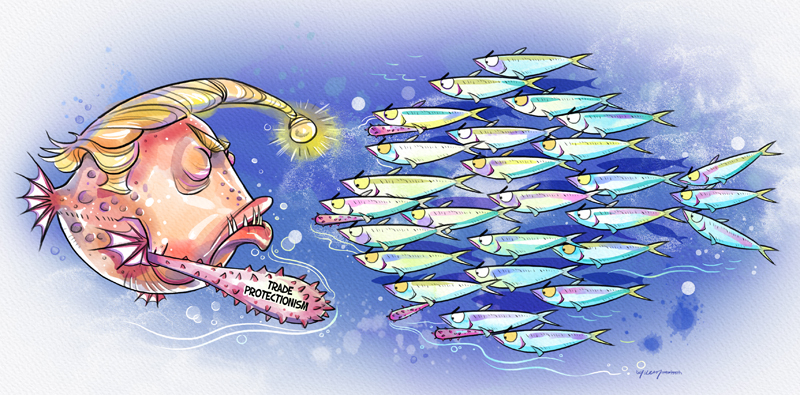
The United States has resorted to trade protectionism to not only boost its economy but also maintain its global hegemony, disrupting the world order and causing tensions across economies. Should China cooperate with other countries to counter the US' protectionist moves? Two experts share their views with China Daily's Pan Yixuan. Excerpts follow:
Development, cooperation should not be disrupted
The world's only superpower has become its biggest destabilizing factor. This makes it absolutely necessary for all the countries that want to maintain the multilateral international trading system to cooperate, in order to safeguard their interests that are being threatened by the US' protectionist moves.
The need for global cooperation for common development has long been a consensus among the international community. But US President Donald Trump seeks to boost the US economy at the cost of not only other countries, but also the multilateral trading system. The US' protectionist and unilateral moves have harmed its relations with many countries, including its allies, and violated international trade rules.
Therefore, the rest of the world should sincerely promote cooperative development to defeat Trump's designs. As a main target of Washington, Beijing should firmly adhere to free trade. And the other countries which oppose US protectionism should uphold the World Trade Organization rules so as to strengthen multilateral cooperation.
But disagreements among the economies should not be ignored just because they are ready to cooperate to counter the US' protectionist policies. For instance, China, a main target of the US in the field of trade, and the European Union, a US ally hurt by US protectionism, have increased communication and decided to deepen cooperation to protect the multilateral trading mechanism.
But, just like the US, the EU had earlier alleged that violation of intellectual property rights and the role of China's State-owned enterprises in the market were to blame for its trade deficit with China. But unlike Washington, Brussels did not take any extreme measures against Beijing to resolve the issue. So, in order to continue cooperation with the other economies, China must strengthen communication on such issues and honor the promises it makes to resolve those issues, apart from further deepening domestic reform and opening-up.
Lest it be misunderstood, further deepening, or the "deep-water zone", of reform and opening-up is not in response to a looming trade war with the US, but an essential part of China's development process. Further reform and opening-up will strengthen China's economy and boost its competitiveness in world trade in the long run, which in turn will help the country better cope with a trade war.
Only by sustaining its pace of development through further reform and opening-up can China continue to cooperate and negotiate with the rest of the world.
Wang Dong, deputy executive director of the Institute for China-US People-to-People Exchange, Peking University, and secretary general of the Academic Committee of Pangoal Institution
World needs cooperation as well as countermeasures
The US' protectionist and self-seeking trade, export and tariff policies have caused huge losses and a great deal of trouble to China. But as the world's largest economy, the US should realize a trade war, which it seems desperate to launch against China, would harm both sides.
Also, since the US' protectionist moves have hurt the economies of even many of its allies-such as the European Union, Canada, Mexico and Japan-China can work together with those economies, which seem determined to push the US back to the multilateral trade system and neutralize the Trump administration's unilateral actions. In fact, China-EU and China-Japan relations have improved in recent months, making cooperation to counter US protectionism more possible.
Most of the countries opposed to US policies have taken a similar stance: although they don't want a trade war, they are not afraid of taking countermeasures against US protectionism. Based on this understanding, the economies can jointly put pressure on Washington in two ways.
A peaceful approach would be to try and convince the Trump administration that a trade war, which is becoming imminent with each passing day, will backfire on the US economy.
With the collapse of the Bretton Woods Agreement in the 1970s, currencies ceased being pegged to the price of gold thanks to former US president Richard Nixon's actions. The de-pegging of the US dollar from the price of gold made it a fiat currency-and ultimately a reserve currency used by many economies. There was a tacit agreement, though, that the US had to be a big global buyer to retain the privilege of its dollar.
However, since Trump sees trade from a microscopic perspective, he wants the US to both enjoy the currency privilege and reduce the trade deficit. A macroscopic view of trade would show the currency and trade systems have a mirror-image relationship, which means if the US continues to use protectionist policies, there won't be enough dollar left in the world market to maintain its "status" as a privileged currency. Accordingly, the US' global influence will decrease. The US will then be forced to choose between reducing its trade deficit and retaining the dollar as a privileged currency.
Perhaps export-oriented economies such as China, Japan, Canada and the Republic of Korea should jointly explain this fact to the US, so that it stops trying to ignite a trade war.
That does not mean countermeasures should not be taken against the US. Indeed, there is a need to impose restrictions on US investments, including merger and acquisition bids. The EU has already announced investigation into US-based companies such as Facebook.
It is not mathematically possible to calculate the real value of trade in bilateral ties, because in the global supply chain, a country's profits cannot be judged only on the basis of surplus or deficit. As such, China and the other economies should take countermeasures to convince the US that it too will suffer the consequences of a trade war.
Di Dongsheng, associate dean of the School of International Studies, and International Monetary Institute, Renmin University of China





