Sanctions do not work







I have been here before. Yes, I can remember that anticipation on the cusp of a moment when an economy is about to transition and take that tectonic shift from planning to market. I saw it in China in the early 1980s and again in Vietnam and Laos in the 1990s. That feeling of nostalgia returns with the Democratic People's Republic of Korea. The pattern is likely to be the same.
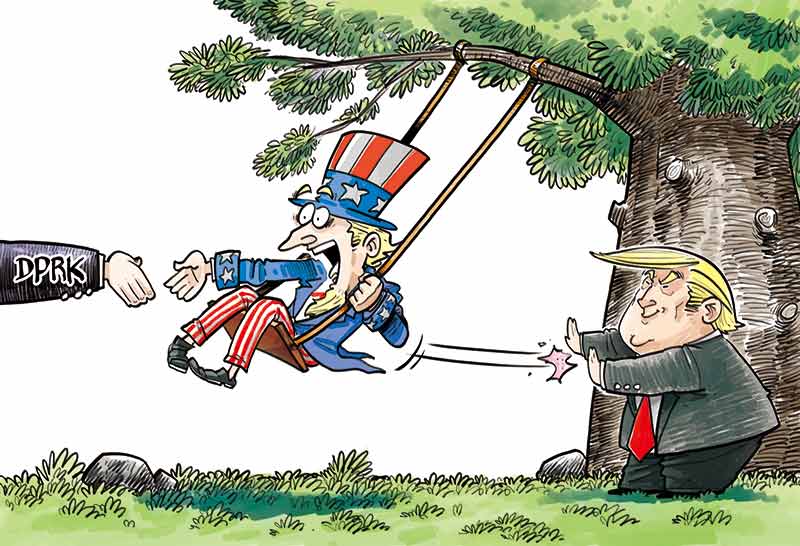
On the eve of Tuesday's historic summit between US President Donald Trump and DPRK leader Kim Jong-un in Singapore, the DPRK is a nation birthing to come in from the cold. Rudi Sirr, a special economic adviser to the DPRK Premier Pak Bong-ju, has said: "There has been a very distinct shift within Chairman Kim (Jong-un) has surrounded himself with advisers and key policymakers who have mostly studied and lived abroad. The DPRK is now looking outwards, not inwards. This is the biggest change."
More specifically, Pyongyang is looking to the models of opening-up and reform adopted by China, and later by Vietnam and Laos. Clearly the need for cheap labor will be a magnate for investment when the DPRK's economy begins to open up. Determination by both the Republic of Korean President Moon Jae-in and Kim Jong-un to proceed in direct economic engagement, regardless of the roller coaster about-face decisions or Twitter feeds of Trump, heralds an era of cross-border investments that is reminiscent of the days when Hong Kong led all global investments on the Chinese mainland focusing on the special economic zones of the southern region.
In some ways, the dynamics of the Korean Peninsula politics is just responding to an economic momentum already in play. Since Kim took power, the DPRK's GDP has soared 17 percent driven by a construction industry boom bent on remaking Pyongyang in anticipation of change. That in turn has sparked the emergence of a small urban middle class, which has begun to use a local credit card system run through the central bank. A fledgling private sector is also emerging, from cafes and restaurants to rock bands and kids playing with cell phones.
Underscoring these socioeconomic changes, the number of mobile phone users in the DPRK has increased to 3 million since the Egyptian mobile provider Orascom entered the market in 2008. Purchasing power is demonstrated at a cost of $300-500 per phone unit. Phones and monthly subscriptions are paid in foreign exchange, which the DPRK's fledgling middle class has despite the sanctions.
The only question is, when will the United States lift the sanctions?
In the end, just a simple meeting between Trump and Kim in itself will be a historic breakthrough. Even if tempered by the White House's idiosyncratic patterns of flip-flop diplomacy. The key question will be whether this meeting can put into momentum a process for laying down a reasonable and rational blueprint for lifting sanctions against the DPRK. Then everything changes.
The bottom line is: when US sanctions against a nation are lifted, economies open up, reform occurs and people's lives can flourish. But when economic sanctions are imposed on any country, it amounts to a blockade. People cannot have access to capital finance, trade ceases, and information is cut along with access to imported medicines and pharmaceuticals.
Sanctions are at the core of everything against globalization: openness of capital, trade and free flow of ideas, not to mention the basic right to medicines and livelihood.
In short, economic sanctions are one of the gravest violations of human rights on our planet perpetuated today. Now it is time to abolish sanctions.
The author is the founding director of Himalayan Consensus and a senior international fellow at the Center for China and Globalization.