Shutdown provides green catalyst







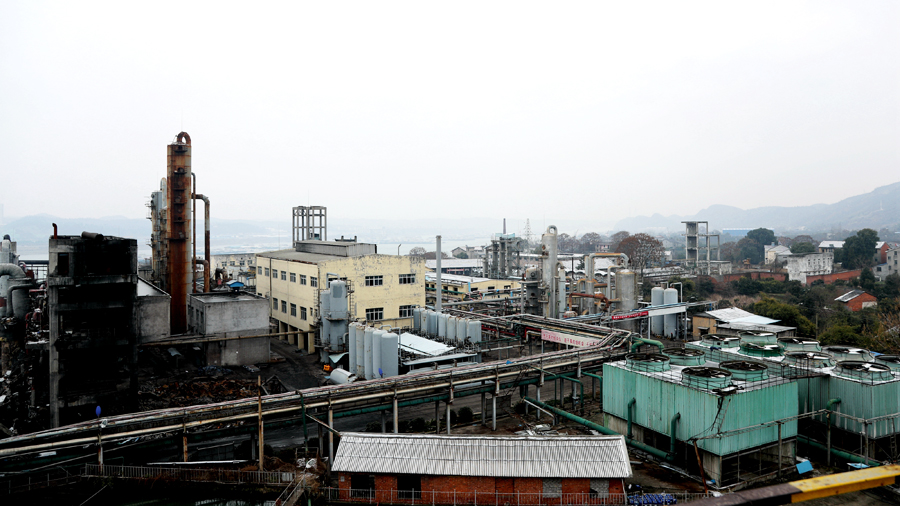
More than 130 heavily polluting plants have been removed from banks of Yangtze River
As he looked out across the Yangtze River, Dai Shengdong, a former employee of Tiantian Chemicals Co, spoke sentimentally about his former employer.
"We did pretty well, and we paid a lot of tax," he said, standing near the company's partially demolished fertilizer plant in Yichang, a city in Hubei province.
Despite his fond memories, the 50-something conceded that the decision to close the factory, which lay on the banks of the river, was the correct one.
Last year, the management of Tiantian Chemical agreed to cease production after the Yichang government formulated a three-year plan to get rid of chemical plants along the course of the Yangtze, especially those built within a kilometer of the river, and promote environmental protection.
In total, 134 chemical plants were affected by the plan; some would close, some would be relocated to one of two approved industrial parks that boast state-of-the-art waste treatment facilities, and others would be transformed into nonpolluting businesses.
Tiantian Chemical, located in Aijia township just 100 meters from the river's south bank, was the first plant to close. Even though production ceased around a year ago, the walls of nearby buildings are still specked with stubborn stains.
In China, people usually hang clothes to dry in half-open spaces at home, such as balconies, but that wasn't an option for the 4,000 residents who lived near the plant, which produced synthetic ammonia and ammonium bicarbonate for agricultural use.
"Coal dust and particles pervaded the entire area. Now the factory has closed, people are happy to hang out their clothes," said Li Haiyang, head of Aijia township. "Before, if I left my office door ajar for a few hours, a layer of dust would form on my desk. Now, even if I don't wipe it for three or four days, the desk stays clean."
Yichang is a major industrial hub on the middle and upper reaches of the Yangtze River.
Thanks to an abundance of phosphorus ores and water resources in the area, the chemical industry was a main driver of the local economy for many years.
Two years ago, 134 chemical plants were spread along the river, employing 52,500 people and accounting for one-third of Yichang's annual revenue.
While the location provided chemical companies with cheap, easy transportation options for their products, a lack of environmental regulations allowed the plants closest to the river to use the waterway as a dumping ground for wastewater and solid industrial waste.
However, as the main gateway to the Three Gorges stretch of the river and the Three Gorges Dam, the city has a pivotal role in the Yangtze's environmental protection.
As a result, the Yichang government faced a dilemma. Should it allow the chemical industry to develop further and boost the local economy, or would it better to close the plants and protect the environment? Eventually, the city opted for environmental protection.
The decision saw 25 chemical plants close last year.
The financial loss was considerable as some of the factories generated annual revenue of more than 100 million yuan ($15.6 million) and paid more than 10 million yuan in taxes per year.
As a result, Yichang's revenue declined by 9.7 percent and fixed asset investment fell by more than 19 percent.
"The chemicals sector was the city's most important pillar industry, so the move to control the pollution it caused has affected the city's economic development. That will continue for some time," said Guo Kangxin, director of the Yichang development and reform commission.
"It is a painful part of the city's transition. Hopefully, it won't last for too long."
- Huzhou to spend 1b yuan per year to develop green finance
- Hong Kong displays its financial charms in pitch to Bay Area
- Green revolution quickens China's carbon goal
- Green vehicles to drive capital's logistics industry progress
- China boosts financial support for small firms, green economy with MLF collateral rules



- Lantern Festival lights bring the Dunhuang grottoes to life
- China's 2026 Spring Festival travel rush to begin
- Knocking on the stone-framed door
- Shanghai Science and Technology Museum to reopen soon
- Shanghai celebrates Spring Festival with intl students
- Pegasus fondant artwork ushers in Year of the Horse in Shanghai