



Bicycle Economics – 1981 Re-visited







China Reform and Opening – Forty Years in Perspective
Bicycle Economics – 1981 Re-visited
Editor’s note:Laurence Brahm, first came to China as a fresh university exchange student from the US in 1981 and he has spent much of the past three and a half decades living and working in the country. He has been a lawyer, a writer, and now he is Founding Director of Himalayan Consensus and a Senior International Fellow at the Center for China and Globalization.
He has captured his own story and the nation’s journey in China Reform and Opening – Forty Years in Perspective. China Daily is running a series of articles every Thursday starting from May 24 that reveal the changes that have taken place in the country in the past four decades. Keep track of the story by following us.
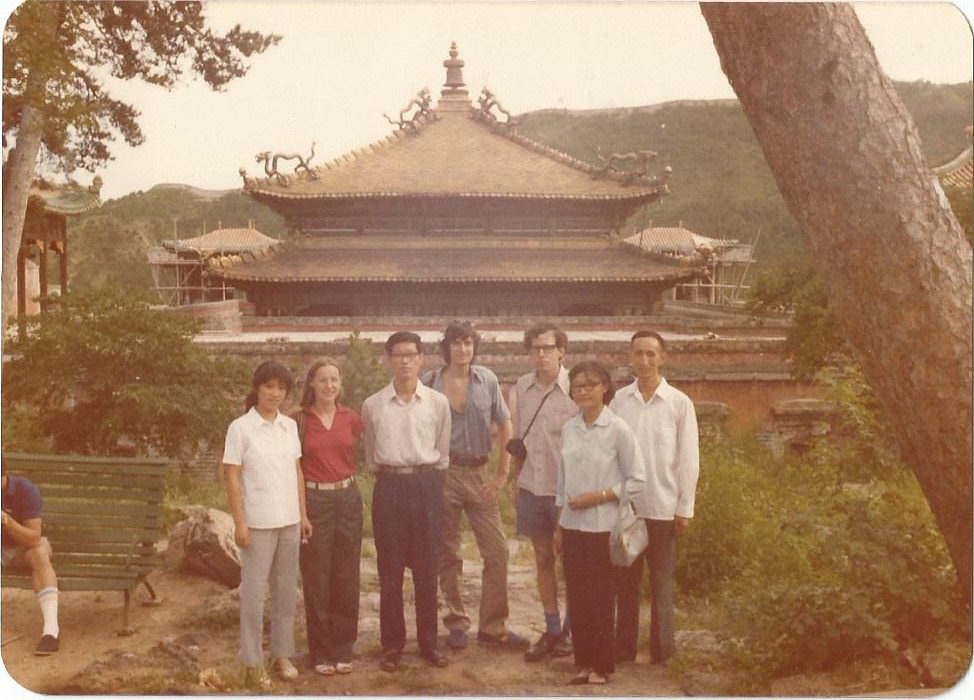
Laurence Brahm (center) with his classmates and teachers in Nankai University. Picture taken in 1981. [Photo provided to chinadaily.com.cn]
During my first year in China, I spent a few months in Tianjin studying Mandarin at Nankai University. The old industrial city was one of the treaty ports carved up by foreign colonial powers after the Opium Wars during the Qing Dynasty (1644-1911). So the main streets were European.
Our class of exchange students was only the second wave of Americans to study in China. We felt like pioneers. President Jimmy Carter had just normalized relations with China two years earlier in 1979. Everything was just opening.
The Tangshan earthquake shook China in 1976. A portent in the year of Mao’s death, the earthquake destroyed many homes in the vicinity. People used debris for makeshift shelters, which could be seen everywhere.
It was still a command economy and people waited for specific commands.
Everyone wore the same clothes: baggy white shirts so thin you could see through them and green army pants. Soon, I was wearing green army pants.
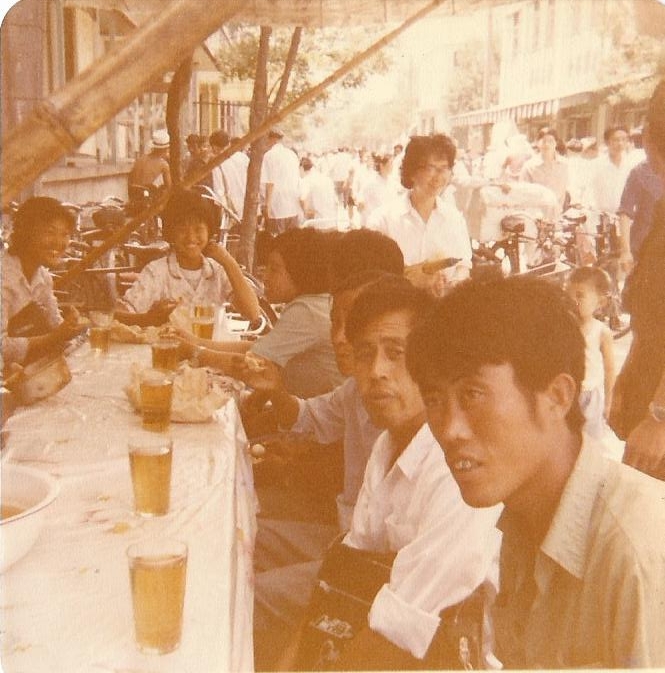
Old photo of Tianjin. Photo taken by Laurence Brahm in 1981. [Photo provided to chinadaily.com.cn]
I bought a bicycle. As the hot summer dragged on, it fell apart. Each day I had to get a different piece replaced. The quality of state-produced products was just that bad. Eventually, the bike I finished up with was different from the one originally bought! As I rattled along the muddy potholed streets of Tianjin, I could hardly imagine that China would one day dominate global exports of spare parts.
While a classmate and I were fixing our bikes and replacing another broken part, he pointed to an old farmer, who rode up to the bicycle repair stand. His bicycle was completely assembled from rubbish, tied and soldered together. This frugal ingenuity of the Chinese people struck me, their ability to survive and engineer with so little in available resources amazed me.
That bicycle was my first glimpse of China’s potential to financially leverage industrial reconstruction. It became my metaphor of where this place was going.
There would be streams of bicycles riding alongside the river that wound through Tianjin’s center. I would be one among everyone riding together. There was something so interconnected about those moments, a feeling of more connectivity with those around you than looking at a social media APP today; mainly because the people, the place and the bicycles were real.
There were no cars. Only bikes. But there were traffic lights. We all had to stop our bikes at intersections for the traffic lights. One day I was not paying attention and rode my bike right though the light. Within seconds, my bike was impounded with some kind of really simple bike cuff. The police asked me to make a public confession before all the other bike riders as I had disobeyed a traffic rule. For me this was a defining moment of cultural identity.
I realized that by saying sorry and acknowledging one’s mistake to everyone else, that one earns a different kind of respect. Moreover, it is a more practical way to just get on with other things and make friends out of those that you may have inadvertently offended. So I made my public confession. The police released my bike. And I rode on with the other bikers back toward the gates of Nankai University.
Riding through the streets of Tianjin and going to stores that had no commodities at all, it occurred to me that money had less meaning in that society. It was hardly in circulation after all. A higher morality influenced the way people thought. They cared about respect. That is what that bike incident was all about, a greater social respect than my individual attitude.
Once I paid one mao(ten Chinese cents) more than the stated price for something I bought. The vendor chased me all over the city to give back the change. He finally showed up at the door of my dormitory at Nankai University apologizing for the oversight.
Another time dust entered my contact lens while riding my bike in the crowded street. So I stopped at a little shop and used their broken dirty mirror to refit the contact lens. In the mirror, over my shoulders, I could see a huge crowd of onlookers had gathered to see what I was doing. Someone asked if it was another magic trick taking my eye out and putting it back.
But such innocence would not last long.
After my Mandarin classes were finished, it came time to leave Nankai University. When the school held a banquet for us foreign students, teachers took home the leftovers in tiny metal boxes they had brought with them in baggy green army bags, shouldered over their flimsy shirts that never seemed to fit. I was not aware that over the next three decades, I would watch China grow out of those army bags and replace them by Prada and Louis Vuitton apparel, which the Chinese now purchase en masse like no other nation on earth.
The thought did not even occur to me, as I sold my bike – on the freshly emerging black market.
Please click here to read the previous episode.






