Photo raises hopes for survival of the 'Goddess of the Yangtze'







Resources required
Hua Yuanyu, one of the first scientists to survey the species back in the 1980s, said, "To salvage the possible surviving baiji dolphins, emergency action needs to be taken using the country's best resources, talent and technology.
"Waterborne transportation along the Yangtze ought to be properly managed to reduce the noise that has gravely affected the lives of these sonar-guided dolphins," said the retired professor from the Life Science Institute at Nanjing Normal University in Jiangsu province.
He condemned destructive fishing methods such as high-voltage electro-fishing, floating gill netting, and muro-ami, a technique in which encircling nets are fitted with "pounding devices" such as large rocks or concrete blocks that are designed to scare fish from hiding places.
These practices should be strictly forbidden, and any violation should be punished to protect both the dolphins and their prey, Hua said.
"The baiji is a mammal that uses lungs to breathe. If shocked by electricity, it may lose consciousness and drown," he said, criticizing the fishing practices as well as the discharge of waste into the waterway.
He called for improved law enforcement and for local fishermen to be better educated to help them become protectors of the ecosystem.
"Protection of the Yangtze should include the water, the banks and the wetland along its path, because the ecosystem is one whole," he said,
He suggested that the protection zone for river dolphins should be extended to cover the habitat of the possible last few baiji in Wuhu.
"I am optimistic that if the environment continues to improve, the baiji will come back," said Hua, who invented a sonar orientation method that he and his team used to observe and deduce the size and distribution of the baiji population in 1986.
In the mid-1980s, there were still about 300 baiji living in 42 family-like pods along the river. Hua believes that these intelligent mammals have been hiding from human activity and river industries, quietly surviving in unexploited, serene waters.
Eco-restoration
The baiji flourished in the middle and lower reaches of the Yangtze for more than 20 million years.
However, in recent decades that peaceful existence was shattered by the rise of industrialized fishing and a transportation boom that pushed the species to the edge of extinction.
In ancient times, the mammal was regarded as a goddess that protected fishermen and sailors along the 6,380-kilometer-long waterway that rises in Qinghai province in Northwest China and enters the East China Sea at Shanghai.
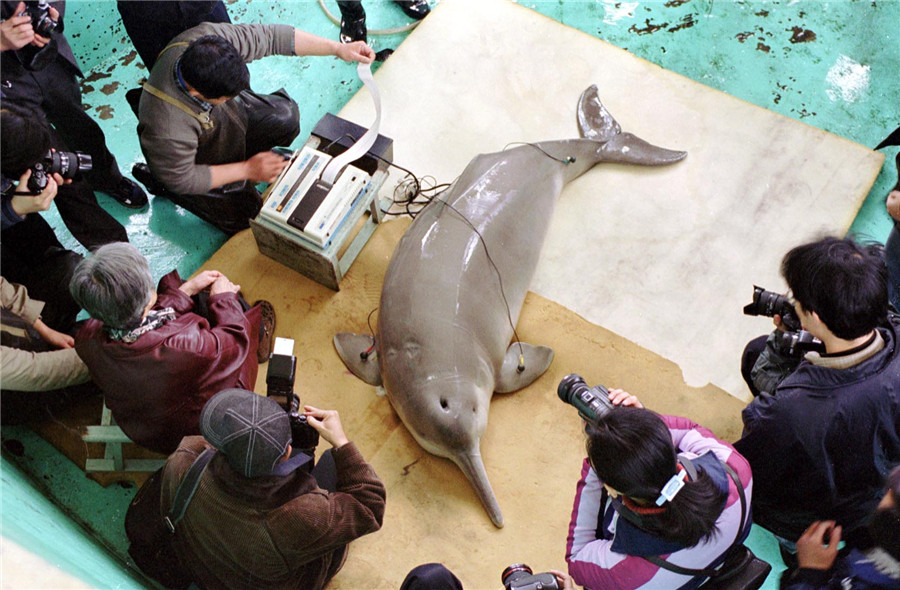
Once described as "numerous," the last known captive baiji died in 2002. After an international expedition in late 2006 failed to find any proof of its continued existence, the species was declared "functionally extinct" the following year.
On the International Union for Conservation of Nature's Red List of Threatened Species, the baiji dolphin is designated as "critically endangered, possibly extinct".
In the absence of the "goddess," China has been making vigorous efforts to restore the ecosystem of the Yangtze.
The construction of an ecological civilization has even been written into the Constitution as a national development objective.
As a result, scientific surveys have confirmed a rise in numbers of the Yangtze finless porpoise, another of the river's mammalian residents.
The supposed reappearance of the baiji is more evidence of the ecological improvement of the Yangtze, according to Hua.
Wang, from the hydrobiology institute in Wuhan, said there is still a long way to go in the protection and restoration of the river's natural habitats for species such as the finless porpoise.
"But the current development strategy has been adjusted in the right direction," he said.
"Monitoring, protecting, revitalizing and restoring the ecology and natural habitats of the Yangtze River should be our main tasks for the next 50 years."