



Capital outflows may crimp forex reserves







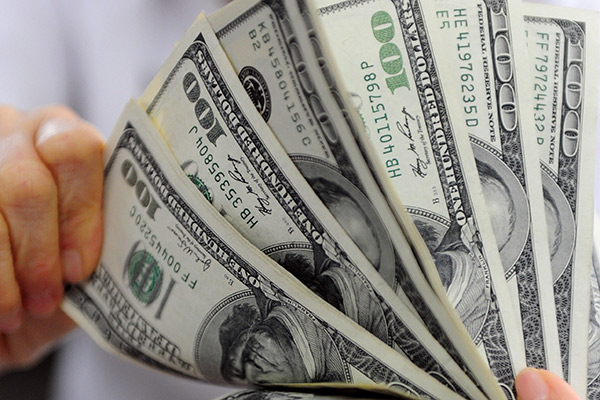
Nation's foreign exchange holdings drop by $36.6b from January to April
China's $3.12 trillion foreign exchange reserve may further decline under the pressure of capital outflows, said experts, predicting a stronger US dollar supported by the Fed's possible interest rate hike in June.
The nation's foreign exchange reserves, which were used as a currency defense when the yuan suffered strong depreciation pressure two years ago, has dropped $36.6 billion from January to April, after 12 months of growth since February 2017, according to data from the central bank.
Due to the continually strengthening US dollar, on Monday, the onshore Chinese yuan's spot exchange rate hit its lowest level since Jan 23 to 6.3888 per dollar, and the offshore yuan declined by 150 points to lower than 6.38 on the same trading day.
The 10-year US Treasury yields, which usually have a positive correlation with the US dollar and the Federal funds rate, exceeded 3.1 percent last week, up from 2.8 percent a month earlier, the highest level since May 2011, which has sparked turbulence in some emerging markets including Argentina and Turkey.
Regional financial vulnerability is emerging as those emerging economies increased interest rates to deal with surging capital outflows, resulting in debt risk exposure.
Zhou Xiaochuan, former governor of the People's Bank of China, the central bank, warned his successors in a speech at the weekend "to keep a close eye on what will happen next" if the 10-year US Treasury yields continue to rise and the dollar's strength wanes.
He especially mentioned that financial vulnerability could be stimulated by capital outflows in emerging economies, especially those that have large debts.
"The interactive impact of small-probability events could lead to significant results," he said.
The China-US interest rate differential is usually seen as one of the key factors influencing the pace and direction of cross-border capital flows. A higher US interest rate will attract more capital into its capital market seeking higher investment returns.
The interest rate gap was about 90 basis points in April when Chinese central bank Governor Yi Gang identified it was in "a comfortable range" for balanced capital flows. Now the gap has fallen to 60 basis points.
"If there were major fund outflows and excessive market volatility, the central bank could be pressured to hike local interest rates to support the currency and avert undermining investor confidence," said Jonathan Cornish, an analyst with the global credit ratings agency Fitch Ratings.
But any local rate increase could pressure the asset quality of domestic enterprises and increase funding costs, especially given the current high level of private-sector credit in China, although the PBOC has responded to recent Fed hikes, according to Cornish, who predicted the Fed's fund rate to be 2.50 percent at the year end and 3.25 percent by 2019.
Pedro Martins, chief emerging markets equity strategist and head of LatAm Equity Research with JPMorgan, predicted that US policy rates should gradually move upward within two years, and the central bank balance sheet normalization will likely result in rising long-term rates over time in emerging markets.
"There is limited room for further sovereign spread compression across emerging markets," he said.
"The drivers behind emerging markets' economic growth are growing large and include a solid pickup in global trade fueling more benign emerging market dynamics via a sustained rise in private sector confidence and the credit impulse turning positive for the first time since 2014."




















