



Migrants now find jobs closer to home








For decades, many of China's vast army of migrant workers-rural workers who leave their hometowns-h(huán)ad to travel far from their families to seek better jobs. Now, more are finding employment closer to home.
In Chinese statistics, rural workers are people born in rural areas who are not engaged in farming. They are no longer considered rural workers if they obtain an urban hukou, or household registration. Migrant workers are those from rural areas who work outside their hometowns.
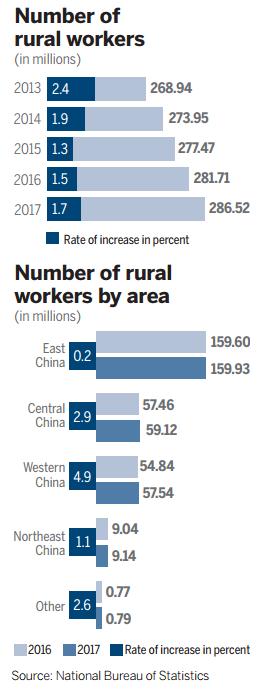
Some 2.51 million rural residents joined the migrant workforce last year, taking the total to 172 million, a 1.5 percent rise year-on-year, according to the National Bureau of Statistics.
While the increase is no surprise, analysts say what is telling is that 96 percent of the new group chose jobs in their native province, including in the underdeveloped western region, rather than heading further afield.
The trend has developed rapidly in recent years-88 percent of new migrant workers stayed local in 2016. It has been fueled by local governments' efforts to retain labor, rising salaries and changes in the kind of opportunities offered in traditional destinations for migrant workers, mostly on the country's east and south coasts, according to experts.
Zhang Yi, a senior labor researcher at the Chinese Academy of Social Sciences, said it is now much easier for people from the traditional sources of migrant workers-Henan, Anhui, Hubei, Hunan and Sichuan provinces-to find work at home due to the growing economies in these places.
Sichuan, Anhui and Hubei, in particular, have seen an obvious shift in behavior in the past five years, according to a 21st Century Business Herald report. In Anhui alone, 85,000 residents who had previously worked outside the province returned to local jobs in 2017, the paper said.
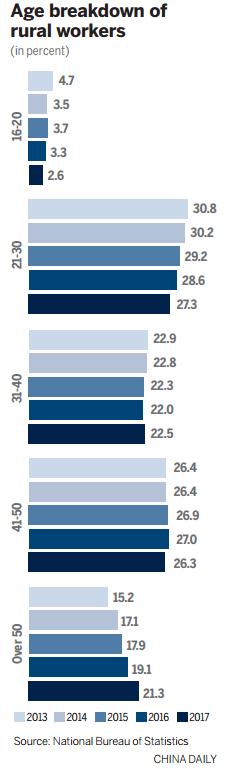
The trend has coincided with above-average GDP growth in these three provinces, ranging from 7.7 to 8.9 percent between 2015 and 2017, compared with a national average below 6.9 percent, according to NBS figures.
"Better economic growth means more business and more orders for companies in those areas. This of course means a greater demand for workers," said Yang Yiyong, director of the Society Development Institute, part of the National Development and Reform Commission. "So rural laborers have far more options to choose from."
Meanwhile, he said, the traditional destinations for migrants are going through industrial upgrades, leading to a change in what kind of workers are needed.
"Developed regions like the Yangtze River Delta and Pearl River Delta are seeing a transformation in their industrial structures, which means some work can be completed by machines rather than human labor," Yang said. "With fewer low-tech jobs, it's harder for many migrant workers to find jobs in these areas."
Preferential policies introduced by provinces to attract and retain migrant workers have also had an effect. The policies make it easier for them to access social services, start a business or send their children to local schools.
Hubei, for example, helped 475,000 children from migrant families enroll in schools in 2016 and contributed to their tuition to ensure they had access to China's nine-year compulsory education system, Hubei Daily reported.
The report said provincial authorities invested 45.7 million yuan ($7.18 million) to set up care centers in 457 towns for children who remain in villages while their parents work in cities.
Hunan also has promoted programs aimed at boosting migrant laborers' professional skills and knowledge, including occupational safety, and last year the province included them in its lifelong vocational training system.
The growing appeal of western China-chiefly driven by Sichuan and Chongqing-h(huán)as seen it outstrip other regions in the past two years in rural workforce growth. In 2017, the number increased to 57.54 million, up 4.9 percent year-on-year.
"These days, areas like Sichuan and Chongqing are performing much better than eastern and Central China in economic development, and that's brought more job opportunities," Yang said.
Salaries in the western region are also quickly catching up with the eastern and southern coasts, according to Zhang at the CASS. "The income gap is not that large anymore, but living costs in the west are still lower. It's something migrant workers will consider," he said.
Last year, the average monthly salary in the western region was 3,350 yuan, up 7.5 percent year-on-year, while for the eastern region it was 3,677 yuan, according to the National Bureau of Statistics.
Meanwhile, Kunming, Xi'an, Yinchuan and Xining-all capitals in western China-were ranked among the top-six cheapest places to live in the 2016 Blue Book on Quality of Life in Cities. The traditional destinations for migrant labor-Shenzhen, Beijing, Shanghai and Guangzhou-were the most expensive.
Wang Gangxian, 25, used to lug bricks and mix cement on construction sites in Hangzhou, capital of Zhejiang province, but returned to work in his native Kunming, capital of Yunnan province, in March.
"I'm more familiar with this place," he said, plus he can earn as much as 3,000 yuan a month, only about 500 yuan less than he did in Hangzhou. "Fortunately, bosses in both cities have taken care of my accommodations, but in Kunming I save about 700 yuan on food and daily necessities," he added.


- Investigation uncovers mismanagement of donated artifacts
- Gold mine accident kills 7 in East China
- Defense minister greets foreign military envoys at Chinese New Year event
- Judicial efforts lead to decline in China's pollution cases
- SPP steps up food and drug safety oversight
- Visually impaired student's rail journey goes viral












