Taking stronger steps







Different types
There are eight different types of osteogenesis imperfecta, and they range in the severity of their symptoms and the specific medical problems they can cause.
"People with the lightest symptoms may never experience a single bone fracture in their lifetime. They are just like normal people and may have no idea that they are OI sufferers. Some others can experience frequent bone fractures, even from the slightest amount of stress," he explains.
He adds that it's hard to estimate the exact number of sufferers of the disorder in China because some of them, especially those with lighter symptoms, are never accurately diagnosed.
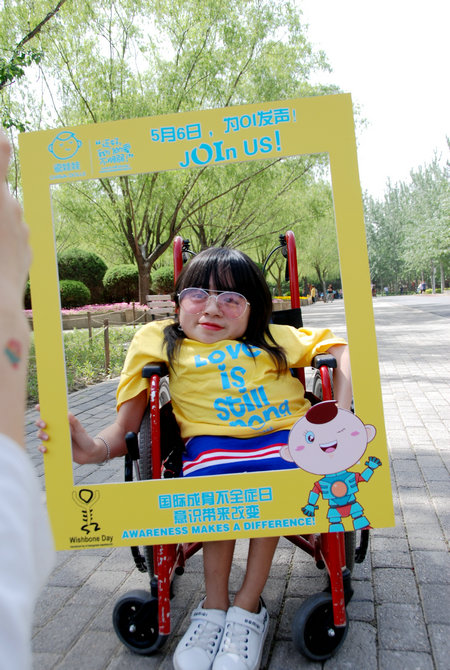
Zhang Zhijun, a 19-year-old from Xinjiang Uygur autonomous region, completed the 5-kilometer hike on his wheelchair without assistance to mark Wishbone Day.
"We'd like to call for more attention from society, and also show that we are not as fragile as people imagine," says Zhang, who regularly exercises and often takes part in similar events.
As an OI patient, he has experienced more than 30 bone fractures over the years, with the earliest going back to when he was only one week old. Zhang wasn't able to travel to school because of the disease and received home tutoring instead.
According to Zhang, in his hometown of Karamay in the northwest of Xinjiang, local doctors had never encountered osteogenesis imperfecta before and even misdiagnosed it as chondropathy-a disease of the cartilage-in his early years.
"The doctors said there was little they could do and simply told me to stay in bed to avoid more bone fractures," Zhang says. "But that actually caused more problems, such as muscle atrophy, while worsening my symptoms of osteoporosis."
He was correctly diagnosed with osteogenesis imperfecta at a Beijing hospital at the age of 6, after suffering numerous bone fractures.
"It was very difficult to find any information, either about the disease, or about suitable hospitals," he recalls.
When he was about 12, Zhang and his family spent several months searching online before finally finding two hospitals, one in Tianjin and the other in Shenzhen, that were able to perform the correct kind of surgery.
He has undergone several bone surgery operations since, including a recent one to his leg after an accidental fall.
The surgery also cured his leg-length discrepancy caused by the genetic condition, and he is expected to be able to walk short distances with walking sticks after recovering fully from the operation. In recent years he has increased his rehabilitation training schedule on the advice of his doctors.
"I had heard about this disease before, but had no idea of what patients experienced from day to day. I also had some misconceptions about the disease due to exaggerated media reports. It has been a meaningful experience for me to take part in this activity and interact with fellow sufferers directly," says Xue Jia, a 48-year-old magazine editor who attended the Wishbone Day event.
According to Wang, people with osteogenesis imperfecta will be affected by the disease for the duration of their lives, and timely intervention and targeted therapies are essential ways to help sufferers maintain a higher quality of life.
Comprehensive treatments, including surgery for those with severe symptoms, medication to increase bone density and rehabilitation guidance, are offered to most OI patients.
Over the past few years, the China-Dolls center has been working on ways to better help children with OI receive proper treatment during the critical stages of the disease, while at the same time promoting awareness of the disease among doctors.
According to Sun Yue, director of the center, in the past only a few hospitals and doctors provided specialized treatment for OI patients, and usually the clinical departments tended to work separately.