Attracting more manufacturing bases given priority by countries







African nations strive to lure Chinese entrepreneurs to set up factories and create jobs
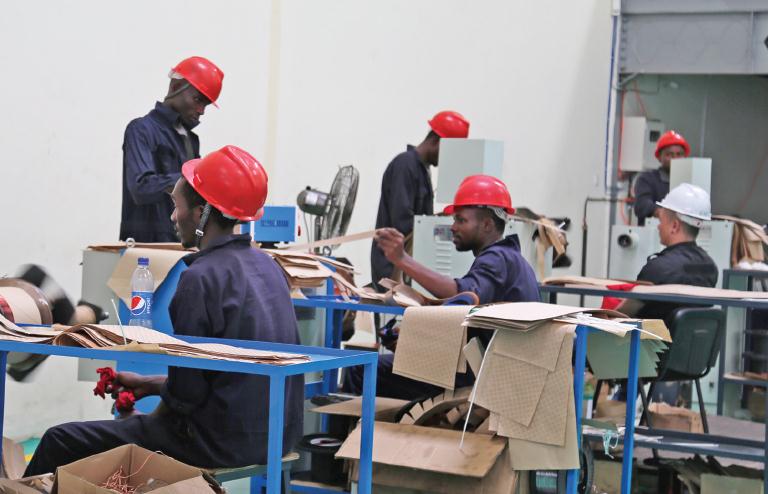
As the Chinese government continues to encourage investors to venture overseas, African nations are wooing entrepreneurs to set up manufacturing bases in their countries.
The World Bank estimates that China could shed 100 million low-skilled manufacturing jobs over the next few decades, and African countries are vying to take advantage of this opportunity.
Albert Muchanga, the AU commissioner for trade and industry, says Chinese investors should take advantage of the newly signed African Continental Free Trade Area to set up manufacturing bases in Africa.
The ACFTA will cover an African market that now has 1.2 billion people but is expected to hit 1.7 billion by 2030.
"By setting up manufacturing bases in Africa, Chinese companies are assured of a cheap, adequate labor force, access to raw materials and a big market," he says.
Recently, the Kenyan government held a forum with Chinese enterprises, wooing them to support it in fast-tracking attainment of the country's Big Four development agenda in the manufacturing, housing, healthcare and agriculture sectors.
The Kenyan government seeks to raise the share of the manufacturing sector from 9 to 15 percent of gross domestic product by 2022, as well as create 1.3 million manufacturing jobs.
In the leather industry, the country targets production of 20 million shoes by 2022, while for textiles, the targets call for development of cotton production using hybrids. In agri-processing, the government plans to support the creation of 1,000 small and medium-sized enterprises as well as 200,000 jobs by 2022. Other plans include creation of export processing zones in efforts to increase exports annually by 20 percent.
Ethiopia is already ahead of the pack in terms of attracting Chinese factories. Currently, many Chinese companies have invested in the country's shoe-and garment-making sectors.
In its effort to accelerate manufacturing growth, Ethiopia is implementing an ambitious industrial park strategy that hinges on attracting foreign direct investment to the export-led and labor-intensive manufacturing sector.
The imperative is to build on the country's agricultural foundations by moving toward new tradable activities in manufacturing that absorb large numbers of young and semi-skilled workers.
Tanzania, Senegal and Rwanda are also pursuing Chinese textile investment through establishment of industrial zones.
According to the World Bank, sub-Saharan Africa's potential competitiveness in light manufacturing is based on two advantages.
The first advantage is low labor costs. In Ethiopia, for example, while labor productivity in some companies approaches levels in China and Vietnam, wages are only a quarter of China's and half of Vietnam's, and overall labor costs are lower still. Sub-Saharan Africa's second advantage is an abundance of natural resources that supply raw materials such as hides for the footwear industry, hard and soft timber for the furniture industry and land for agribusiness.
A 2016 report by the African Center for Economic Transformation, "Seizing New Opportunities in Manufacturing", said that even though African countries face challenges in breaking into world manufacturing markets, new developments work in their favor.
These include rising wages in China, a shift in Asia away from export-led growth to domestic and regional consumption-led growth, Africa's growing regional markets and falling transportation costs. Other promising factors include improved access to abundant natural resources, improving productivity, access to global value chains and improving economic policy environments, the report said.
However, African manufacturing is still in its infancy and is seen as being curtailed by a number of structural shortcomings, including lack of quality transportation infrastructure and electricity supplies, low productivity and a shortage of skilled labor and innovative entrepreneurs, it said.
edithmutethya@chinadaily.com.cn