US criticisms on IPR belie its real motive







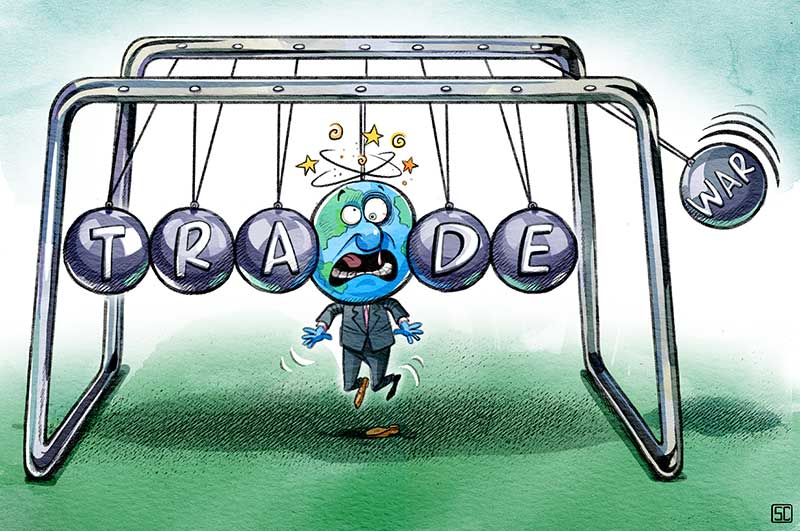
If a Beijing-Washington trade war does break out, it will be because the United States has been continuously taking unwarranted unilateral measures in the hope of reducing its trade deficit with China as well as accusing China of using improper measures to "acquire" US technologies and intellectual property.
When it comes to protection of intellectual property rights (IPR), China has for long been the target of businesses and governments from the developed world. The latest example of such an accusation is the European Union Chamber of Commerce in China's statement in March claiming foreign businesses in China are forced to disclose and transfer their technical know-how to their Chinese partners.
The Chinese government has repeatedly denied such accusations, with the Ministry of Commerce stressing that China has neither issued any law allowing the forced transfer of foreign technologies nor encouraged IPR violation in any form. Speaking at a news conference after the conclusion of the first session of the 13th National People's Congress, China's top legislature, Premier Li Keqiang emphasized that transfer of technology forced on foreign companies can never be allowed in China.
Since China is still in the process of building a comprehensive and foolproof legal system for IPR protection, some IPR violations at the company level might have occurred. But that doesn't mean the Chinese government encourages such moves; on the contrary, the government takes strict action against those indulging in such activities.
During the 30-odd years of high-speed growth, Chinese companies first learned from Western examples, a practice widely followed by developing countries, before developing their own intellectual property. IPR violations might have occurred during that period due to a lack of strong regulations and punitive measures. However, it is unfair to accuse the Chinese government of encouraging such IPR violations and forcing the transfer of foreign technologies.
The government has been making untiring efforts to strengthen IPR laws, which have been recognized by the World Intellectual Property Organization. The guideline on how to further open up the economy and actively use foreign capital issued by the State Council, China's Cabinet, in early 2017 underlines the protection of foreign companies' interests in China in several terms, reflecting the government's determination to safeguard foreign companies' IPR.
Furthermore, in an effort to address specific concerns of the US, China has inked several agreements on IPR protection since the 1990s and conducted a series of exchanges with the US while promising to upgrade its laws on IPR.
A WIPO report published on March 21 this year says China became the second-largest source of international patent applications (filed via the Patent Cooperation Treaty) in 2017-second only to the US. The report also says China could overtake the US as the largest source of international patent applications in the next three years. But the US' trade policy outline for 2018 explicitly says the country's leadership in research and technology should be guaranteed and the investigation under Section 301 of the Trade Act of 1974 was initiated to stop China from acquiring US technology and intellectual property through "unreasonable and discriminatory" measures.
Together with the fact that China is swiftly catching up with the US in intellectual property development, it has become clear that Washington's protectionist move is meant partly to prevent, at least delay, China's ascent to the higher end of the industrial chain, which in itself is unfair and against the spirit of free competition.
The author is a professor at the University of International Business and Economics.