Workshop urges action to protect critically endangered duck







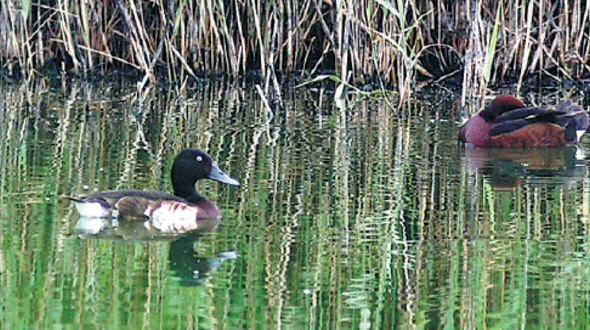
Few people have heard of the Baer's pochard, a duck that at first glance resembles the mallards readily seen around Beijing.
There are fewer than 1,000 of the migratory, diving ducks living in the wild, making them rarer than the giant panda, and the Baer's pochard has been classified as critically endangered by the International Union for Conservation of Nature since 2012.
Even fewer people know that the Hengshui Lake National Nature Reserve in Hebei province, about 250 kilometers southwest of Beijing, is home to the world's biggest known population of Baer's pochards - with 309 individuals recorded on March 8 last year - making it vital to their survival in the wild.
That's also why scientists and conservationists from 10 countries - Bangladesh, China, the Democratic People's Republic of Korea, India, Japan, Mongolia, Myanmar, the Republic of Korea, Russia and Thailand - gathered at the nature reserve, on the outskirts of the city of Hengshui, on March 19 and 20 to discuss urgent issues relating to conservation of the bird.
During the workshop, delegates agreed to a Hengshui declaration, calling on the Chinese authorities to add the bird to the country's critical protection list, and encouraging all countries where the bird lives - including the 10 represented at the workshop, organized by the Baer's Pochard Task Force - to strengthen the protection of sites supporting the bird as a matter of urgency.
"The Baer's pochard is a jewel in the crown of East Asia's natural heritage. With distribution concentrated in China, we have a unique responsibility to ensure its survival in the wild," said professor Ding Changqing, an ornithologist at Beijing Forestry University who also chairs the Baer's Pochard Task Force, an international conservation program launched in 2015 in response to a catastrophic - more than 90 percent - decline in its population.
"I'm delighted that the State Forestry Administration has recommended that the Baer's pochard be added to the list of species with top-level protection in China. If approved, this will mean severe penalties for anyone poaching or endangering this bird and will be a significant step toward ensuring the species' long-term survival."
The delegates counted 98 Baer's pochards during their field survey in Hengshui and were impressed by the important role Hengshui Lake plays in the breeding and wintering of the pochard. In their declaration, they suggested that the site be nominated as a wetland of international significance under the Ramsar Convention.
"At our reserve, we are doing all we can to ensure the site is managed in a way that allows Baer's pochards to flourish and reverses the beautiful duck's decline in the wild," said Yuan Bo, director of the national nature reserve.
Richard Hearn, head of monitoring at the Wildfowl and Wetlands Trust, an international conservation organization, and coordinator of the Baer's Pochard Task Force, said: "This workshop has been a resounding success, and it has been truly heartening to hear from so many people, from so many countries, who care about the future of this special duck.
"The workshop has also provided a clear understanding of what we need to do next to help ensure its survival," he added.
An international action plan prepared in 2014 said the causes of the duck's sharp population decline since the 1980s are largely unknown.
But it identified two key threats as having likely had the largest impact on the diving ducks, particularly at their breeding sites: One is habitat loss and degradation; the other is "unsustainable harvesting as a result of poisoning, trapping and egg collection".
chenliang@chinadaily.com.cn




- China moves to set national standards for pre-made dishes
- Chinese company unveils plans for commercial space flights
- Latest addition to Shiziyang Bridge constructions brings main tower above 300 meters
- Hebei's 'ancient pressure cooker' setting internet ablaze
- Major urban renovation restores Xi'an's ancient moat
- China launches nationwide employment assistance program