US wrong to think it can win a trade war







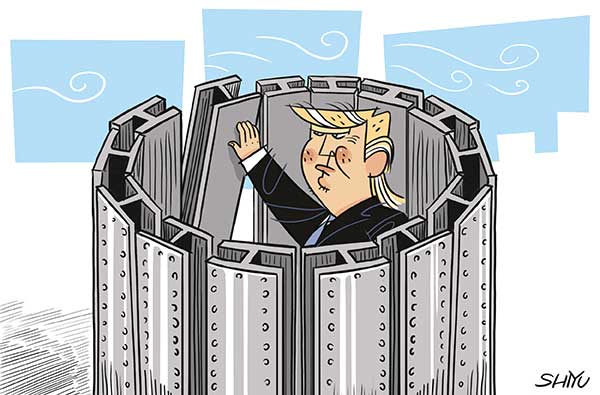
The signing of a memorandum to impose tariffs of up to $60 billion on Chinese imports and the demand that China reduce its trade surplus by $100 billion by US President Donald Trump is, to say the least, a reckless act. But it reflects the United States' long-term comprehensive strategy toward China.
The US aims to reshape its manufacturing industry and solve its domestic problems in the short term through trade, and diplomatic and military measures, in order to "make America great again". It also wants to interrupt China's industrial upgrading and prevent it from realizing the great rejuvenation of the Chinese nation.
First, by attempting to ignite a trade war, the US is testing the efficacy of its overall strategy vis-a-vis China. For example, the US has raised tariffs of Chinese products such as new generation information technology products; high-end machine tools and industrial robots; aerospace, ocean engineering, new energy, high-tech shipping and high-speed train equipment; agricultural machinery; new materials; biological medicines and high-performance medical equipment. As Robert Lighthizer said, these products are made by the major development industries listed in Made in China 2025 through which China aims to achieve independent research, development and application in two to three years.
Since it would go against US' interests if China becomes a leading global player in these fields by 2025, the Trump administration is making every effort to prevent China from achieving its goal.
Second, the US is adept at dealing with a trade war, especially because of its economic and/or diplomatic alliances with other economies. As the US imposes punitive tariffs on Chinese steel and aluminum products, it also requires such economies as Canada, Mexico and the European Union-which also are major steel and aluminum exporters-to impose trade sanctions on China in exchange for being exempted from the US' high tariffs.
The US supposes it can easily win a trade war because China cannot bear the economic loss. But the reality is different. China's overall exports of goods and services last year accounted for only 9.1 percent of its GDP, with its exports to the US dropping from 21.55 percent to 18.24 percent of its total export volume. In fact, economists estimate the punitive tariffs on Chinese imports will only reduce China's GDP growth from 6.9 percent to 6.8 percent. It is therefore clear that China's economy doesn't depend on the US' trade policy.
According to experts, international organizations and think tanks, China will suffer losses in a trade war, but it can expand trade with its other major trade partners such as the EU to reduce those losses. In fact, the US will be the bigger loser if a full-fledged trade war breaks out between the two countries.
The US is also aware of that. That's why it has imposed penalty tariffs on Chinese high-tech products, while ignoring the products manufactured by labor-intensive industries in China.
In the first two months of this year, the value of the yuan appreciated from 6.9 to 6.3 against the US dollar. But the exports of seven kinds of labor-intensive products grew 19.5 percent year-on-year, accounting for 20.2 percent of China's overall export volume. Since a 20 percent tariff on Chinese high-tech products can hardly offset the rapid increase in the export of labor-intensive products to the US, Trump's move will only make US citizens' life more difficult and, to a certain extent, neutralize the effects of his tax cut policy.
The recently concluded annual sessions of China's top legislature and top political advisory body decided to deepen reform, boost domestic consumption and solve the problem of secondary distribution of wealth, which will largely offset the negative impact of the US' protectionist moves. That's why Vice-Premier Liu He told the US treasury secretary during their phone conversation on Saturday that China is ready to defend its interests. This should force the US administration to think twice before launching an all-out trade war.
The author is a researcher at the Institute of American Studies, Chinese Academy of Social Sciences.