China 'moving forward' in technology research







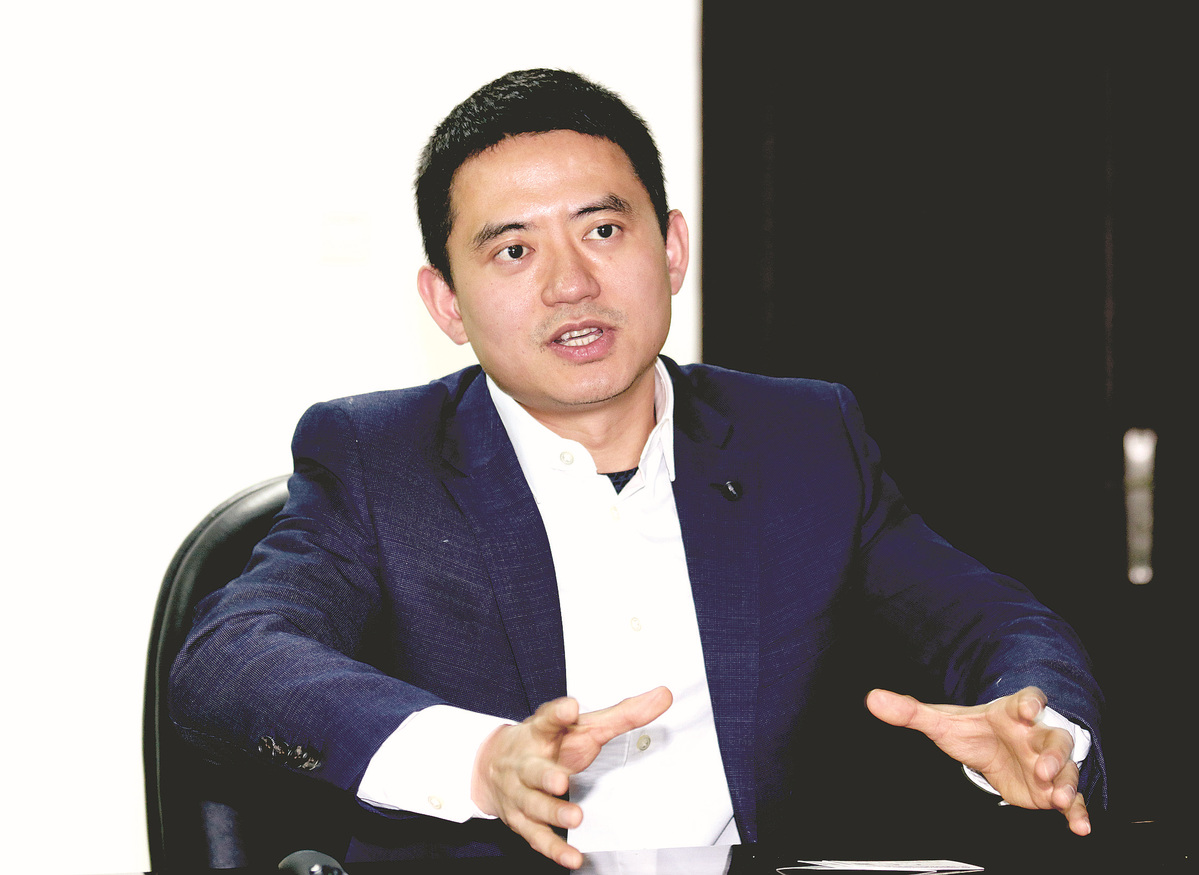
Dalian institute is seeking important breakthroughs that can benefit industry immediately, says deputy director
Cai Rui believes China is catching up with the West in the technology race.
The 41-year-old deputy director of the Dalian Institute of Chemical Physics, one of China's national-level science institutes, says the country is now making major progress.
"We are getting closer and closer to the US and countries like the UK. China is moving forward in all areas of research," he says.
A report published in December by the European Commission, "The 2017 EU Industrial R&D Investment Scoreboard", pointed to an 18.8 percent increase in research and development spending by some of China's top companies in 2016.
"We are seeing within our institutions an annual increase in our budget of about 10 percent. We also getting a lot of support from industry as well, since everyone has an interest in investing in technology," he says.
General Secretary Xi Jinping, in his report to the 19th National Congress of the Communist Party of China in October, set the objective for China to become a global technological leader by 2035.
With its Made in China 2025 strategy, China also has the more immediate goal of making breakthroughs in such areas as artificial intelligence and robotics.
Cai, speaking in a meeting room at the institute's Xinghai campus in Dalian, Liaoning province, says the goals have created a lot of energy, adding that turning them into reality is now part of a general national effort.
Cai says that when he returned from the United States in 2010 and "went to the city government and talked to them about supporting ideas, the response was often quite slow. Now they just come to us and ask for our ideas."
The Dalian Institute of Chemical Physics is the obvious place to go. It is by far the biggest research institute in Dalian and one of 104 national research institutes under the Chinese Academy of Sciences, the country's largest research and development institute.
The institute, which was established in 1949, has four campuses where 2,500 people work and study, including 14 members of the CAS and the Chinese Academy of Engineering; 213 professors; 437 associate professors; and around 600 students pursuing PhDs.
It attracts 1 billion yuan ($158.9 million; 129.7 million euros; £114.9 million) in research funding each year and has 10 international research centers on its campuses in which it collaborates with international partners.
Two of its most important collaborations are with British oil conglomerate BP and Saudi Arabian chemicals giant SABIC.
With BP, it set up an Energy Innovation Lab in 2008, and with SABIC, it founded the Research Center for Advanced Chemicals Production Technology in 2013.
"With BP, we have the longest history ... setting up an office here with just one person in 2000. They have about 10 people on campus right now. We have learned a lot from them, particularly in areas like protecting intellectual property and how to negotiate - areas in which scientists often don't have enough knowledge."
The SABIC research center is involved in research in a number of areas, including new, fossil and alternative energy as well as fine chemicals and new materials.
"SABIC is one of the largest chemical companies in the world. The collaboration fits in with the government's Belt and Road policies," adds Cai.
Cai says Chinese institutes such as the DICP are often more open to foreigners than their counterparts in the West, particularly in the US.
"There is research going on here related to national security activities and to spacecraft technology, yet we allow foreigners to join us here. We regard this as perfectly normal, but to work in such a national laboratory in the US, you would probably need a green card at least to do so," he says.
The institute is ranked first among CAS institutes for the number of patents it has granted over the past five years and third in terms of the number of academic publications it has published, after the Beijing-based Institute of Chemistry and the Shanghai Institute of Organic Chemistry.
Cai admits the institute's strength is in applied research, coming up with breakthroughs that can be of immediate benefit to industry.
"Our strength is in doing applied research for commercialization. Within the CAS system, we do have a lot of prestigious institutes working on fundamental or blue-sky research. If you go to Beijing to the Institute of Chemistry or the Institute of Physics, 95 percent of the people there will be working on fundamental research. There is a lot of support from government and also the CAS headquarters for this kind of research," he says.
"At the CPC's 19th National Congress last year Xi Jinping mentioned that fundamental research was the key to China achieving its national goals."
Cai, who was appointed deputy director of the institute last year, presents a youthful modern face for the DICP.
Fluent in English, he is not a native of Dalian but is from Zhenjiang, Jiangsu province.
He studied chemistry at Nanjing University and then moved to Liaoning to get his PhD in physical chemistry at the DICP.
However, he has experience in both Chinese and Western scientific academia after spending five years as a postdoctoral scholar at the University of California, Riverside, before returning to the DICP in 2010 as an associate professor.
Cai believes that Chinese academic institutions do not lag behind their Western counterparts in the quality of scientific education. One of the criticisms of the Chinese system is that the quality of teaching at PhD level in China is poorer and more limited and that the thinking is more rigid than at Western universities.
"I just don't think this is true," says Cai. "China is a big country, and we have many different universities. I think people here are often more diligent and devoted to their studies. Certainly that was my experience when I was at Riverside in California, which is a middle-ranking university in the US," says Cai.
"It does, however, depend on the institution. While in California I also spent some time at Caltech (the California Institute of Technology), which was a totally different story. Clearly at places like Harvard also, students work very hard."
A key effort of the institute is to address China's energy needs. One of the country's major problems is that it has to import most of its oil, much of which has to be shipped through the Strait of Malacca, the narrow shipping lane that connects the Pacific and Indian oceans.
Last year, the DICP put into operation the world's first plant capable of producing ethanol from coal. Launched in conjunction with Shaanxi Yanchang Petroleum Group in January last year, it has the capacity to produce 100,000 metric tons of anhydrous ethanol annually.
"We have to focus on coal in China because we don't have any choice," adds Cai. "We import 60 percent of our oil from overseas and last year probably 65 percent. If our oil supplies had been cut off, what can we do?"
The work of the institute is aligned with China's Energy Innovation Action Plan (2016-30) as well as President's Xi's call for an "energy revolution" in terms of consumption, production, technology, policy and international cooperation.
"Most of us are doing energy-related research. We are trying to develop technologies that are more efficient and produce less pollution. We also have a team working on fuel cells and battery technologies as well as new energy, solar energy and a broad range of other technologies," he says.
Cai says it is wrong to see Northeast China, built on traditional heavy industries, as an area of inevitable decline, since these industries can be modernized and play a major role in the country's modernization.
"These industries are very important and they are the base of this area. We have a lot of existing infrastructure, let alone a lot of workers in these industries. The challenge is to remodel this whole sector and bring in new industries. This really should be the blueprint for the development of Northeast China," he says.
Contact the writers at andrewmoody@chinadaily.com.cn


- US defense policy act fuels Taiwan tensions
- New Year holiday to bring peak in travel
- China's top 10 sci-tech news events unveiled
- Over 700 generative AI large model products complete filing in China
- Beijing accuses Lai of 'kowtowing' to US
- Hong Kong's global standing boosted with increasing presence of intl organizations: justice secretary