



Pony Ma shares his vision for business







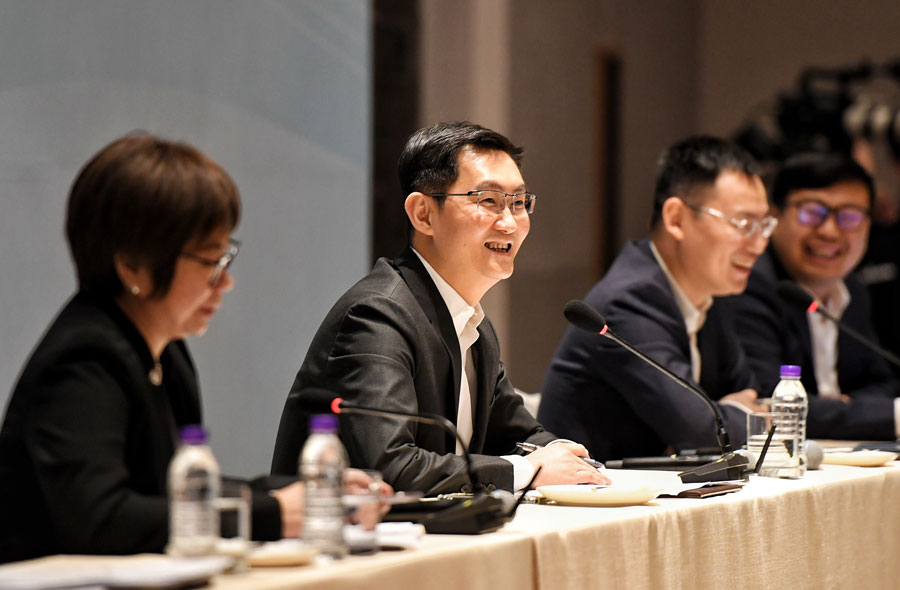
NPC deputy believes digital economy could become the engine driving China's next phase of development, affecting many sectors
There may not be a phrase to properly encompass all the businesses operating as part of Tencent Holdings Ltd.
Similarly, one can hardly live in China without using Tencent's services - be it messaging, paying for coffee, hailing taxis, listening to music or watching videos - at least once a day.
Such rapid progress is even beyond the imagination of Pony Ma Huateng, a deputy to the 13th National People's Congress, and founder and chairman of the firm that stands among the world's top 10 most valuable companies with a market cap of half a trillion US dollars.
Two decades ago, Shenzhen-based Tencent started out with messenger service provider QQ, but its best-known product today is WeChat, whose user number has just surpassed 1 billion globally.
Unlike most messenger apps, WeChat has become far more than a mere communications tool. It now acts as a "portal" connecting thousands of products that deal with wealth management, civic affairs and an array of online-to-offline demands.
And it doesn't stop there. Tencent owns Clash of Clans maker Supercell and the smash hit King of Glory, and still makes the majority of its profit from gaming.
It is also a prolific buyer in other sectors, aggressively advancing, for example, into the retail front, investing in Carrefour SA's China unit among other bids to revamp the country's old-school retailing using data-backed technologies.
During a two-hour media conference in Beijing, Ma shared his insights about opportunities in China and around the globe and the development strategies of Tencent's multiple business lines, as well as the conglomerate's investment logic.
What opportunities do you think China's reform and opening-up have brought to the private economy?
I grew up in Shenzhen, where Tencent was set up and developed. I thus had the opportunity to witness the entire process of reform and opening-up. It's indeed a miracle that the country can lift some 700 million people out of poverty in just four decades.
Thanks to the opening-up policy, companies are achieving high-quality growth. I hope that China's economy will maintain steady growth in the long term and the country will pay enough attention to the development of the digital economy, which could become the engine driving the next phase of growth.
How can internet companies participate in the government's digitization reform?
Last year, we piloted a program allowing residents in Guangzhou to link their identity cards to the WeChat messaging app. Currently, we are conducting a program with the Guangdong provincial government in building a digitalized information center, which enables private and State-owned companies to take part in the authorities' digitalization process. Such a public-private partnership can be used to offer the government a full set of digital solutions in the future.
Tencent has done many acquisitions and investments. What is your investment logic?
First, we invest in content-based industries. We are very willing to invest in good IP (intellectual property), as Tencent is at the forefront of cultural and content-based sectors. Second, we invest in companies that are in line with our development strategies. We would lean more towards backing our partners strategically instead of holding controlling shares directly. Since we don't necessarily expand our business to each and every sector, we support and empower our partners to success. This is the ecosystem we want to create.
What is Tencent's strategic layout in artificial intelligence, notably in the medical sector?
Many of our offerings, including precise advertising and personalized content recommendations, are using AI. In the future, AI can be simulated as a brain to process massive data at lower costs and find a learning pattern on its own. This is a brain that will never get tired.
On the medical front, we don't have many advantages in this industry but we already have some investments. First, we developed an AI medical image product called Miying that can be used to help screen some cancers. Second, we are offering solutions to develop intelligent hospitals.
Simply put, a patient can conduct the whole process of medical treatment, including making an appointment, payment and receiving medicine, all through our mini programs. Everyone can do it by simply scanning a QR code - the popularity of WeChat in China will lower that threshold.
We focus on technologies such as face recognition, which will enhance capabilities of hospitals in many aspects. In fact, we do these businesses more through cooperation with hospitals rather than doing it on our own.
How do you view the industrial internet?
The industrial internet we often talk about is still in the early phase where we only need to solve problems among producers, consumers and demanders. However, intelligent manufacturing involves coordination between upstream and downstream manufacturers, and within manufacturing itself. How we can use technologies including AI to lower cost of modules and improve efficiencies is also an important part of intelligent manufacturing.
One latest instance is that we've proposed AI into the manufacturing process of Foxconn to help high-definition cameras adapt to changes of modules, as some modules may wear out and will become inaccurate as time passes by. If we can introduce such advanced technologies to the manufacturing process, it would be a big step forward. We are also expected to cooperate with specific industries to better comprehend their demands and bottlenecks.
What is Tencent's strategy in the field of retail?
In the past month, Tencent has just set up a special unit, which combines all resources across business sectors, in order to serve the surging needs for smart retail ... We, however, have no plan to start our own retail business, but rather to support our retail partners by deploying data techniques.
To achieve that, we plan to develop apps and cloud computing to bridge between retailers and consumers. Many retailers have come to us and showed their interest for further cooperation. We think AI retail is promising as it gives technical support for an online-offline integrated user experience. For instance, a lot of retail stores embrace mobile payment and a digitalized product supply chain. No matter how popular online shopping is, offline shopping will never be replaced as customers need some real-life experience. Our partners get to keep all data to their own. That is what we call "decentralized" approach in our retail endeavors.
How do you prevent teenagers from becoming addicted to gaming?
Our gaming business group has set up a platform from which parents can get login and access information of their children's gaming account. We have been doing that for a year and received very positive feedbacks.
In addition to the platform, we also have a protection system on our hit title King of Glory. It guarantees that children under 12 can only play one hour per day and have no access to the game after 9 pm.
Simply banning games can never be an effective solution for addiction prevention. A better way is to facilitate communications between parents and children through their interactions in game.
What is the value of "WeChat Red Packet", and how is WeChat Pay developed overseas?
Giving money in a red packet during Spring Festival is a cultural ritual in China. We want to digitalize that process so we started a trial program in our internal network. It was popular immediately, so we decided to promote it to the public. Now it has over 800 million active users per month, which is quite sizable.
The popularity of "Red Packet" facilitates the development of mobile payment. More people started to link bank cards to their WeChat account so that they can transfer money or make a payment. Going forward, it can be meaningful for business expansion from online to offline in fields like bike sharing and food delivering.
WeChat Pay is also working on its overseas expansion through cooperation with third party payment service providers. We aim at offering a more convenient shopping experience for Chinese people when they travel abroad.
However, one big challenge is to apply for certain licenses by local regulators. Also, we look forward to more technical innovation and better infrastructure in local markets.
Why is Tencent actively promoting cultural development?
Chinese culture has thousands of years' history abundant with many great legends. With good screenwriting and storytelling, those legends can be presented through various mediums like film and TV. I also believe with good productions, those legends won't lose ground to Hollywood franchises.
We've undervalued those legends in the past - that is why we emphasize their development right now. Our investment will focus on those of highest possibility to succeed. Now domestic films are gradually dominating the market and they have rather high production value. I believe there's great potentiality to explore in our traditional culture.
What's your take on blockchain?
Blockchain is a good technology but it really depends on how one utilizes it. There are still a lot of risks in the virtual currency ICO and Tencent has no plan to step into that business. However, we are exploring other fields that can adopt the blockchain technologies into verification of receipts and documents. The technique guarantees that there's neither duplication nor change on the original version.
CV
Name: Ma Huateng
Age: 46
Nationality: Chinese
Education:
Bachelor's degree in computer sciences from Shenzhen University
Career:
1998-present: founder, chairman of Tencent Holdings Ltd


- China releases reports on budgets, national economic and social development plans
- China issues guidelines to enhance professional social work workforce
- China-Vietnam friendship exchange to strengthen bonds, security, ministry says
- Beyond the racetrack: F1 Chinese Grand Prix showcases Shanghai culture
- AWE 2026: A glance at tech for the future
- China has broken disability-poverty link, Rome seminar hears





