


Artist brings Lunar New Year heritage to life on stamps








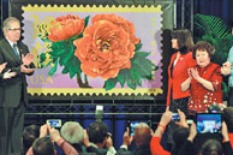
You may not be familiar with the name of the Chinese-American artist Kam Mak but you have probably seen his latest work - The Year of the Dog stamp sheetlet, which highlights and refreshes a lot of fond memories about Chinese Lunar New Year celebrations.
Mak, who moved to New York with his parents from Hong Kong when he was 10 years old, has been commissioned by the US Postal Services (USPS) to design the second set of Celebrating Chinese New Year stamp series since 2008.
The USPS' first set of 12 zodiac stamps was designed by Chinese-Hawaiian designer Clarence Lee and first introduced in 1993.
HIGHLIGHT CUSTOMS &TRADITION OF LUNAR NEW YEAR CELEBRATION
"I hope I showcase our culture, customs, and traditions well," Mak said in a recent interview with Xinhua. "(What) we want to really highlight is how beautiful our tradition is and the custom ... especially to people who don't really know about the Lunar New Year."
The Year of the Dog stamp, released by USPS early last month, continues Mak's concept of using the Lunar New Year symbols to highlight the customs and tradition of the Lunar New Year celebration.
The 56-year-old artist said he specifically chose three stalks of lucky bamboo to symbolize three types of good fortune: fu (happiness), lu (wealth), and shou (long life).
"The bamboo stalks are artistically curving and twisting, which symbolizes life's paths. Though the journey may be fraught with twists and turns, the budding leaves on top are always optimistically facing upward to heaven."
"The red ribbon of fate floats throughout the middle," he said, "signifying joy and rebirth, entwining us together in peace and cooperation while anchoring us firmly to the earth."
On the right side of the design is a red square positioned on one point (diamond shape) with additional script characters fu written on red paper, he said. The color red has been used to symbolize luck in Chinese culture. The word fu stands for good fortune or happiness.
"Recalling my childhood in Hong Kong, my grandma would pay someone to write Fu and other couplets on red paper by hand, and she would post them around the house just before the New Year," he said.
The stamp also incorporates two elements from the previous series of Lunar New Year stamps - Lee's intricate cut-paper design of a dog which Mak said had gained a great following.
"So I think this is a beautiful concept, incorporating the traditions, the customs and still have the animal there," he said.
SELECTION OF SYMBOLS A MAJOR CHALLENGE
Mak, who now teaches painting at New York's Fashion Institute of Technology, said the selection and presentation of the symbols were a major challenge during the design process.
"The biggest challenge of stamp designing is how to convey your ideas in a space of a square inch," he said.
The zodiac series require the designer not only to think about the composition, but also to understand Chinese culture. The first draft he presented to USPS made officials shake their heads.
"No, no. The illustration will lose too many details when printed on stamps," they told him. Mak started to think about how to simplify the illustration. He had also to make his design different from the previous set.
"The stamps designed by Clarence focus on the images of the zodiac animals. I wanted to show in mine the variety of the Chinese culture," said Mak. "So I decided to not put the spotlight on the animals but on other cultural symbols such as peonies, daffodils, oranges, and red envelopes. But not everyone likes the idea."
Mak had to do presentations again and again to explain the meaning of the symbols to the USPS officials and other people who viewed the drafts until they were approved.
In 2010, on the stamp for the Year of the Tiger, Mak drew five white daffodil flowers. Some people immediately opposed it saying that white is not a blessed color in the Chinese culture, and the white flowers may affect the sales of the stamp, he said.
It was only after he explained that, with the yellow stamens and the white petals, the daffodil flower is also called jin zhan yin tai - gold wine cup on a silver plate - in Chinese, and is believed to bring good fortune, did USPS accept the idea.
"In China, everyone knows the origins and meanings of the cultural symbols," said Mak. "But in the US even Chinese Americans born here may not know much. So I have to explain everything to the audience. After listening to my speech, many people said they like the stamps very much and are enchanted by the Chinese culture."
LUNAR NEW YEAR STAMP MEANS A LOT FOR CHINESE COMMUNITY
The issuance of Chinese zodiac stamps by the USPS is the result of a longtime effort by Chinese American communities in the United States.
The Organization of Chinese Americans (now OCA Asian Pacific American Advocates), a major advocacy organization in the Asian community, started to push for the stamps in 1988 under the suggestion of a member in the US state of Georgia named Jean Chen who is also a stamp collector.
More importantly, they hoped to bring to light how Chinese immigrant workers played a big blood-and-sweat role in building the transcontinental railroad essential for the US economy. They decided on the Lunar New Year theme.
"This lunar year stamp series has a different meaning for us. It's incredible to see my culture being displayed on a stamp in America," Mak said. "It's never too late."
Recognition of Chinese culture in America goes beyond stamps. New York Mayor Bill de Blasio announced the Chinese New Year a public school holiday in 2016.
Mak said it was a thrill for the Chinese American community. Many kids including him back in the days had to skip school for the new year. "That was wonderful. It's about time," he said.
On Feb 24, Mak led a stamp-making workshop at a special program held by the Metropolitan Museum of Art (MET) to celebrate the Chinese Lunar New Year. This is the ninth consecutive year for the museum to hold celebratory events for the festival.
"I'm so happy to see all that stuff going on, and we are promoting our culture," Mak said. "This country has many different cultures from different countries and we should all embrace that multiculturalism. Because that's what makes America great."
Mak thinks the holidays are a great opportunity to ingrain customs and cultures into the next generation, like what they eat and do around the Chinese New Year. "I think it is through the holidays that I find is a wonderful way to share the customs."
"One of my students, she's born here she couldn't even speak Chinese but she's performing a lion dance at the MET," said Mak, who goes to inner city schools to read his book My Chinatown: One Year in Poem.