



Tax reduction could boost newborn population







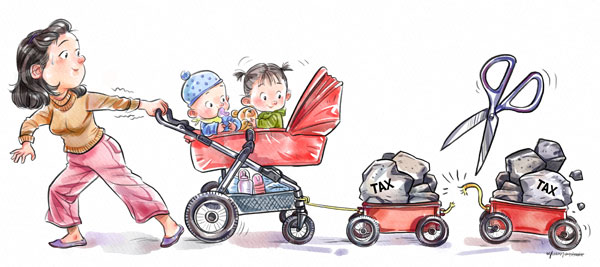
"We will raise the personal income tax threshold and create expense deductions for items such as children's education and treatment for serious diseases, appropriately lightening burdens, and encouraging our people to increase their incomes and achieve prosperity through hard work."
This paragraph in the Government Work Report which Premier Li Keqiang presented on Monday shows the government is about to take one of the most important steps that will touch people's lives and livelihoods.
The comprehensive two-child policy which allows all couples to have two children is a big change over the past five years, as pointed out by Li in the report.
However, experiences show that only easing the family planning policy will not increase China's birth rate. Corresponding measures, such as implementing favorable social and economic policies to promote childbearing, also need to be taken to increase the birth rate and build a sustainable demographic future. Hopefully, the tax reduction, which aims to improve people's livelihoods, will be the beginning of more policies that will help create a parent-friendly environment by cutting the costs of raising children.
China's newborn population in 2017 was 17.23 million, about 630,000 less than in 2016, according to National Bureau of Statistics data. But the figure was 790,000 more than the average annual newborn population before the family planning policy was revised during the 12th Five Year Plan (2011-15) period, and implemented from Jan 1, 2016, allowing all couples to have two children. It was also the second-highest since 2000.
The population of newborn second children last year was 8.83 million, up 1.62 million over 2016 and accounting for more than 51.2 percent of the overall newborn population.
Although the new family planning policy achieved initial success last year, the population of newborn first children declined. The population of newborn first children last year was 7.24 million, that is, 2.49 million less than in 2016, and the birth rate was only 1.243 percent, also lower than in 2016.
Many experts predicted there would be a baby boom between 2016 and 2018 following the implementation of the new family planning policy. But the NBS data are not optimistic. In 2016 the overall newborn population was only 1.31 million more than in 2015, while the newborn second child population increased by only 570,000. In fact, both the birth rate and newborn population declined last year, reflecting the great challenge posed to China's demographics by the low fertility rate.
Low fertility rate seems to have become the new normal, and the long-term low birth rate could be a major demographic risk that China faces. The high cost of bringing up a child has made many childbearing-age couples wary of having a second child, with some deciding to not have even one child. Many couples are also worried about not being able to give enough time to their children because of their busy everyday schedule.
However, there are certain things we could do to increase the low birth rate. To encourage couples to have two children and increase the birth rate, the authorities need to improve public services related to childbearing and education. This will help couples to overcome their problems and fears of bringing up children.
The easing of fiscal and taxation policies, which will reduce childbearing costs, could also encourage couples to have two children. And the move to increase the threshold of the individual income tax, highlighted in the Government Work Report, is a right step in this direction. But more needs to be done. For instance, the fiscal policy should be designed to make income distribution fairer, in order to encourage all couples to have two children.
Moreover, the authorities should calculate the average cost of raising a second child and help couples to reduce their economic burden, by giving subsidies to parents for having a second child. Many countries grant economic subsidies or tax exemptions to couples with newborns, so that they can have more children. For instance, the Singaporean government gives subsidy to couples with newborns, and in Canada, children get "milk subsidy" according to their age. The Japanese government gives childbirth subsidy to every couple with a newborn, and the Russian government has established a "mother welfare fund" project for families that have more than one child. China could learn from the experiences of such countries to encourage couples to have two children.
Some experts suggest that the government further reduce the individual income tax for families with two children, so as to ease their economic burden and prompt other couples to have two children.
The authorities should also increase investment in public services and facilities related to childcare and education, especially crèches, nurseries and preschools. In particular, they should promote the construction and development of public childcare centers, to reduce the economic burden of families with infants and toddlers.
Parents with two children should be the norm in Chinese society, but for that we need to build a childbearing-friendly social atmosphere and policy environment.
The author is a professor at the Population Research Institute of Peking University.





