Quality of GDP statistics improving







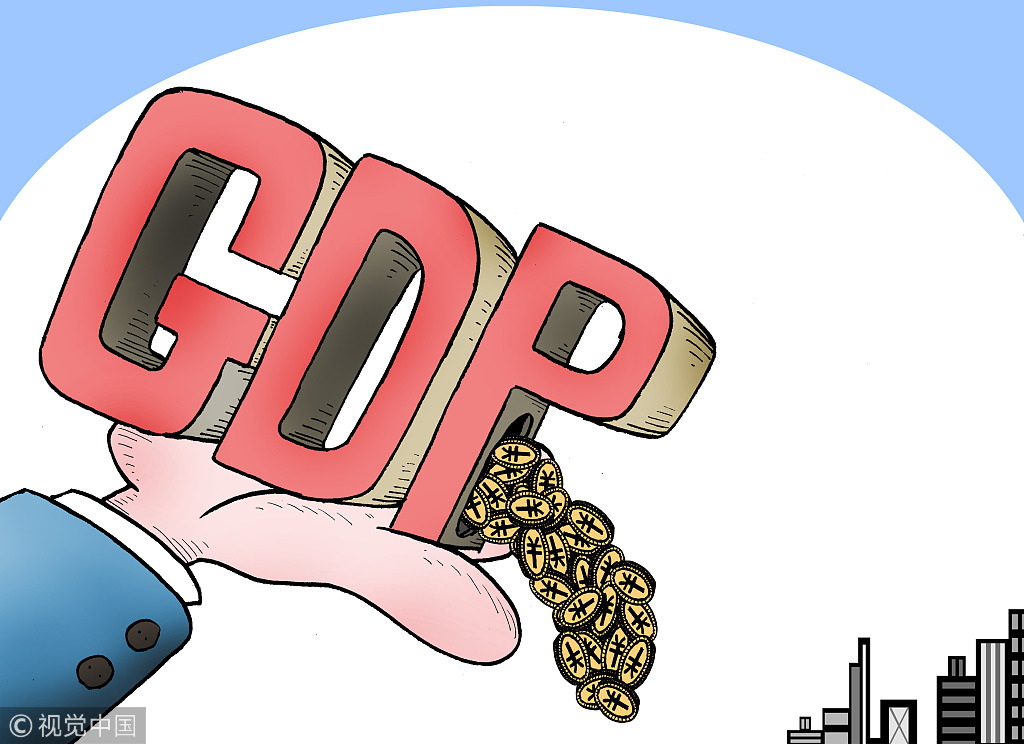
Figures released by the National Bureau of Statistics show that China's GDP grew by 6.9 percent in real terms to reach 82.7 trillion yuan (nearly $13 trillion) last year. Between 2010 and 2017, the size of China's nominal GDP has increased from 39 percent to 63 percent of the United States' GDP, and it will overtake the United States to become the largest economy by 2025 even if its speed of catching up were to slow a bit.
However, the recent revising of their GDP figures by several provinces has raised serious doubts about China's GDP figures. Following Liaoning province, which trimmed 23.3 percent of its GDP in early 2017, Tianjin and the Inner Mongolia autonomous region drastically cut their GDP figures at the end of the year. For example, Tianjin reduced by half the GDP produced in the Binhai New Area, the city's major industrial district.
It has been known to researchers and policymakers that local economic data are subject to the interference of local governments. However, the direction of error is uncertain. In most places, GDP figures are likely to be inflated because better economic performance helps the promotion of local officials. But in some places, notably fast-growing cities, GDP could be underreported because local enterprises may want to avoid paying too much tax.
The figures of the national GDP, however, are not obtained by just aggregating regional reports. The National Bureau of Statistics has its own direct reporting systems. Its enterprise survey obtains production data from companies that report their figures through an electronic reporting system; its household surveys obtain income and expenditure data from sample families that keep diaries about their income and expenditures. Those surveys should return more accurate data to the National Bureau of Statistics. Comparing data released by the NBS's household survey and data obtained from the China Family Panel Studies, an independent survey carried out by Peking University, one finds that they provide similar figures for household income.
However, because a large share of investment is carried out by local governments, the National Bureau of Statistics relies on local governments' reports to come up with its investment figures. Its staff has to do some "guesstimates" to figure out the numbers. And the results may go in either direction.
When the economy is booming, local governments invest heavily in infrastructure and the real estate sector. The central government, though, is often in a different mood-it worries about overheating and often asks local governments to slow down investment. This gives local officials the incentive to underreport their investment figures, and vice versa when the economy slows down. The result is that the national GDP tends to be underreported in fast-growing periods and overreported in periods of slower growth. However, this is not the whole story about the real size of China's GDP; most economists believe that it is larger than the official figures.
One source of underestimation is underreported consumption from housing. Housing is a durable good that produces a stream of welfare to its owner. In the national account, this is captured by so-called "inputted rents"-artificial rents paid by the owner as if he or she were a tenant. The National Bureau of Statistics does record inputted rents, but those rents are calculated on the basis of operational costs, not the market prices that advanced economies use in the calculation. China's GDP would be increased substantially if market prices were used for the calculation. As a comparison, inputted rents account for 6.8 percent of the US' GDP, but less than 2 percent in China.
Consumption can also be underreported by China's accounting rule governing enterprise expenditures. Currently, all the spending carried out by enterprises is counted as material inputs which are subtracted when value-added is calculated and thus are not part of GDP. However, a large proportion of enterprise spending is consumption expenditure on banquets, gifts and entertainment. Many private entrepreneurs budget their own consumption, including personal spending on cars, travel, and sometimes houses into their companies.
According to two economists, Zhang Jun and Zhu Tian, the share of consumption in China's GDP would increase by 10 percentage points if inputted rents and enterprise consumption were correctly measured.
Another source of underestimation is unaccounted economic activities, particularly in the service sector where cash transactions are common. The National Bureau of Statistics conducts a national economic census every five years and each time it revises up China's GDP figures, mostly because of bringing back underreports in the service sector.
Following the practice of the US, the National Bureau of Statistics has begun to count R&D expenditures as part of GDP in its 2017 GDP release. This move has increased the size of China's GDP by about 2 percent. The National Bureau of Statistics also plans to adopt market prices as the cost basis for inputted rents. This will further revise up the size of China's GDP.
To sum up, it is safe to say that the growth rate of China's GDP is more or less correct when it is averaged out in a complete business cycle. In between, judgments are needed to come up with the correct yearly growth rates. With continuous improvements, the National Bureau of Statistics will definitely produce more accurate figures in the future. One immediate and major improvement is that starting from this year, the National Bureau of Statistics will prepare to directly produce regional GDP figures for provinces in 2019. This will greatly reduce the errors in China's GDP statistics.
The author is Cheung-Kong Scholar and Boya Chair professor, and the dean of the National School of Development, Peking University.