THE DIGITAL JIGSAW







Innovators, from finance to logistics, are harnessing AI and big data to transform the way we live
Isabella Jia is making preparations for her lunar new year trip. The post-90s fashion blogger is no stranger to travel — but taking a vacation with her 8-month-old daughter, parents and parents-in-law will be a new experience.
To her surprise, though, when Jia started booking hotels and flights online, she found websites behaving like private butlers with inside knowledge of her needs.
“It was amazing. It really saved me time,” said Jia.
Obviously, the websites could not read her mind, but the effective use of big data allows them to offer customized choices by tapping information about what she buys online or pays for via mobile payments, what she reads and watches online every day, and where she goes using car-sharing apps.
“We are witnessing a very important turning point for the world,” said Eric Thain, managing director Shanghai and head of digital innovation, China, at digital communication agency Lewis Global Communications, and the president of the Artificial Intelligence Society of Hong Kong.
“With AI in the picture, it’s regularly referred to as the fourth industrial revolution, and rightly so. There is no doubt at all that it is transforming the global economy.”
The potential of innovation to drive growth is front and center in Hong Kong as the key theme of the annual Asian Financial Forum on Jan 15-16. The theme of this year’s gathering of thousands of regulators, experts and key global opinion leaders is Steering Growth and Pioneering Innovation: Asia and Beyond.
“Technology innovation is no longer the exclusive domain of ‘technology’ companies, if it ever was, with all businesses and sectors needing to embrace technology and innovation to be able to continue to compete,” said Adrian Lawrence, Asia-Pacific chair of law firm Baker McKenzie’s technology, media and communications group.
Mayi.com, a Chinese online short-term accommodation provider similar to Airbnb, is one site that surprised Jia, the backpacker, with its seemingly precisely tailored recommendations and promotions.
Shen Zhiqiang, Mayi’s CEO, told China Daily that his site is using big data more and more.
“For example, we collect information from dialogues between hosts and guests, analyze the data and design a host assistant robot that can help individual hosts to answer current and new guests’ queries in a 24-hour, seven-day roster,” Shen said.
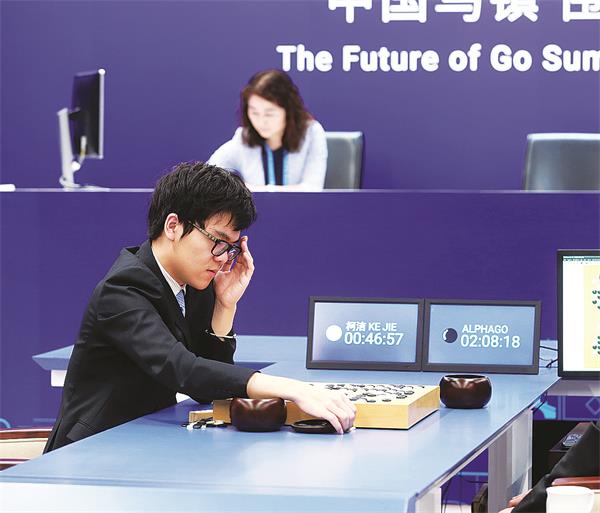
Among all the tech innovations driving the world economy, AI and big data might be the big stars, particularly after the high-profile victory in the game of Go by Google’s AI-driven computer AlphaGo. Ke Jie, the best human player of the game, shed tears after his loss. The machine’s victory was so overwhelming that Ke said it played “like God”.
The way experts see it, however, the changes to the world economy brought about by AI and big data are subtle.
“The best tech has a character of being effortless,” said Thain of Lewis Communications. “When the (mobile) telephone (first) came out, it was big, clunky and expensive. As it got more mainstream and affordable, it became effortless in becoming part of our lives. AI is evolving in a way like that. It’s actually already in everyone’s life in some form or other but most people have not been aware of that.”
A telling example of how AI is part of the economy is the fact that more than 6 billion personalized shopping pages were generated during Taobao’s Double 11 sales event on Nov 11. Each one of these predicted consumer interest based on users’ behavior data.
At the close of that day, the Chinese e-commerce company made headlines by smashing the previous year’s 24-hour Singles Day sales, notching up total sales of 168 billion yuan ($25.8 billion). At its peak, 325,000 orders were being made per second.
It is expected that big data technology will boost global GDP by more than 2 percent year-on-year through 2020. The global market for AI software services and related hardware is forecast to reach more than $47 billion by 2020, up from an estimated $8 billion in 2016, according to research firm IDC.
China, the world’s second-largest economy, has shown its ambitions of being a global leader in AI.
In 2016, China’s core industry in the big data sector attained a market value of 16.8 billion yuan, a 45 percent increase from 2015, according to a recent survey by the China Academy of Information and Communications Technology. The country is expected to grow big data industry sales to 1 trillion yuan by 2020.
“The scale of China and data makes it easier to do things quickly. AI algorithms need to be trained by data. That’s why it’s called machine learning. This is a core part of the AI machine learning. With a 1.4 billion population, you can train it quickly. It is not comparable,” said Thain.
With the rise of big data and AI, other technology innovations have been applied more in traditional business and finance as they complement each other. One will not be able to function that well without the other.
Simon Loong, founder and CEO of WeLab, a fintech company that creates seamless mobile lending experiences with competitive interest rates, said: “We developed our own software designed to enable rapid credit assessments without compromising on accurate pricing. Making use of information provided by the customer as well as unstructured mobile big data, we efficiently make credit decisions for individual borrowers within seconds.
“Fintech, as compared to traditional finance, has an edge to use big data to screen (out) bad apples,” Loong said.
Fintech has smashed the confines of traditional financing. Peer-to-peer (P2P) lending — one of the hottest areas in fintech —is competitive on pricing, accessible and opening up credit to all kinds of people, which is fundamentally changing the economy.
“It is about decentralization and disintermediation,” said David Matthieu, CEO of Daxue Consulting, a Beijing-based intelligence provider. “Players lending money to each other through P2P without the involvement of banks.”
He said that small and medium-sized enterprises, in particular, could bypass traditional banks and reap the benefits. “The next stage of economic growth and more employment will not come from State-owned enterprises but these SMEs.”
FinUp Group, which focuses on big data processing and fintech research and development, is one of the top fintech companies in China. It currently owns several Internet-based businesses, such as Iqianjin, an online P2P lending platform with 7.1 million registered accounts, and Money Station, an online credit assessment service app for consumers.
Yang Fan, cofounder of FinUp Group, said: “Fintech has largely boosted the efficiency of traditional financial services and lowered the barrier. It helps push forward the concept of financial inclusion.”
Traditional banks, too, are dipping their toes into innovative areas and starting to shift their mind-set.
“The Open Vault at Oversea-Chinese Banking Corporation was launched with the aim of opening the bank up to external innovative ideas and to scout for new technologies,” said Altona Widjaja, vice-president of fintech and innovation at the Singapore-based bank.
“We aim to learn from running smart and rapid experiments by testing these technologies and solutions in a secure space before bringing solutions quickly to the market.”
Since launching The Open Vault, the bank has partnered with 25 fintech startups to pilot new solutions in wealth management, virtual customer assistance, transaction monitoring, business banking, consumer marketing and life insurance.
“We plan to commercially adopt these solutions if the pilot tests are successful,” Widjaja said.
While the wheel of innovation is rolling fast, not all of the news is exciting. It is widely accepted that the technology revolution will disrupt the labor market by eliminating low-qualified jobs.
“It’s already affecting finance: Traders are being replaced by one trader managing a lot of algorithms in AI. This will be a big issue in the coming decade for a lot of countries — people who are not able to train themselves and adapt to new skills will lose their jobs,” said Matthieu at Daxue Consulting.
Another source of concern over tech innovation is the fluctuation of cryptocurrencies.
The value of bitcoin, for example, has multiplied by more than 12 times since January last year and remains prone to extreme volatility. In early December, it nearly doubled in value from $10,240 to almost $20,000, before falling 30 percent and then climbing back to around $16,000.
“Bitcoin and other cryptocurrencies are underpinned by what can largely be described as a fear of missing out in the fintech sector, and it may lead to the formation of bubbles. A lot of people actually have no idea what bitcoin is and are just rushing to invest in the ‘next big thing’,” said Douglas Streeter Rolph, a senior lecturer at Nanyang Technological University’s Nanyang Business School, in Singapore, and an adviser to private investment firm SoHo Capital.
“Any fallout from the bursting of the bitcoin bubble is likely to have negative ramifications for the wider economy, which could also lead the industry to become more cautious with respect to adopting new technologies, ultimately slowing its development.”
Indeed, regulation might be needed to guide innovation and counter the risks it poses to global economic development and the financial system.
“In terms of the regulatory perspective on managing the risks tied to digital currencies, the severity of responses varies widely, with some (territories) such as the Isle of Man embracing cryptocurrencies and building infrastructure to promote the adoption, and other (countries) such as China banning cryptocurrency exchanges and ICOs (initial coin offerings),” said Hugo Cheng, a consultant at Quinlan & Associates, a strategy consulting firm specializing in financial services.
“Most countries, including (in) the European Union, are currently considering ways to regulate the cryptocurrency industry, such as through enforcing an onboarding process for exchanges and wallets to avoid anonymity, and requiring individuals to disclose their cryptocurrency holdings.”
Something similar is happening with AI. Few places in the world have any rules on the use of AI.
The European Parliament last year drafted a resolution to regulate the development of AI and robotics across the EU and there have been white papers proposed in the US, but there is little else out there beyond those nascent efforts.
Looking ahead, however, there is widespread optimism that innovation will continue to fuel global economic growth.
“That does not mean that there will not be winners and losers in that process,” said Lawrence at Baker McKenzie.
“The key question for individual companies and economies is whether there is a true focus on innovation to determine new and more efficient ways of addressing markets, or whether companies and economies are simply seeking to protect the status quo in terms of exist