Arsenic and old nails







Research endeavor
Starting in early 2015, students from RISE have been going back and forth between Beijing and Pingyao working on ways to reduce the arsenic level in the local drinking water.
To come up with a low-cost arsenic removal technique, Kate Smith, an Australian PhD candidate at Tsinghua's School of Environment, spent days experimenting with different filters.
In total, she and her colleagues tested seven versions of sand-iron filters trying to identify which was the cheapest and most effective at removing arsenic.
"We thought that we were building a filter that was really good," says Smith. "But it didn't work."
"The best results were from a filter with nails in the sand which we didn't expect," she says.
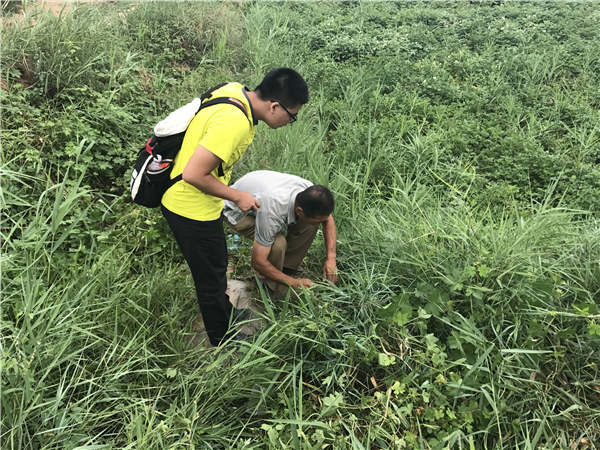
Last summer, if you happened to visit Liangjiabu, you would have probably encountered the 13 students squatting in the sun cleaning the simple water purifiers, which are essentially buckets containing different layers of sand and rocks with five kilograms of iron nails on the top.
Rust from the iron adsorbs the arsenic and when the arsenic sticks to the rust, it is removed from the water, says Smith.
But good as that sounds, while removing the arsenic, the filter also produces rust, which directly affects the water quality, so they had to add another bucket to filter out the rust.
"Solving problems makes new problems," she says. "And you have to make the water purification equipment accessible both in terms of price and maintenance."
In the first five months of the experiment, they successfully reduced the arsenic to below 50 micrograms per liter at the cost of 136 yuan ($22) per filter.
The results were later turned into a research paper published by Chemosphere, a peer-reviewed international scientific journal.
"Our aim was always to find where there's a problem and provide a solution," says Smith. "We've had a lot of results, so I thought we should work it into a paper, as that might help others."
Altogether the group has installed about 70 filters, directly benefiting over 280 people in the area.
Liang has been assisting with the program since its beginning. He says the program solved a very practical issue for villagers.
"For poorer people, the filter offers them access to better drinking water," he says.
On the other hand, the project also brought attention and spread awareness of water safety among villagers. In the past years, Liang has been seeing an increasing number of households buy water purifiers including commercial ones to clean their drinking water.
"Arsenic is not something that you can see, smell or taste. Only if someone tells you it's there, (then) can you know it's there," says Smith.
Li Zhenyu, an associate professor at School of Environment of Tsinghua University, appreciates the efforts taken by RISE.
"The research program, participated in by both international and domestic students, focuses on improving the living standard of the rural residents," says Li. "The topic, the research methods they employed and their aspirations should be recognized."
Li also suggests RISE should continue standardizing the arsenic removal project and work on areas including solid waste treatment so that the concentrated arsenic won't cause secondary pollution.
This year, a new central water supply project covering three local towns and 56 villages including Liangjiabu will be constructed, according to Li Ansheng, a local governmental official in Pingyao.
The project, which is scheduled to start in March, is expected to benefit nearly 80,000 local people and fundamentally solve the arsenic contamination issue.