



Unnecessary US fuss about China's rising consumption







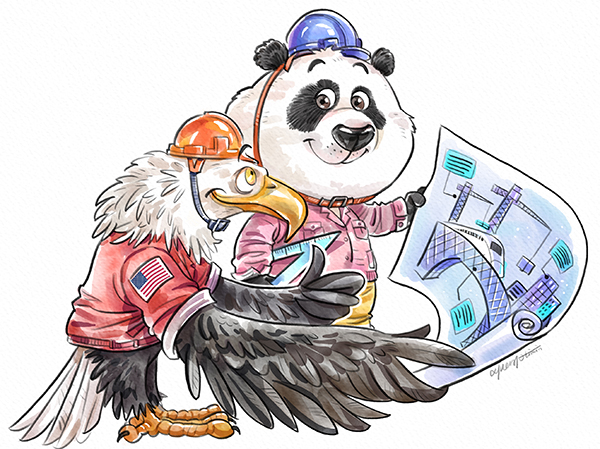
The media have made quite a fuss about a recent forecast that retail sales in China are expected to equal or exceed those in the United States in 2018. "China's retail sales are on track to hit just over $5.8 trillion," The Washington Post said in a report published on Jan 12, citing data from Mizuho, a Japanese bank.
Forbes, however, said in a post on its website on Jan 26: "China's 'game changing' retail sales should be greeted with skepticism."
The credibility of Mizuho's data aside is another matter. But of real importance is what China would do when its consumption market overtakes that of the US? Or more bluntly, what would China do when it posts significant deficits in trade?
For the first question, the scenario doesn't seem far away. At the China-Latin America Economic and Trade Cooperation Forum in Santiago, Chile, last week, Chinese Foreign Minister Wang Yi said a recent report by a reputable international agency predicted that in 2018 China will, for the first time, overtake the US in domestic consumption.
Regardless of the accuracy of this forecast, it is expected that the Chinese market, which has three to four times more consumers than the US, will continue the current trend of fast expansion, Wang said, according to a transcript of his speech posted on the Foreign Ministry's website on Jan 27.
For such an expanding market, President Xi Jinping has re-affirmed on many occasions that China's door will be only opened wider.
The second question is pertinent in the context of the Donald Trump administration vowing to deal with a "glaring" trade deficit with China through a series of trade actions against Beijing.
US President Trump and his trade advisers are considering penalizing China under Section 301 of the US Trade Act of 1974 for its alleged "improper" intellectual property practice, a move that smells of protectionism. The Trump administration announced last week to slap steep tariffs on Chinese washers and solar cells, an action China's Ministry of Commerce said was an "abuse" of trade remedies.
In China, academics and officials have envisaged such US actions, saying the structure of China's trade with the US and other countries will see a fundamental change. "In the future, many other countries and the US may well sell more to China than they buy from us," Wang said in Santiago. "This may build into a big shift in China's trade structure whereby there will be ever more cases of China running a deficit with its trading partners."
The world should take note of what Wang said about the veritable scenario when the "big shift" occurs. "When that happens, we will not threaten anyone with something like the Section 301 investigation, nor politicize trade issues… We will continue to follow a positive approach to the workings of new market dynamics and strive to make the pie bigger with greater progress in our business ties with other countries."
The philosophy behind Wang's remarks is rooted in a Confucius adage, "do not do to others what you wouldn't have them do to you". For now, Beijing has said that "trade protectionism is a double-edged sword" that hurts the user as it pierces others.
John Edwards, a nonresident fellow at the Lowy Institute in Australia, has stated that the reality of the trading relations between China and the US is "distinctly different" from the 2017 Report to Congress on China's WTO Compliance submitted early this month by US Trade Representative Robert Lighthizer, which suggests the bilateral trade relationship is woefully bad, and much worse than it was.
"In the decade from 2006 to 2016, the last year for which we have full-year data, US goods exports to China increased at nearly twice the rate of China exports to the US: 116 percent compared to 61 percent, using US Census Bureau numbers," Edwards, an adjunct professor with the John Curtin Institute of Public Policy at Curtin University, wrote on Jan 24. That explains a lot of things.
The author is deputy editor-in-chief of China Daily USA.
huanxinzhao@chinadailyusa.com





