One global economy, two visions







The World Economic Forum's 48th annual meeting in Davos, Switzerland, kicked off with copious measures of optimism and caution. On one side, IMF upped its global growth projections for 2018 and 2019 right before the meetings began. Also prior to Davos was an announcement by Apple, the most valuable company in the world, that it would contribute $350 billion to the US economy, creating 20,000 new jobs in the next five years. Both these developments set a tone of optimism for the meetings. At Davos, CEOs cheered and clapped the US tax reform, companies declared their goodwill and vowed to increase workers’ wages among other concessions, envisioning an ever-stronger American economy that would strengthen global growth along with it.
On the other end, IMF director Christine Lagarde appeared circumspect in the press conference in which the IMF presented an analysis of its global economic outlook including higher growth projections. Lagarde expressed caution on three points: first, that too many are left behind, particularly in emerging and developing countries, which saw declines in their per capita income in 2017; second, the cyclical nature of the current recovery paired with a low productivity, aging population will continue to weigh economies down in the medium term; and third, uncertainty in 2018 created by current low interest rates making the financial sector potentially vulnerable and with high debt levels. Similarly, the forum’s Global Risks Report 2018, released before Davos, pointed to clouds looming over the economy — including inflated stock markets, high debt levels in emerging markets, prospects of higher interest rates in developed countries that could result in shocks in developing countries.
Most significantly, a dominant theme that marked both the WEF’s report and Davos meetings was the complexity of issues and uncertainties in the global economy, largely due to rapid changes driven by technological change. Discussions addressed the impact of technological change on labor markets, causing unemployment and requiring new skills; cybersecurity, an important issue for business; and regulatory issues, including those addressed to big Internet companies and their monopolistic practices. The threat of technological unemployment looms over developed economies. To counter such fears, French President Emmanuel Macron proposed building human capital through the cultivation of new skills in order to accelerate technological innovation.
Similarly, Germany's Chancellor Angela Merkel, pointing to Germany not leading the way in Europe of the digital world and to its aging population, drew attention to the need to bring digital into the education system and to the need to introduce new solutions to social systems in the face of disruptive technologies. Merkel further emphasized the need for ethical management of the digital age to ensure no one is left behind and overcome divisions within countries. In the developing world, too busy catching up with technological development in the West, technology is not viewed as a threat but risks associated with technological development will become even more acute where low-skill positions are more liable to be taken over by machines or robots.
Against this backdrop of the global economy, the theme of this year’s Davos was “Creating a Shared Future in a Fractured World”, alluding to a pessimism around inequalities in wealth and inward-looking tendencies in the global economy associated with protectionism. Protectionism was of particular concern at Davos to leaders like Canadian Prime Minister Justin Trudeau – who announced the signing of the Trans-Pacific Partnership minus the United States ahead of Davos and referred to the North American Free Trade Agreement talks next week, from which US President Donald Trump has threatened to pull out. While Prime Minister Narendra Modi of India, who delivered the opening keynote for Davos, focused on embracing globalization, he also highlighted international collaboration in technology transfers to developing countries to tackle climate change.
Looking beyond the protectionism-globalization binary, there was also an attempt to address nuances in negotiating multilateralism. The new approach, best articulated under the Chinese G20 Presidency, is critical of multilateral formulas and points to long-term cooperation patterns among different entities in the international order. China’s Belt and Road Initiative best exemplifies this perspective. At issue is a crystallization of an Asian globalism whereby regional interactions are inclusive, not only through cooperation agreements with or links to China but also establishing links among countries in the region, as well as providing opportunities for them to connect to global markets including the EU. This model of integration first and foremost assumes an infrastructural network of trade and energy corridors, electrical as well as fiber-optic networks.
Multiple sessions on the Belt and Road Initiative at Davos testified to an optimism that is evoked by the idea of individual countries carving their own visions for the future and of economic change. In this regard, Minister of State for Information Technology and Telecommunication of Pakistan, Anusha Rahman Khan, referred to her country’s cooperation with China around the China-Pakistan Economic Corridor and pointed to spillovers in education in digital technologies — about 20,000 information technology graduates each year from the country. Khan referred to orientation of China’s presence in Pakistan as one of “cohesive sincerity” due to its interest in the region in contrast to the previous US presence, which focused mostly on military aid allegedly fighting terror.
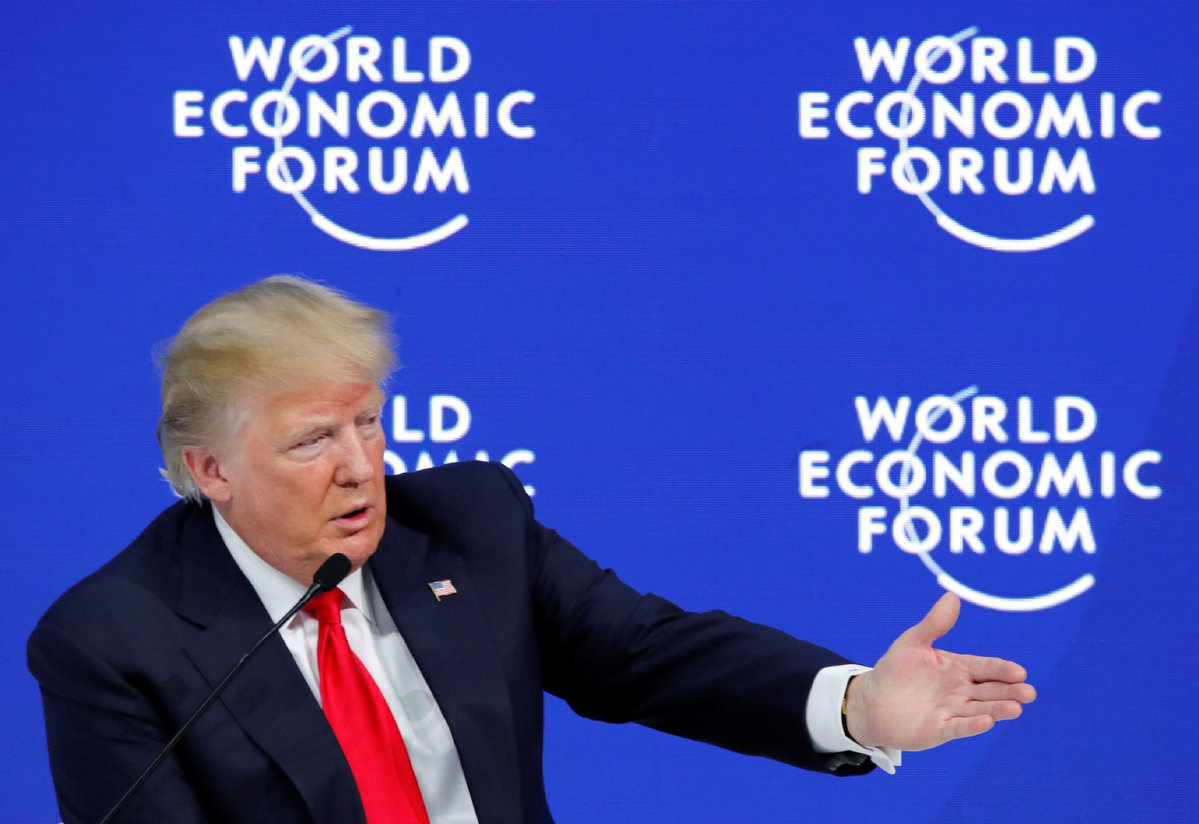
The Western world and Asia have diverging expectations for the global economy. On the Asian side, a model of cooperation for trade and investment and regional development has priority. In the Western economies, inequalities of wealth within individual countries and technology and its related unemployment and governance issues dominate the discussion. In his Davos speech, Trump conveyed a strong domestic message and his vision of the global economy, in which each country looked after its own interests and developed its competitive capacities and capabilities to attract investments, to provide jobs and prosperity domestically. From Davos emerged a picture of China and the United States, two leading countries, with seemingly diverging views of the global economy. China set to rebuild the global economy on multiple cooperation networks and the US President Donald Trump’s “America First” platform bends on attracting global investments to America. The implications for a shared future of these two views are very different for developed and developing economies.
The author is a Policy Analyst at the Economic Policy Research Foundation of Turkey (TEPAV) in Turkey.
The opinions expressed here are those of the writer and do not represent the views of China Daily and China Daily website.