China releases its policy on Arctic region







The State Council Information Office of the People's Republic of China
Contents
Foreword
I. The Arctic situation and recent changes
II. China and the Arctic
III. China's policy goals and basic principles on the Arctic
IV. China's policies and positions on participating in Arctic affairs
1. Deepening the exploration and understanding of the Arctic
2. Protecting the Arctic's eco-environment and addressing climate change
3. Utilizing Arctic resources in a lawful and rational manner
4. Participating actively in Arctic governance and international cooperation
5. Promoting peace and stability in the Arctic
Conclusion
Foreword
Global warming in recent years has accelerated the melting of ice and snow in the Arctic region. As economic globalization and regional integration further develop and deepen, the Arctic is gaining global significance for its rising strategic, economic values and those relating to scientific research, environmental protection, sea passages and natural resources. The Arctic situation now goes beyond its original inter-Arctic States or regional nature, having a vital bearing on the interests of States outside the region and the interests of the international community as a whole, as well as on the survival, the development and the shared future for mankind. It is an issue with global implications and international impacts.
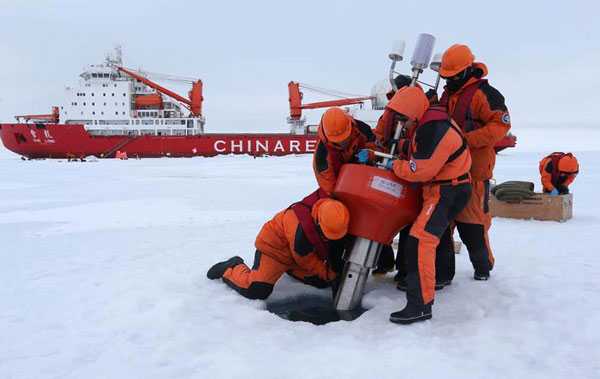
A champion for the development of a community with a shared future for mankind, China is an active participant, builder and contributor in Arctic affairs who has spared no efforts to contribute its wisdom to the development of the Arctic region. The Chinese government hereby issues this white paper, to expound its basic positions on Arctic affairs, to elaborate on its policy goals, basic principles and major policies and positions regarding its engagement in Arctic affairs, to guide relevant Chinese government departments and institutions in Arctic-related activities and cooperation, to encourage relevant parties to get better involved in Arctic governance, and to work with the international community to safeguard and promote peace and stability in, and the sustainable development of, the Arctic.
I. The Arctic situation and recent changes
The Arctic is situated at a special geographical location. It commonly refers to the area of land and sea north of the Arctic Circle (approximately 66 degrees 34 minutes N), totaling about 21 million square kilometers. In the context of international law, the Arctic includes the northernmost landmasses of Europe, Asia and North America adjacent to the Arctic Ocean and the relevant islands, and a combination of sea areas within national jurisdiction, high seas, and the Area in the Arctic Ocean. There is no single comprehensive treaty for all Arctic affairs. The Charter of the United Nations, the United Nations Convention on the Law of the Sea (UNCLOS), the Spitsbergen Treaty and other treaties and general international law govern Arctic affairs at present.
The continental and insular land territories in the Arctic cover an area of about 8 million square kilometers, with sovereignty over them belonging to Canada, Denmark, Finland, Iceland, Norway, Russia, Sweden and the United States. The Arctic Ocean covers an area of more than 12 million square kilometers, in which coastal States and other States share maritime rights and interests in accordance with international law. These coastal States have within their jurisdiction internal waters, territorial seas, contiguous zones, exclusive economic zones and continental shelves in the Arctic Ocean. Certain areas of the Arctic Ocean form part of the high seas and the Area.
States from outside the Arctic region do not have territorial sovereignty in the Arctic, but they do have rights in respect of scientific research, navigation, overflight, fishing, laying of submarine cables and pipelines in the high seas and other relevant sea areas in the Arctic Ocean, and rights to resource exploration and exploitation in the Area, pursuant to treaties such as UNCLOS and general international law. In addition, Contracting Parties to the Spitsbergen Treaty enjoy the liberty of access and entry to certain areas of the Arctic, the right under conditions of equality and, in accordance with law, to the exercise and practice of scientific research, production and commercial activities such as hunting, fishing and mining in these areas.
The Arctic boasts a unique natural environment and rich resources, with most of its sea area covered under thick ice for most of the year. The Arctic natural environment is now undergoing rapid changes. Over the past three decades, temperature has been rising continuously in the Arctic, resulting in diminishing sea ice in summer. Scientists predict that by the middle of this century or even earlier, there may be no ice in the Arctic Ocean for part of the year. On the one hand, melting ice in the Arctic has led to changes in the natural environment, or possibly can result in accelerated global warming, rising sea levels, increased extreme weather events, damaged biodiversity and other global problems. On the other hand, with the ice melted, conditions for the development of the Arctic may be gradually changed, offering opportunities for the commercial use of sea routes and development of resources in the region. Commercial activities in the region will have considerable impact on global shipping, international trade and energy supply, bring about major social and economic changes, and exert important influence on the way of work and life of Arctic residents including the indigenous peoples. They may also pose a potential threat to the ecological environment of the Arctic. The international community faces the same threat and shares the same future in addressing global issues concerning the Arctic.