



Monkeys cloned for drug research







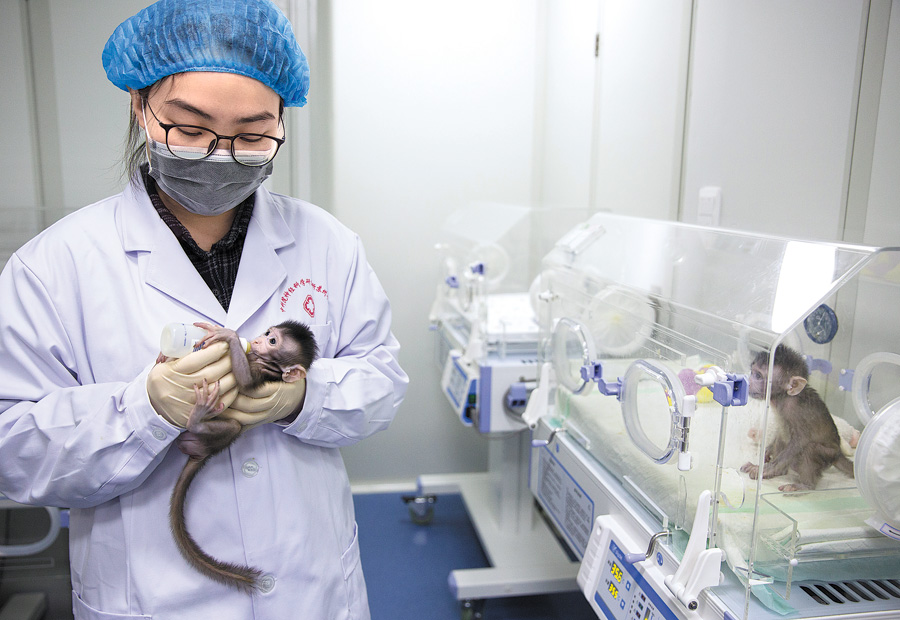
China has cloned two monkeys using the same method that created Dolly the sheep in Scotland, paving the way for more accurate and affordable animal testing for new drugs, scientists said on Thursday.
Zhong Zhong and Hua Hua, the primates, were created using the nuclear transfer of somatic cells, an organism's nonreproductive cells, at the Chinese Academy of Sciences' Institute of Neuroscience.
The duo, both born late last year, are being bottle-fed and are growing normally. Researchers said a third clone, Meng Meng, is expected late this month or early next month if everything goes smoothly.
Somatic cell nuclear transfer is the technique used by scientists in 1996 to create Dolly in Scotland. After the sheep was born, researchers cloned 23 mammal species, including cattle, cats, deer, dogs, horses, mules, oxen, rabbits and rats, according to an article published in Cell, an international science journal.
"Cloning monkeys using somatic cells has been a world-class challenge because it is a primate that shares its genetic makeup — therefore all of its complexity — with humans," said Pu Muming, director of the neuroscience institute in Shanghai.
"For drug and other laboratory tests, scientists have to purchase monkeys from all over the world, which is costly, bad for the environment and produces inaccurate results because each monkey might have different genes.
"By cloning monkeys using somatic cells, we can mass cultivate a large number of genetically identical offspring in a short amount of time, and we can even change their genes to suit our needs," he said. "This can save time, cut down experiment costs and produce more accurate results, leading to more effective medicine."
Sun Qiang, the director of the nonhuman primate research facility at the institute, said most of the drug trials are currently done on lab mice. However, drugs that work on mice might not work or may even have severe negative side effects on humans because the two species are so different.
"Monkeys and humans are both primates, so they are much more closely related and testing on monkeys is supposed to be as effective as testing on humans," Sun said. This is especially useful in testing drugs for neural diseases such as Parkinson's disease, metabolic and immune system disease and tumors, he added.
"This achievement will help China lead world research on international science projects related to neural mapping of primate brains," Sun said. However, bio labs from the United States, Japan, and European countries also are capable, and they will quickly catch up to China after the monkey cloning technology has been made public, he said.
So far, the success rate of developing a healthy cloned embryo is extremely low. "This means we have to innovate continuously and work extra hard this year to stay ahead," Sun said.
However, ethics critics feared that the technology used to clone monkeys has opened the door to copying humans.
While the technical barrier of cloning humans has indeed been broken, "the reason we break this barrier is to produce animal models that are helpful for medical research and human health," said Pu, of the institute. "There is no intention to apply this method to humans."


- Death toll rises to 8 in North China factory explosion
- Over 140m train tickets sold for Spring Festival travel rush
- Vice-president of Agricultural Development Bank of China under investigation
- PLA conducts routine patrols in South China Sea
- PLA conducts routine patrols in South China Sea: spokesman
- Annual session of Shanghai Municipal People's Congress concludes












