E-businesses tap into fresh food sector







New supermarket operating model could reshape China's shopping scene
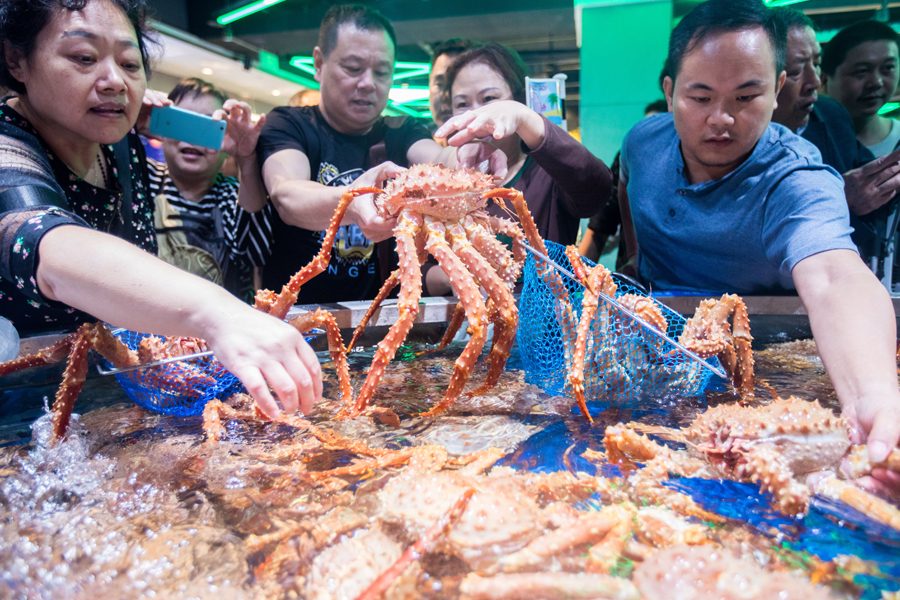
Zhang Hui, a clerk working at a technology company in Yizhuang, a southern suburb of Beijing, likes to go straight from work to a newly opened fresh food supermarket-7Fresh-where she chooses her favorite seafood dish, say, lobster or crab.
She doesn't take the food home, but asks restaurant staff to cook the seafood on-site for her and eats at a dining area of the supermarket near her company.
"The supermarket impressed me a lot as I have never had such an experience before. If I am not willing to go out to dine, I can order online through an app and have it delivered within half an hour. Apart from seafood, I can choose meat, fruit, vegetables, dairy, bakery, wine and even flowers," Zhang said.
The brick-and-mortar store is the first offline fresh food supermarket owned by Chinese e-commerce giant JD. Covering an area of 4,000 square meters, it started official operations on Jan 4.
The rapidly growing number of China's high-income consumers has become a key driver of premium brands and other high-quality food products, especially imported meat and freshly caught seafood.
Major e-commerce companies have tapped into the fresh food sector, opening such supermarkets as well as investing in the supply chain and logistics infrastructure.
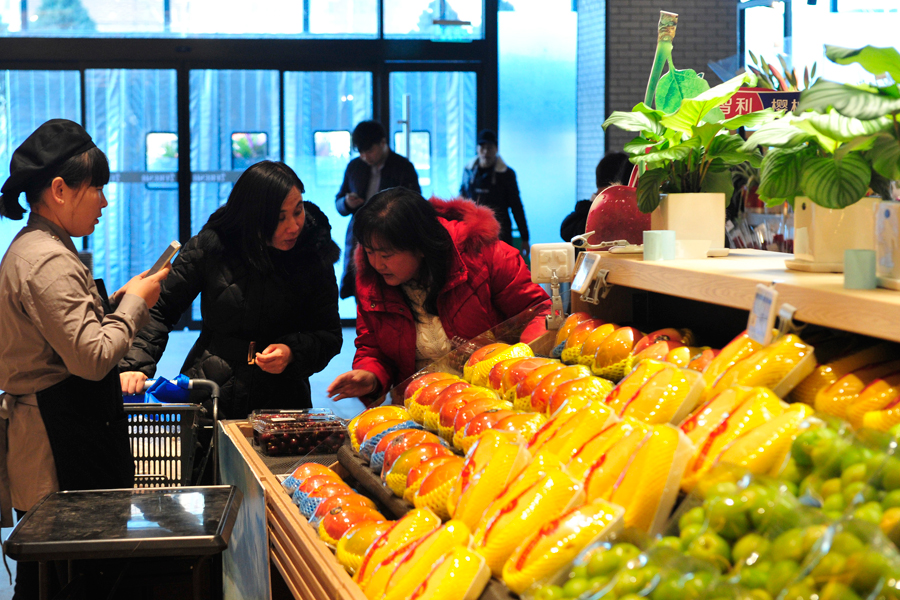
These stores integrate the online and offline worlds with logistics and data, enabling customers to shop, order groceries for home delivery and eat in-store-a one-stop food center experience. Various options are offered, including frozen seafood, meat, fruit and flowers.
Although experts said the fresh food supermarket is still in an initial stage and needs time to see whether the brick-and-mortar store can make a profit, the new model is already changing China's traditional retail sector.
"Fresh food is the most demanding category in e-commerce, and covers a range of fields including logistics, finance and users operation. But at the same time, it has huge market potential," said Lyu Haoze, an analyst of China E-Commerce Research Center.
Lyu added the online fresh food sector has entered a phase of reshuffling, and surviving enterprises are likely to see explosive growth.
Wang Xiaosong, the JD senior vice-president who runs 7Fresh, said the company will open more than 1,000 such stores across the country in the next three to five years.
Seventy-five percent of the products sold at the store are fresh products. As Chinese consumers are increasingly concerned about food safety and the product supply chains, JD said it has taken a series of measures to ensure the product quality.
"We have a special procurement team to source products from all over the world directly and ensure the quality of the products," Wang said.
They also have a product quality control team to verify the qualification of suppliers, and do a spot check on all products before they are put on the shelves, he added.
"For the traditional supermarkets, inventory turnover rate is more than 30 days. For us, it is shortened to fewer than four days-guaranteeing freshness of all products sold in the store," Wang said.
In January 2016, JD launched JD Fresh as an independent fresh food business unit. The fresh food supermarket leverages JD's nationwide cold-chain logistics network, ensuring that all of its fresh products are transported in frozen or refrigerator trucks. The whole process will be monitored.
According to market research company iResearch Consulting Group, China's fresh food retail market is developing rapidly, with a growth rate of more than 50 percent each year on average. The transaction volume of China's online fresh food market reached about 139.13 billion yuan ($21.6 billion) in 2017, an increase of 59.7 percent.
Hema Xiansheng, a fresh food chain invested by Alibaba Group Holding Ltd, is also likely to reshape the landscape of China's retail industry.
As a pioneering example of Alibaba's "new retail" strategy, which integrates online with offline shopping and provides a refreshing shopping experience, Hema will offer 24/7 services after the coming Spring Festival starting on Feb 16.
"Consumers could not only buy fresh food from us, but also adult products, maternal, baby and female necessities, and other daily household products," said Hou Yi, CEO of Hema, at the second new retail summit in Shanghai held Jan 10-11.
On Jan 3, Hou said Hema will open 30 fresh food supermarkets throughout Beijing this year. The company claims that customers within a three-kilometer radius of a store can have their shopping items delivered within 30 minutes.
The online giant has opened five stores in Beijing and will concentrate more on the Beijing market apart from expanding its business across China, according to Hou. It opened its first offline store in Shanghai two years ago.
"Only when the online giants continue to expand and operate a certain number of fresh food supermarkets can we discuss the profitability issue," said Lu Zhenwang, CEO of Wanqing Consultancy in Shanghai, adding the cost of warehousing, cold chain transportation and supply chain construction is very high.
Chinese consumers are pursuing a high-quality lifestyle along with the consumption upgrades. However, the shelf life of fresh food is short, so the cold chain logistics plays an important role in this sector, Lu said, adding that quality control of the fresh food is also significant.
Lyu added that the appearance and expansion of fresh food supermarkets will inevitably grab the market share of traditional stores, gaining favor from a new generation of young consumers.
"This will force the traditional supermarkets such as Walmart and Carrefour to transform, expanding their services online."